
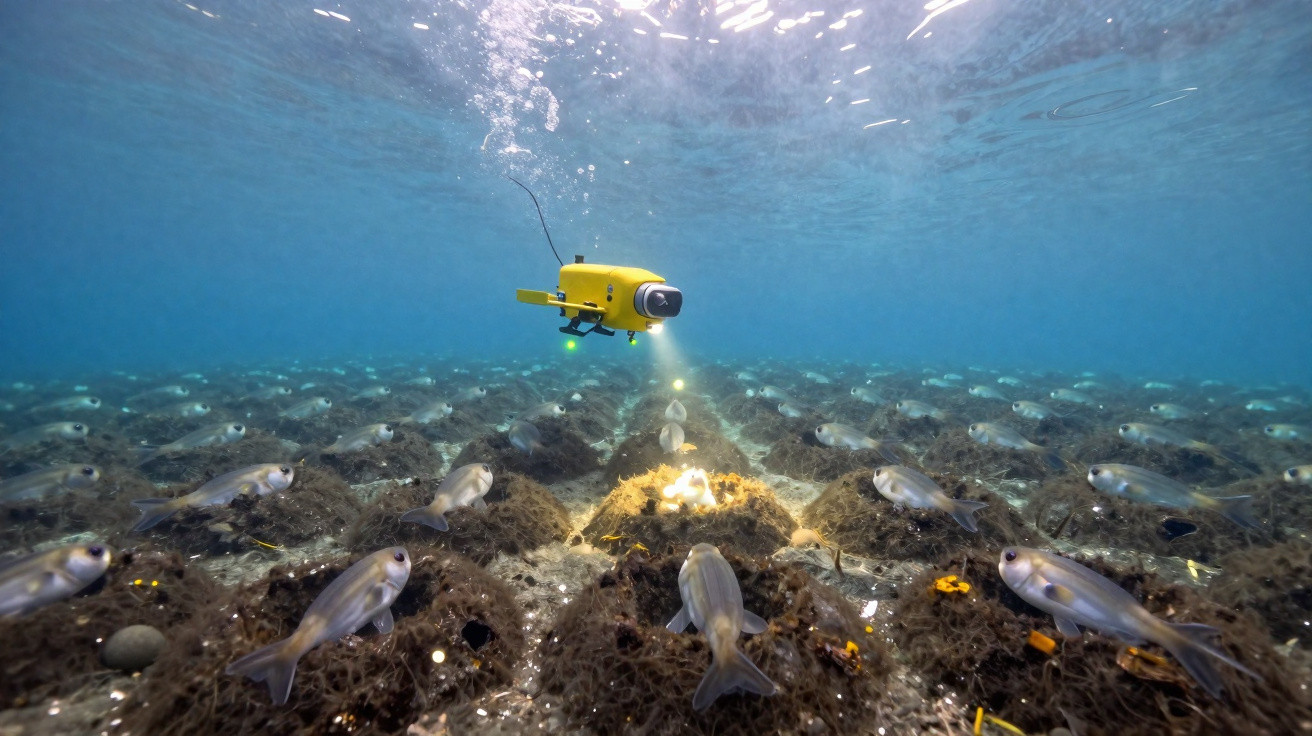
The ship’s engine gave off the low hum of a faraway refrigerator while the camera passed beneath the sea ice into territory no human had seen before. At first, scientists watching the monitor assumed the dark marks scattered across the seabed were random. The marks became rings, the rings became craters, and every crater contained one pale fish protecting a small pocket of life in the frozen emptiness.
An unusual silence fell across the room. Someone murmured, “This is a city.”
They were right - but this city, located just off Antarctica’s Filchner Ice Shelf, contained millions rather than thousands of nests. Each had been precisely hollowed out of the mud by icefish. It seemed like something from science fiction, not a sonar survey.
Almost as soon as it was discovered, the argument began: should anyone ever return?
Under the ice, a sprawling nursery no one expected
Like many major scientific discoveries, this one began with a flickering camera feed and a group of weary people hoping to see something - anything - happen. A German research team on board the RV Polarstern had sent a towed camera through a hole in Antarctic sea ice for what was meant to be a slow, largely routine seabed survey.
Then the first nest appeared: a circular hollow in the mud, stones arranged around it, and one fish suspended protectively over a cluster of eggs. As the camera continued, further nests appeared. Then more. Before long, the screen resembled a lunar landscape, covered in living craters.
When the team analysed the data, the figures sounded implausible. Around 60 million active nests extended across an area larger than a major city. Each was cared for by one fish - the so-called Jonah’s icefish - which carefully oxygenated its eggs in water only just above freezing.
The scientists had encountered Earth’s largest known fish breeding colony, concealed beneath an ice roof that seldom breaks in a sea crossed by very few vessels. It was like raising the carpet in a quiet home and discovering a humming stadium below it.
This was more than an oddity. Deep on the Southern Ocean floor, it was a biological engine operating quietly.
Its importance reaches well beyond a single fish species. The nests help sustain Antarctic seals, influence local food webs and move nutrients through waters that affect the global climate. This nursery is woven into an immense system that helps make parts of the planet liveable.
The finding therefore ignited a dispute. Researchers on one side called for strong, immediate safeguards for this pristine ecosystem before fishing fleets or mining interests could arrive. On the other, some policymakers and industry representatives resisted, concerned that resources might be closed off in science’s name.
Behind the technical terminology was a stark question: when we eventually discover somewhere humans have not yet damaged, should we interfere with it at all?
Touching the untouched: where curiosity starts to sting
A scientist’s immediate response to a discovery like this is straightforward: return. Bring improved cameras, collect samples and map the whole place. That is how knowledge advances.
Yet in a breeding ground like this, each “sample” is also a living thing, and every instrument disturbs waters that may have remained peaceful for thousands of years. The icefish nests are not museum displays; they are sites of continuous work, with millions of parents fanning eggs to ensure the next generation lives.
One additional expedition could turn a calm nursery into a crowded laboratory passageway.
We have seen versions of this story elsewhere on Earth. Consider deep-sea hydrothermal vents: once viewed as inaccessible, they are now visited by mining prospectors searching for valuable metals. Or consider the Mariana Trench, the legendary abyss where plastic debris has nevertheless been found.
In Antarctica, the Ross Sea Marine Protected Area was praised as “the last ocean”, an enormous sanctuary that was almost untouched. Even there, however, complicated exemptions apply to research and some fishing. The pattern repeats: a wild location is found, described as pristine, and then quickly absorbed into arguments about access, data and resource extraction.
Let’s be honest: once we know precisely where somewhere is, nobody truly leaves it completely alone.
Those calling for strict protection say that is exactly why this icefish colony should be treated differently. In their view, the nursery’s sheer scale - tens of millions of nests - offers an unusual opportunity to establish a firm boundary: no fishing, no mining, and only closely regulated, minimal, non-intrusive science.
Others caution that closing access too decisively creates resentment among countries that regard Antarctica’s Southern Ocean as a potential future source of protein. Some policymakers maintain that conservation can coexist with responsible research and fishing. Their simple question is this: how can we manage something we do not properly understand?
Between those positions lies a delicate and uneasy middle ground, where the urge to understand collides directly with the fear of causing damage.
How to explore without breaking what we love
One practical lesson from this Antarctic story is that the sequence matters: protect first, then investigate in greater depth. That would mean deploying existing tools - including temporary protection areas and emergency measures - before industry arrives.
Scientists can also plan research programmes that observe more while touching less. They can use long-range cameras, acoustic monitoring and autonomous robots that move silently above nests rather than scraping along the seabed. It is rather like replacing heavy boots with soft socks in a nursery.
The aim is not to eliminate all contact. It is to ensure that contact leaves virtually nothing behind - not even a trace of sound.
Many people imagine research as clean and sterile, but ships leak fuel, equipment catches and anchors drag. Few people want to acknowledge that in grant applications. Still, every cable sent down through Antarctic ice represents a small intrusion.
The emotional temptation is clear: we assure ourselves that science is invariably the noble exception. We say that curiosity warrants a little extra disruption and risk because the information might help save the planet. Frequently that is correct; at other times, it is simply a reassuring story we tell ourselves.
We have all felt it: the moment when wonder at a wild place gradually becomes a feeling that we are entitled to enter it.
Some Antarctic researchers are now stating this openly:
“Curiosity isn’t a free pass,” one marine biologist told me. “If we love these ecosystems because they’re untouched, at some point we have to accept being kept out.”
For places such as the icefish nursery, they propose a straightforward framework:
- Set provisional no-go limits around the most vulnerable breeding areas.
- Permit only low-impact observation for a fixed number of years, under strict international supervision.
- Release all data publicly, preventing any country from stockpiling information as leverage.
- Include automatic review stages, so protections can be eased only with compelling public evidence.
- Give local wildlife - seals, fish and plankton communities - legal influence in management decisions, rather than prioritising economic interests alone.
It is not flawless, and shipping lobbies oppose parts of it. Nevertheless, it outlines a future in which the Southern Ocean is not regarded as an empty frontier, but as a neighbour whose boundaries we are bound to respect.
What this Antarctic nursery says about us
For most of the year, the icefish nests lie in darkness beneath ice that never hears a human voice. They are unconcerned with our conference-room disagreements, treaties and hashtags. What matters to them is oxygen, food and temperature: the quiet, ancient arithmetic of survival.
From space, this area of sea looks like another frozen square in the white band around Earth. Learning that it shelters an extensive, delicate city of fish families changes how we see the map. A blank area becomes a story - and stories tend to draw people in.
Perhaps, then, the central question is not “Should we ever touch untouched ecosystems?” but “Can we tolerate the discomfort of not touching them?” Can we honour a place by choosing not to visit, drill or trawl there?
That challenges the way we have treated frontiers for centuries. Yet Antarctica has always been a rehearsal space for a different kind of relationship with the planet - one that is shared, limited and collectively overseen instead of directly owned. The icefish nursery is simply the latest test of whether that principle survives or gradually wears away under pressure.
Some readers will favour absolute protection, while others will support cautious use. Both impulses arise from an understandable desire: to survive on a changing Earth. The nests beneath the ice show that our own survival is entwined with lives we seldom witness in places we rarely enter.
Every time we find one of these hidden worlds, we get another shot at choosing differently than we did with forests, reefs, and rivers. Whether we take that opportunity depends less on new technology than on an old and persistent question: how much is enough, and where do we stop?
Perhaps the bravest response to certain discoveries is to leave them largely alone - and to learn to feel proud rather than deprived when the door remains nearly shut.
| Key point | Detail | Value for the reader |
|---|---|---|
| Vast under-ice nursery | ~60 million Antarctic icefish nests found beneath the Filchner Ice Shelf | Understand the real-world scale of a “pristine ecosystem” |
| Science vs. disturbance | Research delivers knowledge, but also noise, pollution and physical impact | Helps you recognise that even “good” human activity leaves a mark in wild places |
| Protect-first mindset | Emergency protected zones and low-impact monitoring before any industry | Provides a model for how other fragile ecosystems could be treated too |
FAQ:
- Question 1 What exactly did scientists find beneath the Antarctic ice?
- Answer 1 They found the largest known fish breeding colony on Earth: tens of millions of icefish nests spread across hundreds of square kilometres beneath the Weddell Sea, each containing a guarding adult and clusters of eggs.
- Question 2 Why does this colony matter beyond Antarctica?
- Answer 2 The icefish and their eggs provide food for higher predators such as seals and help shape nutrient cycles in the Southern Ocean, which in turn affects global climate and carbon storage.
- Question 3 Is anyone already fishing in this area?
- Answer 3 The region is not yet a busy fishing ground, but interest is growing in Antarctic waters for species such as toothfish and krill. That is why conservationists want robust protections in place before fleets expand.
- Question 4 Can science be done there without damaging the nests?
- Answer 4 Low-impact approaches - remote cameras, acoustic sensors and autonomous vehicles that do not touch the seabed - can limit disruption, particularly when ship movements and sampling are tightly controlled.
- Question 5 Who decides what happens to this ecosystem?
- Answer 5 Decisions are made through the Commission for the Conservation of Antarctic Marine Living Resources (CCAMLR), a group of countries that must reach consensus on new protected areas and rules governing fishing and research.



Comments
No comments yet. Be the first to comment!
Leave a Comment