
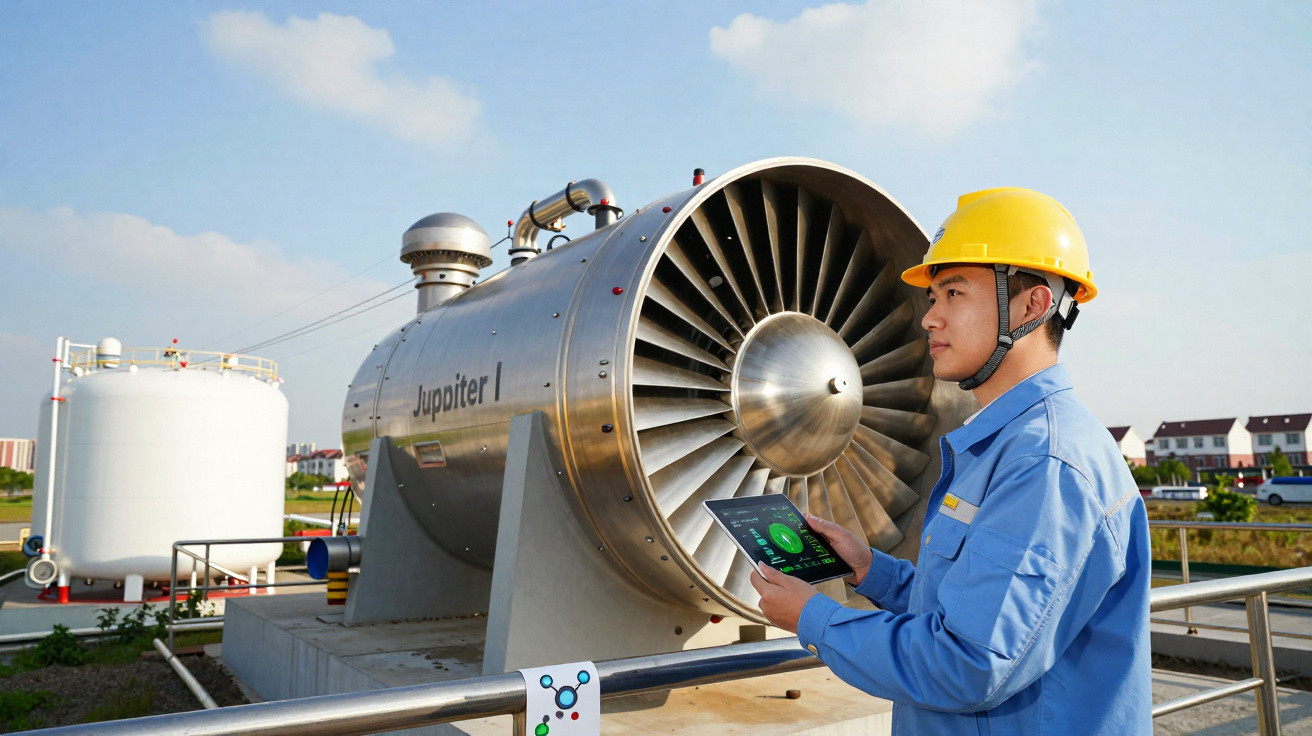
China’s newest energy machine resembles an ordinary gas turbine, but it could quietly transform the way clean electricity supports the grid.
Beneath the technical terms and striking figures lies a straightforward challenge: how can electricity supplies remain reliable when wind and solar generation fall, without returning to coal and gas?
A hydrogen giant joins the grid
In Inner Mongolia, an area already home to extensive wind farms and solar parks, Chinese manufacturer MingYang Group has brought a new machine online: Jupiter I, a gas turbine powered entirely by hydrogen. With a rating of 30 megawatts, it is currently the world’s largest turbine fuelled by 100% hydrogen.
The turbine is capable of consuming as much as 30,000 cubic metres of hydrogen each hour. Engineers illustrate that volume as roughly the equivalent of twelve Olympic-size swimming pools of gas passing through the machine every hour at full output.
Jupiter I delivers up to 48,000 kilowatt-hours of electricity each hour, enough to cover the typical demand of roughly 5,500 households.
Where conventional gas turbines use fossil methane, Jupiter I uses only hydrogen produced upstream. This gives grid operators a rapid, controllable power source that can be increased or reduced almost in real time.
Why a hydrogen turbine matters for renewable energy
Wind and solar installations have expanded quickly, particularly across China, but their generation depends on weather conditions. On a windy night or a sunny weekend, electricity output may overwhelm the system when too few consumers are available to use it at that moment.
Grid operators in many places already rely on a crude response: curtailment. They instruct wind and solar sites to reduce generation or stop altogether because the network cannot safely take more electricity. As a result, clean power is lost before it can provide any benefit.
Large-scale batteries could assist, although they have distinct constraints. They need substantial volumes of minerals, add considerable cost to projects and are most effective for relatively short storage periods. Using batteries alone to cover several days of fluctuating generation would require enormous systems that few nations have built so far.
Hydrogen turbines target a gap batteries struggle with: large bursts of controllable power on demand, especially when the grid needs a rapid boost.
Hydrogen can provide a buffer between periods of surplus and shortage. When renewable generators produce more electricity than the grid can absorb, electrolysers convert that excess into hydrogen. A turbine such as Jupiter I can then burn the stored gas and return electricity to the network within minutes, or even seconds.
The basic approach: converting surplus electricity into hydrogen
An established concept reaching industrial scale
The principle itself has long been understood. Electrolysis uses electricity to split water into hydrogen and oxygen. At times of peak renewable generation, operators can send spare electricity to electrolysers rather than waste it. The hydrogen produced can then be kept in tanks, underground caverns or pipelines and transported to its point of use.
Much of the hydrogen discussion to date has centred on fuel cells. These systems turn hydrogen back into electricity through a chemical reaction, operating efficiently and quietly. They are particularly suited to stable, long-duration uses including backup power systems and remote microgrids.
Fuel cells, however, generally increase output more gradually and deliver lower power ratings per unit. A national electricity system dealing with a sharp demand rise, or the sudden failure of a major power station, requires equipment able to supply tens or hundreds of megawatts very quickly. Gas turbines remain difficult to surpass in that role.
Hydrogen versus natural gas in a turbine
Standard gas turbines burn natural gas, which is chiefly methane. Replacing it with pure hydrogen involves much more than fitting a different nozzle, because the fuels behave very differently during combustion.
- Hydrogen ignites more readily and burns more quickly than methane.
- Flame temperatures can become substantially higher, placing strain on metals and coatings.
- Hydrogen molecules are extremely small and may escape through seals intended for natural gas.
- Rapid flames can become unstable, potentially causing dangerous flashback into the burner.
Because of these characteristics, designers must reconsider the turbine’s entire “hot section”. MingYang’s engineers redesigned the combustion chambers, internal airflows, fuel-injection equipment and the digital control system that tracks pressure and temperature in real time.
The outcome is a 30 MW turbine that runs continuously on hydrogen, maintains a stable flame, and fits into an industrial environment already connected to renewables.
Engineering obstacles behind the record
Controlling a volatile flame
Hydrogen flames can oscillate, creating vibrations and major temperature fluctuations that reduce the lifespan of turbine parts. Designers address this by shaping the combustion chamber to steady the flame front and by deploying advanced sensors to monitor flame movement.
Part of the process is similar to tuning a musical instrument. When pressure waves in the chamber match natural resonant frequencies, they reinforce each other and produce damaging pulsations. The turbine’s design and fuel-delivery pattern are intended to interrupt those resonances before they intensify.
Jupiter I must also limit nitrogen oxide, or NOx, emissions. Hydrogen creates no carbon dioxide at the point of use, yet very high combustion temperatures can still form NOx from nitrogen and oxygen in the air. Low-NOx burners, staged combustion and closely controlled temperatures are used to restrain those emissions.
Higher standards for materials and seals
Hydrogen may enter metals and change their structure over time, an effect commonly known as hydrogen embrittlement. This risk requires turbine makers to improve alloys, coatings and sealing materials, particularly in high-pressure areas.
The Inner Mongolia machine therefore also functions as a test platform. Every year in service will provide further evidence on how parts age when exposed to pure hydrogen, how frequently they require replacement and which design changes can enhance reliability and reduce costs.
Climate effects and system advantages
Project estimates indicate that Jupiter I prevents more than 200,000 tonnes of carbon dioxide emissions annually compared with a coal- or gas-fired plant producing a similar amount of electricity. This estimate depends on hydrogen being supplied from low-carbon sources, including electrolysis powered by wind and solar energy.
| Technology | Main fuel | Direct CO₂ emissions | Typical role on grid |
|---|---|---|---|
| Coal plant | Coal | Very high | Baseload, some flexibility |
| Gas turbine | Natural gas | High | Peaking, balancing |
| Hydrogen turbine | Hydrogen | Near zero* | Peaking, balancing, backup |
*Excluding emissions from hydrogen production upstream.
The project’s importance extends beyond its headline emissions figure. By supplying flexible backup capacity, the turbine enables more wind and solar facilities to operate without curtailment, effectively increasing the proportion of clean electricity that the grid can use.
Hydrogen turbines do not just generate low-carbon power; they help unlock renewable generation that would otherwise be wasted during off-peak hours.
For China, where power demand is climbing sharply alongside climate commitments, this pairing of flexibility and decarbonisation carries strategic importance. It also helps develop a wider hydrogen economy, including pipelines and storage facilities that could ultimately support industry, transport and heating.
A new model for “firm” electricity
For many decades, firm or “dispatchable” electricity - power that can be switched on when required - has mostly been provided by fossil fuels or nuclear reactors. Jupiter I suggests an alternative arrangement: flexible, gas-based equipment connected to green molecules instead of hydrocarbons.
Hydrogen is still far from an ideal energy carrier. Electrolysis requires large amounts of electricity, while compressing, liquefying and transporting hydrogen create additional losses and costs. Establishing a complete hydrogen supply chain also demands investment, regulation and public acceptance of safety considerations.
Projects of this kind nevertheless indicate that the individual elements are beginning to connect. Electrolysers turn excess renewable electricity into gas, storage infrastructure retains it until required, and turbines convert it back into power on demand. Software coordinates the entire cycle by tracking weather forecasts, market prices and grid demand.
What Jupiter I could mean beyond China
Europe, the US, Japan and the Middle East are all trialling hydrogen-capable turbines. Many existing machines still use blends of natural gas and hydrogen, often containing up to 30–50% hydrogen by volume, before progressing gradually towards greater proportions.
China’s choice to move straight to a dedicated 100% hydrogen turbine at industrial scale increases pressure on international rivals. It demonstrates confidence not only in turbine engineering, but also in the capacity to produce and store enough hydrogen for dependable operation.
For energy planners elsewhere, the Inner Mongolia development provides a practical reference point. It indicates the approximate scale of infrastructure involved, the amount of grid capacity delivered by one 30 MW turbine and the possible emissions reductions if the model is repeated at several locations.
Key questions for the coming decade
Hydrogen turbines still face several unresolved issues. One is cost: at which hydrogen price can they equal or outperform traditional gas peakers when fuel costs, carbon pricing and grid limitations are considered? Another concerns where the fuel comes from: how rapidly can renewable “green” hydrogen replace high-emission hydrogen produced from fossil gas?
Grid dependability is also part of the calculation. As electricity systems rely more heavily on variable renewable generation paired with hydrogen, operators will closely assess how frequently turbines such as Jupiter I need servicing, how quickly they can start from cold conditions and how they perform in extreme weather.
A short example can help put the scale into perspective. Consider a regional grid experiencing a 150 MW evening demand surge just as solar output drops away. Five turbines comparable to Jupiter I, fuelled by hydrogen generated earlier that day, could in principle meet that increase without using a single cubic metre of fossil gas.
Risk is another consideration. Hydrogen escapes more easily than methane and ignites more readily, meaning facilities must meet rigorous design and safety requirements. However, it also disperses quickly in open air, shortening the time during which flammable clouds remain present. Regulators and engineers are continuing to develop rules and best practices for concentrated groups of hydrogen sites close to populated areas.
The technology may also benefit several sectors at once. Industrial areas containing steelworks or chemical plants could use the same hydrogen network that supplies turbines. Joint planning for electricity generation and heavy industry could lower costs and even out demand, as factories and grids frequently follow different daily load patterns.




Comments
No comments yet. Be the first to comment!
Leave a Comment