
The helicopter makes a single circuit above the fractured white expanse of the Barents Sea before descending. Beneath it, a female polar bear is standing belly-deep in a seal carcass; her coat is marked pink where blood has melted the snow. She is enormous. Her sides have the rounded strength of a powerful swimmer, rather than the hollow silhouette now commonly linked with a warming world.
The researchers exchange brief looks from the aircraft. They have spent years flying over Svalbard to follow, measure and worry about its bears. Recently, however, both the figures and the animals themselves have begun to suggest a slightly different picture.
The Arctic is warming more rapidly than almost any other place on the planet.
But in Norway’s far north, some apex predators appear better nourished than they have been for years.
Norway’s unexpectedly chubby polar bears on the sea ice
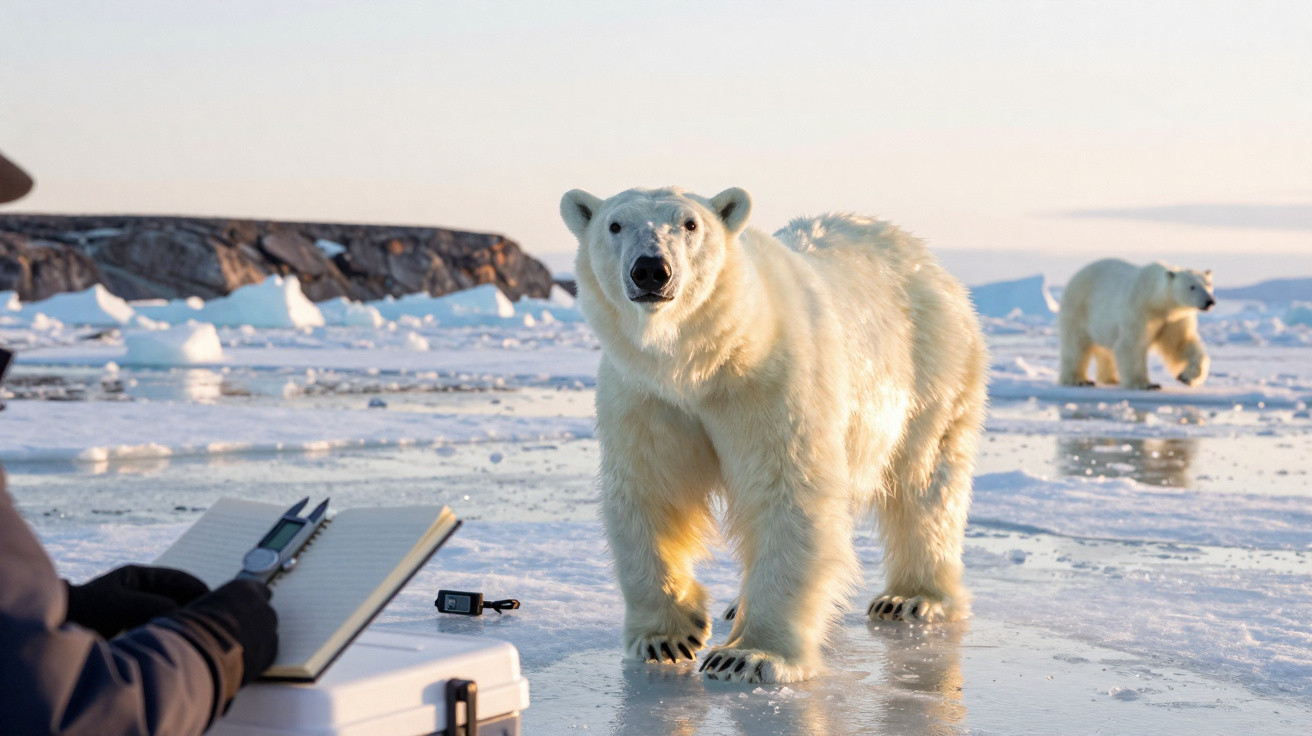
A few kilometres from the coast of Spitsbergen, ice gives a muted groan beneath boots and equipment. Jon Aars, a marine biologist with the Norwegian Polar Institute, approaches a tranquillised bear, his breath clouding in the cold air. At close range, every detail is clear: the dense fat beneath the coat, the broad paws, and the unhurried movement of a chest belonging to an animal that has plainly not gone short of food.
This is not the emaciated emblem seen throughout climate campaigns. It is a 250‑kilogram female with sound teeth, a shining coat and sufficient fat stores to endure a long winter. For the researchers measuring and weighing her, the tape measure offers no room for doubt.
For more than four decades, Norwegian researchers have collected information on thousands of polar bears across the Svalbard region. They record body length, girth, fat depth, breeding success and how many cubs remain at a mother’s side. Comparing current records with those from the 1990s repeatedly reveals the same pattern: throughout important parts of the Barents Sea population, bears are heavier and in stronger condition.
Certain females are raising more cubs, while cub survival rates are higher. It is a subdued statistical narrative, buried beneath sea-ice reports and greenhouse-gas charts, yet the trend line in the spreadsheets is moving… upwards.
Scientists describe an unexpected sequence of effects. When sea ice around Svalbard melts and withdraws earlier each year, warmer Atlantic water reaches further north. This increases ocean productivity, supporting more plankton and fish. Ringed and bearded seals in particular benefit from the boom, becoming more numerous and larger before hauling out on remaining ice or along the coast.
Local polar bears can still hunt from drifting floes and coastal ice, and suddenly encounter something resembling an Arctic buffet: more seals, heavier seals and longer hunting periods near land. This is not a happy tale of climate resilience, but a small local variation within a far larger and darker account.
Why some Arctic predators are thriving as the ice melts
To grasp events around Svalbard, it helps to see how a bear hunts. Imagine one pressed flat against the ice beside a seal’s breathing hole, almost motionless except for its working nostrils and ears. As the seal emerges, the bear lunges, seizes it with claws like meat hooks and pulls it on to the ice. A single seal may provide tens of thousands of calories.
Provided the ice edge remains accessible and seals cluster around it, every successful ambush can be a windfall. Several effective spring hunts may determine whether a bear thrives during the whole year.
In recent years, satellite photographs and drone recordings have documented seal colonies gathering in new locations near Svalbard as the ice zone moves. Fjords formerly sealed by ice now stay open for longer and are rich in plankton and fish. Seals go where the food is available, and bears follow those seals.
Researchers have observed adult females swimming shorter average distances than in the past but reaching shore with more weight. On land, cameras have captured them resting on beaches flecked with seal remains and rolling on their backs beneath the midnight sun like oversized labradors that have discovered the snack cupboard.
The contradiction is that the climate pressures benefiting certain Norwegian bears are damaging polar bears in other regions. In Canada’s Western Hudson Bay, for instance, spring ice breaks up sooner and returns later. There, bears are forced to fast on land for longer, and their physical condition has worsened.
What may seem like positive news around Svalbard is therefore also a caution. A modest change in ocean currents and ice distribution can make one area a short-term winner and another a loser. Climate change does not unfold in straight, simple lines. It produces areas of plenty alongside areas of scarcity, leaving wild animals struggling to adapt.
How Svalbard researchers assess fat, fear and a polar bear’s future
To Svalbard scientists, every bear they capture serves as a living record of change. They do not merely judge whether an animal looks “chubby” or “thin”. They weigh it, measure its neck and body, take blood samples and may use ultrasound to assess fat layers. Before it regains consciousness, they fit it with a satellite collar or ear transmitter.
Over time, the GPS signals create untidy lines across maps: circuits around ice margins, abrupt journeys to remote floes and extended coastal patrols. A well-fed bear whose collar reveals shorter, efficient hunting journeys provides a very precise account of how this altered Arctic is functioning.
When the earliest evidence of improved condition in Norway’s Arctic bears emerged, some conservationists were uncomfortable. Positive findings are welcome, but confusing findings can blur public understanding as well. Many people are already exhausted by climate-related headlines.
There is a danger that photographs of plump Svalbard bears will be turned into a reassuring myth: perhaps they are fine, perhaps nature will simply adapt. That is not what the data says. Researchers repeatedly stress that the benefit is regional and probably temporary, rather than a get-out-of-jail-free card for continued fossil-fuel burning.
“People see a fat polar bear and want to relax,” one field biologist told me, shrugging inside his thick red parka. “But what we’re seeing is a brief window where the system still works for them. If the ice keeps retreating, that window will close.”
- Short term: More open water increases marine productivity, feeding seals and, in turn, local bears.
- Medium term: Ongoing warming pushes ice still further away, making bears swim greater distances and use the fat reserves they have gained.
- Long term: Should summer sea ice vanish entirely from the Barents Sea, polar bears lose their essential hunting platform.
In truth, few people look beyond the surface of the distressing polar-bear photographs that race across social media. The gradual, technical account of fat percentages and seal populations rarely becomes viral, even though it contains the real drama.
A rare piece of good news and its unsettling questions
At midnight on the deck of a Svalbard ship, with pink light touching the mountains and cold wind against your face, two feelings can coexist. There is relief that some bears are flourishing here, alongside a persistent sense that this could be only a fortunate, brief episode within a longer decline.
Crew members whisper and gesture towards a mother and two cubs walking along the ice edge below. Round and healthy, their fur bright against the water, they resemble a small triumph on a vast and complicated battlefield.
Most people recognise the feeling of unexpected good news arriving during an otherwise difficult week. For many researchers, these fat Norwegian bears offer that kind of reminder: nature retains its resilience, its surprises and its ability to find unexpected ways through.
Yet the wider situation remains unchanged. Worldwide ice loss is accelerating. Other polar bear populations are moving in the opposite direction. The species is still classified as vulnerable globally, while the Arctic is warming at roughly four times the global average.
How should this contradiction be understood? Perhaps it should encourage us to abandon the lazy, single-image account of climate change - the solitary starving bear on a tiny floe - in favour of something more complicated and truthful. It is a world in which some animals gain weight for a decade while others disappear. It is a world where local wins do not cancel global risks.
Svalbard’s story is not a justification for slowing down. It is a reason to examine events more carefully, pose sharper questions and acknowledge that the Arctic’s future will not fit tidily into one photograph.
| Key point | Detail | Value for the reader |
|---|---|---|
| Regional gains | Some polar bears in Norway’s Arctic are heavier and healthier because coastal waters are more productive and seals are abundant. | Demonstrates that climate effects can be uneven rather than uniformly negative in the short term. |
| Hidden risks | Continued long-term sea-ice loss may remove core hunting platforms and eliminate today’s benefits. | Prevents readers from taking isolated “good news” stories as reassurance. |
| Complex signals | Better body condition in this region contrasts with declines in other bear populations, including Western Hudson Bay. | Promotes a more nuanced understanding of climate change and wildlife resilience. |
FAQ:
- Are all polar bears getting healthier in a warming Arctic? No. Improved body condition chiefly applies to parts of the Barents Sea population near Svalbard; several other populations around the world are stable or declining.
- Why are some Norwegian polar bears getting fatter? Retreating sea ice and warmer Atlantic water have increased marine productivity, supporting more seals and, for now, providing richer hunting areas for local bears.
- Does this mean polar bears are adapting fine to climate change? Not really. The improvement seems regional and likely temporary; long-term projections still indicate substantial risks as sea ice continues to diminish.
- Are there more polar bears in Norway now? Some measures, including cub survival, have improved, but precise population patterns are complex and differ across the Barents Sea region.
- What can ordinary people actually do about this? Cutting personal and political support for fossil-fuel use, supporting strong climate policies and backing Arctic conservation organisations all contribute to the wider system shaping these bears’ future.




Comments
No comments yet. Be the first to comment!
Leave a Comment