
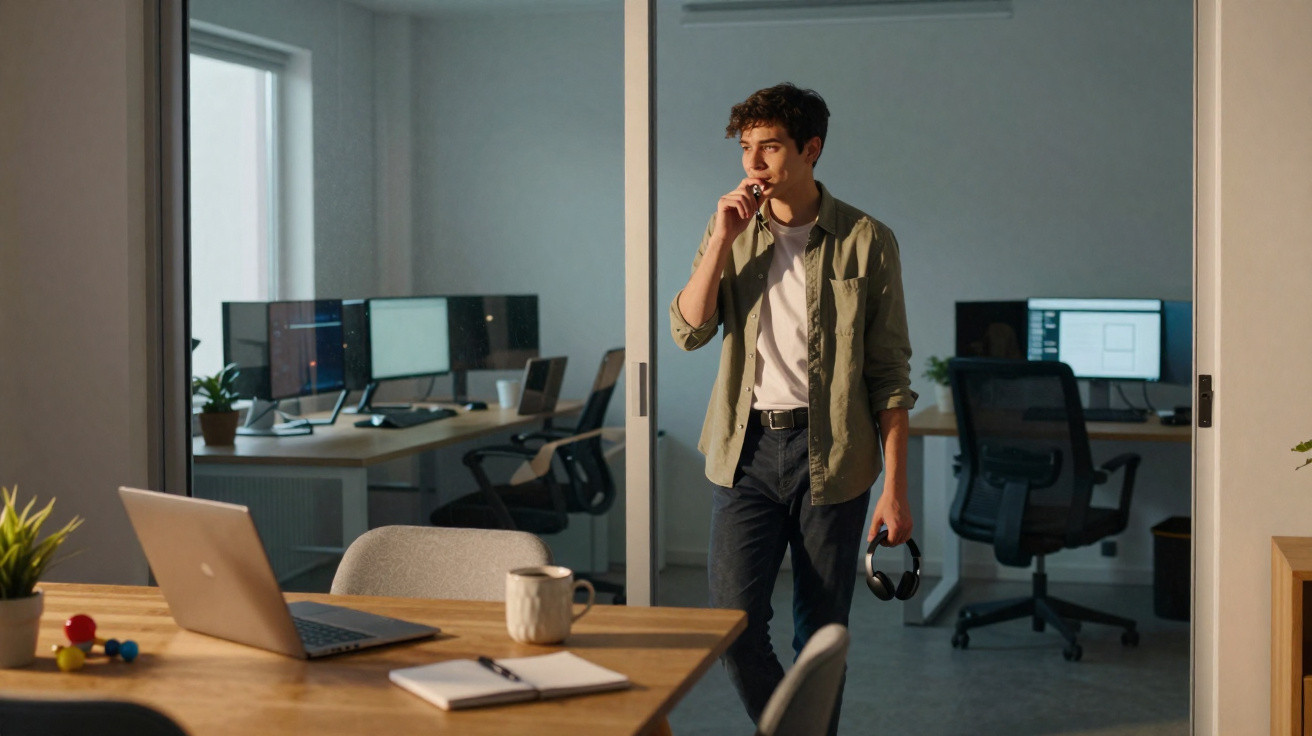
One employee scrolls through Slack in slippers while a cat’s tail moves across the screen like an unhurried metronome. Elsewhere, another adjusts a plastic chair with an ID badge hanging from their neck, trying to recall when the office last felt truly enjoyable.
At one end are remote-work converts, convinced that working from home finally gave them a life worth living. At the other are office devotees, watching vacant desks as though they signal a culture slowly falling apart. The meetings, employers and PowerPoints are identical. Their realities could not be further apart.
Caught between them are managers using dashboards to track productivity, while employees privately assess different costs: the commute, the burden on their minds, the quality of their evenings. One straightforward question keeps resurfacing.
What if both groups are right?
“Real work” vs real life: why the divide feels so intense
In conversations about remote work, the first word is seldom “productivity”. It is relief. People mention gaining an extra hour of sleep, having a proper lunch rather than a miserable sandwich above a keyboard, and catching daylight during winter.
They speak of having more room in the day: enough to think at a calmer pace and act with greater clarity. It is not simply about replying to emails more quickly, but about completing work without the familiar 6 p.m. surge of anxiety. This happiness is rarely dramatic. It is more like lowering a background sound you had not realised was wearing you down.
Meanwhile, some city-centre offices have become stubborn little islands. The desks may be half vacant and the plants slightly dusty, yet regular attendees speak enthusiastically about energy and “real collaboration”. They value coffee-machine chat, private jokes and spontaneous conversations that can influence major decisions.
A software engineer in London told me that a chance five-minute detour to a whiteboard with a manager transformed his whole career. “You don’t bump into people on Zoom,” he said, shrugging. To him, remote work is not liberation but a gradual social desert.
This conflict reaches beyond arguments over chairs and headsets. It is a dispute about identity. For many office loyalists, work has always been a physical setting that gives shape to the day and week, almost a second home. As that setting empties, part of their own role can seem to vanish. For remote workers, however, the office was sometimes where stress, prejudice and burnout took hold. When they hear about the “death of real work”, they silently interpret it as the “death of old control”.
Making remote work happiness sustainable without creating chaos
If remote work makes so many people happier, the task is to turn that immediate comfort into a lasting arrangement. It begins by treating the day as something to shape, like clay, rather than an immovable block. One practical approach used by many employees is the “3 anchors” rule.
They establish three fixed moments: an opening ritual, a midday reset and an end-of-day routine. That might mean opening the laptop only after coffee, in the same place beside the window; walking around the block or stretching before lunch; then closing every tab and physically leaving the room at 5:30 p.m., even if that only means moving away from one corner of the living room. These small, almost mundane actions tell the brain when work has begun and when it has ended.
It is rarely discussed on LinkedIn, but working from home brings very real emotional pitfalls. With boundaries blurred, guilt arrives from both directions. Parents feel guilty about not spending more time playing with their children. Single people feel guilty about failing to “make the most” of their flexibility. Everyone quietly asks whether they are doing enough.
The most common error is attempting to remain available every minute of the day. There are instant responses, late-evening messages and “quick calls” that never seem to finish. Let’s be honest: nobody truly does that every day without paying the price. The healthiest remote workers I spoke to had learnt to say plainly, “I’ll be offline for 90 minutes to focus.” They do not apologise for concentrating properly.
Those who defend office work often say this new ease is delicate, perhaps even illusory. One HR director in Paris said it bluntly:
“If your culture falls apart the moment people stop sharing an elevator, maybe it wasn’t a culture. Maybe it was just a building.”
Beneath the disagreement, both camps fear the same loss: meaning. Supporters of remote work dread returning to a life governed by badge swipes and traffic jams. Office loyalists worry that workplaces will become cold, transactional networks populated by floating avatars.
- Remote workers worry: “Will promotions still exist if no one sees me?”
- Office loyalists worry: “Will my skills matter if everything is just async documents?”
- Managers worry: “How do I lead people I rarely stand next to?”
The argument is not truly about laptops on kitchen tables. It concerns belonging, status and the right to create a life that does not wear you down.
Where remote, office and hybrid work may go next
Across businesses experimenting with hybrid models, several unspoken rules are starting to form. They are not formal policies so much as recurring patterns in real diaries and real decisions. They influence who succeeds in this new environment.
One pattern is that office days are increasingly becoming “relationship days”. People try to fit in one-to-ones, mentoring conversations, whiteboard sessions and candidate interviews. Screens are used for concentrated individual work, while rooms are reserved for human interaction and creativity. It looks tidy in theory. In reality, trains run late, children fall ill and some employees live two hours away. On a wet Tuesday, that theory can unravel very quickly.
Another pattern is that office regulars often receive greater visibility by default. They are the people greeting others in corridors, catching senior leaders between meetings and helping when somebody calls out, “Who’s around?” at 4 p.m. Remote employees notice this and quietly fear a return to “out of sight, out of mind”. Businesses that overlook this silent friction are setting a fuse they may not notice until resignations begin again.
Yet there is also a subtle shift in how people judge a “good job”. Salary and title are no longer the only measures. People discuss how their nervous system feels on a Sunday evening, whether they can collect a child at 4:30 twice a week, and whether their manager values deliverables more than hours spent at a desk.
That change will not disappear, even if offices become full again.
| Key point | Details | Why it matters to readers |
|---|---|---|
| Remote workers report higher life satisfaction | Surveys from major consultancies repeatedly find that people working from home at least three days a week report improved sleep, more family time and less commuting stress, even where their overall working hours remain broadly unchanged. | It allows you to see whether your own sense of relief is shared more widely, while giving you arguments when negotiating flexible arrangements with your employer. |
| Office presence still boosts informal visibility | Managers often acknowledge that promotions and stretch projects still tend to favour people they “bump into” or observe managing difficult situations in person, particularly where companies lack clear written performance criteria. | Understanding this helps you act deliberately: if you mainly work remotely, you can plan regular in-person days around important meetings or request more structured feedback so that you are not missed. |
| Hybrid routines reduce burnout risk | Employees who combine focused home-working days with 1–2 office days report feeling less isolated while retaining control over concentrated work. They commonly reserve office days for collaboration and home days for work requiring quiet and focus. | It shows that an extreme choice is not essential; you can create a realistic rhythm that supports both your mental health and your long-term career. |
We are living through a real-time experiment that nobody properly agreed to join. Blurred Zoom squares, half-empty office towers and Slack channels replacing “the corridor”: each side tells a story shaped by its own scars and hopes.
Some people remember toxic managers, sexist remarks by the printer and the daily dread of a crowded train. To them, home represents safety and dignity. Others recall late-night pizza, shared triumphs after impossible deadlines and mentors who noticed them at exactly the right time. To them, the office is where they became who they are.
At a deeply human level, both sets of memories are valid. The danger lies in pretending that one erases the other. Work is not vanishing; it is breaking apart and taking new forms. Bedrooms become studios. Cafés serve as miniature headquarters. Headsets replace handshakes, though not completely and not yet.
We all recognise the moment when we close the laptop and realise we have not genuinely spoken to anyone all day, or slump into a train seat wondering why the commute still exists. Those moments are clues. They reveal the future we are quietly choosing through our decisions, emails and job applications.
Perhaps the real question is not “office or home?” at all. Perhaps it is this: who gets to decide what “real work” feels like for the next generation?
FAQ
- Is working from home actually more productive or just more comfortable? Most research finds that focused tasks are completed more quickly at home, while creative brainstorming may suffer without effective tools and habits. Many people feel more productive because they avoid the commute and random interruptions, although teams can need extra effort to keep collaboration effective.
- How can I avoid feeling isolated when I work remotely most of the week? Arrange social contact as intentionally as you arrange meetings: try coworking days, lunch calls with colleagues or a weekly coffee with someone outside your team. Even brief, regular check-ins can prevent the days from merging into a lonely routine.
- Do fully remote workers really get fewer promotions? In businesses without clear criteria, it can happen because managers rely on familiarity and visibility. You can lower the risk by seeking explicit goals, asking for regular feedback and sharing your work in common channels rather than only in private one-to-one messages.
- What’s a healthy way to set boundaries when my home is my office? Put at least one physical or symbolic boundary in place: use a particular chair, a separate browser profile or a firm “no email after” time. Pair it with a short ritual, such as closing the laptop and going for a brief walk, so your body notices the transition as well as your calendar.
- Is going into the office a few days a month still worth it? Yes, particularly for building relationships. You can use those days to meet new colleagues, speak to managers in person and take part in workshops or brainstorming sessions that are harder to recreate online.






Comments
No comments yet. Be the first to comment!
Leave a Comment