
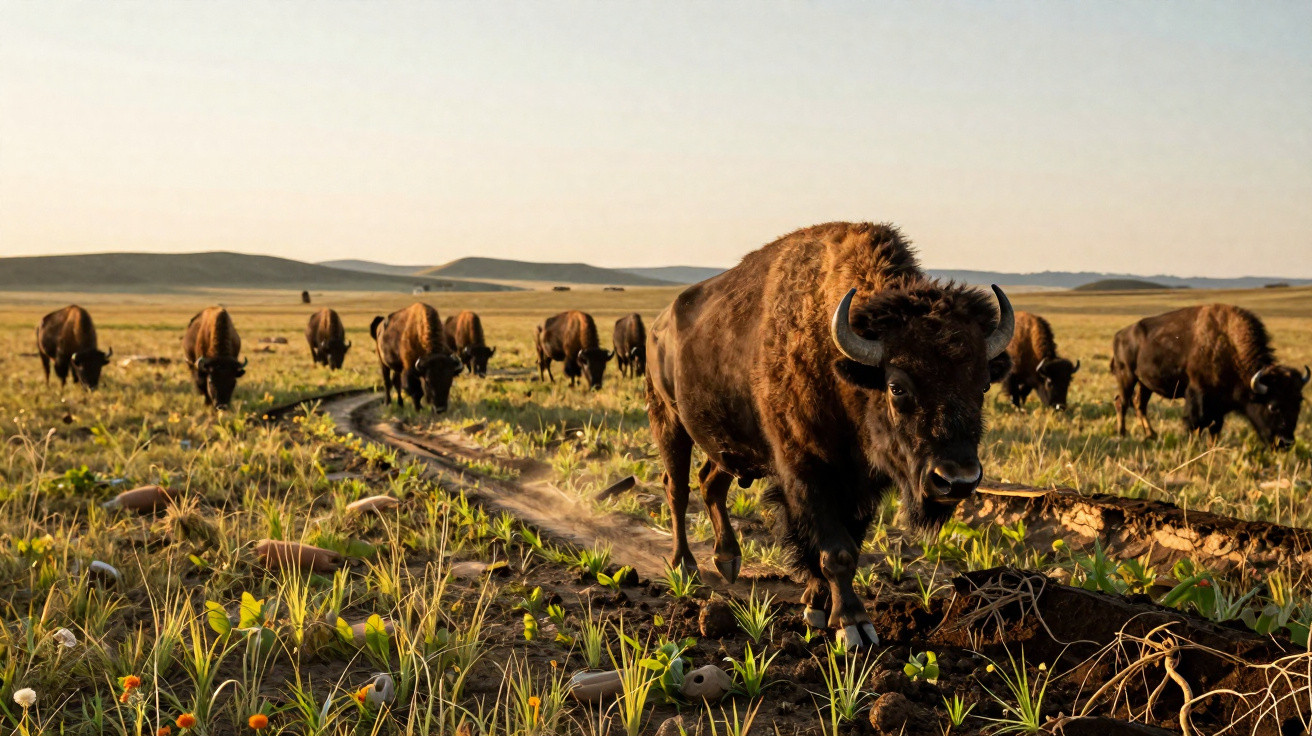
A faint rustling stirs the grass, followed by a deep, rolling sound like surf far out at sea. Dark forms gather on the horizon, growing into a shifting mass of horn and muscle. This ground once grew maize and soya, divided into orderly blocks by tractors. Now, more than 50,000 bison move across restored prairie on former farmland in the United States and Canada, their heavy hooves pressing into earth that was once as hard as concrete.
Dust lingers overhead. Calves leap, wobble and regain their footing. The adults advance with an unhurried, age-old assurance, stopping to pull at hardy native grasses that had nearly disappeared a century ago. Beyond a fence, a rancher rests against a gate, shaking his head-part impressed, part uncertain. The bison are indifferent to his reservations. Their sheer weight is writing a different story into the soil.
And the soil is beginning to respond.
When 450 kg animals become ecosystem engineers
Step onto one of these recovering prairies after a herd has moved through and the first thing you feel is the ground beneath your boots. It is not level or smooth. Hoofprints dot its surface, leaving rough, uneven hollows that collect water and seeds. To anyone raised to believe that “good land” should be flat and uniform, it can look untidy-almost mistaken.
Yet that untidiness is precisely the aim. Bison press and disturb the upper soil layer in ways tractors cannot: forcing seeds into the earth, shattering crusts that once shed rainfall, and trampling old dead stems into a layer that nourishes the microscopic organisms beneath. Cattle grazed continuously often repeatedly damage the same places until they become bare ground. Bison, by contrast, commonly travel as a close, unsettled wave, grazing one patch intensely before leaving it untouched for weeks or months. During that interval, the land has room to recover.
At a 2,023-hectare former farm in South Dakota, ecologists have studied that recovery at close range. They recorded changes in soil after herds were returned: bulk density altered, water infiltration rates rose sharply, and organic matter increased within only a few seasons. Big bluestem, switchgrass and Indian grass-species previously displaced by cropping and overgrazing-began to re-establish themselves. Their roots, which can reach several metres down, started binding the ground together. Birds absent from the site for decades arrived alongside the returning vegetation.
The figures tell a compelling story. At certain sites, bison-managed pasture now supports 30 to 50 percent more plant species than nearby fields grazed only by cattle. Areas grazed hard in one year can be covered in wildflowers the following year. Seen from above, the pattern appears disorderly: a patchwork of close-grazed “lawns” alongside tall, wind-swept grasses. But for prairie shaped by these animals, this mosaic is exactly what health looks like.
There is an apparent contradiction here. Large animals compact the soil, but over time they create greater room for life. Scientists describe the process this way: hoofprints form microhabitats, while short, pulsed grazing stops a single plant species taking over. As plants send roots deeper in search of moisture, those roots create channels that offset compaction at the surface. Once the herd has moved on, dung and urine trigger a managed burst of nutrients, sustaining microbes, beetles and fungi that rebuild the soil’s structure from below.
This is not merely longing for a landscape from before settlement. It is an active experiment in restoring damaged agricultural land without relying wholly on machinery and chemicals. Prairie soils once held extraordinary quantities of carbon, and rebuilding their sponge-like structure could allow them to store more again. These herds are more than symbols: they are unpaid workers, quietly restoring feedback loops that tractors disrupted within a few generations.
How land managers are choreographing ancient bison grazing cycles
Rewilding with bison may sound idyllic until you are studying a map and deciding where 1,000 animals, each weighing roughly half a tonne, can safely range. Today’s land managers combine old knowledge with GPS collars, drones and electric fencing. They do not just open a gate and leave the herd to it. Instead, they organise movements much as a conductor arranges a symphony.
In broad terms, the approach works like this: extensive land is split into large paddocks, generally more spacious than conventional cattle fields. Herds enter, graze hard over a brief period, flatten substantial amounts of plant material, then are guided onwards before grasses exhaust their root reserves. Recovery periods may last 60, 90 or even 120 days, depending on rainfall and how quickly plants recover. It is a contemporary version of the movements 30 million wild bison once made naturally as they followed the seasons, predators and storms across the Plains.
On reserves in Montana and Alberta, some managers now pair satellite vegetation mapping with direct observation in the field. They monitor where bison spend time, which areas develop a patchy appearance and where invasive cool-season grasses begin to spread. Herds are then moved in response, using portable fences and low-stress handling methods. The system is not a rigid rotation dictated by calendar dates. It means interpreting the land as conditions change, then gently steering ancient patterns in the right direction.
There is also an emotional dimension rarely captured in technical plans. At a cold dawn, with mist settled in the draws and a herd silhouetted against a pale sky, the task can cease to feel like “land management”. It becomes more like welcoming home a long-lost relative who understands your house better than you do. Those who have spent decades driving tractors are learning to read hoofprints and dung rather than yield charts alone. On difficult days, it may seem slow, frustrating and almost naïve. On good days, the prairie seems to hum.
Most people recognise the moment when they realise that a familiar way of doing things may itself be contributing to the problem. Conventional grazing often leaves animals on the same ground for extended periods, repeatedly cropping plants at the same height and exposing bare soil to sun and wind. This is when compaction becomes damaging: rain strikes hard ground and runs away rather than soaking in, while roots are denied the chance to extend deeper or become more varied.
With bison, the essential principle is intense use followed by rest, rather than permanent presence. Brief, forceful grazing events separated by long recovery periods allow grasses to regrow fully, restore root mass and retain more carbon. Ranchers trying “bison-style” grazing with cattle report comparable outcomes: fuller ground cover, fewer weeds and improved water infiltration. The change is not solely about which animal is used, but about the rhythm of grazing. Ancient herds established the tempo; modern managers are adjusting their work to follow it.
Let’s be honest: nobody can genuinely manage every hectare this closely every day. Neither farmers nor conservationists have the time or finances to micromanage every acre. The emerging approach is therefore to establish broad patterns, then allow the animals to refine them. Given enough room, bison generally avoid overgrazing the places they prefer most. They rest in places separate from where they feed, use dust wallows as temporary construction sites for birds and insects, and produce natural firebreaks by repeatedly shortening selected patches. The skill lies in offering enough space and time for those instincts to emerge.
Speak with people working on the ground and their language moves away from charts towards something more like awe.
“I thought we were bringing bison back to fix the land,” admits one prairie manager in Kansas. “Now I’m starting to think they’re teaching us how the land actually wants to work.”
That humility is informing new rules of thumb for teams balancing ecology, economics and public attitudes. They discuss “designing for hoof impact” and “leaving ugly patches” where conventional standards would require an even height. They oppose cutting down tall stems simply to make a roadside view appear tidy. Cow pats and bison chips are valued as brown gold, rather than hidden from visiting funders.
- Move herds according to plant recovery, rather than immovable dates in a calendar.
- Leave certain areas ungrazed each year to act as wildlife refuges and seed banks.
- Regard uneven, patchy grass heights as evidence of responsive, adaptable grazing.
- Monitor the land with photographs and straightforward soil tests instead of depending only on memory.
- Consider bison partners, rather than machines expected to deliver one uniform “output”.
Beneath this change is a quiet emotional challenge. Surrendering some control runs counter to modern agriculture, which values tidiness and predictability. Yet as more prairies develop denser grass, additional wildflowers, and returning butterflies and songbirds, their untidy appearance starts to seem less like failure and more like another form of achievement. The land does not recover overnight, but the direction of travel becomes unmistakable.
What these 50,000 bison are really telling us
Return to the edge of a restored prairie several months after the herd has gone through, and sound is the first difference you notice. Grass whispers against your legs. Crickets and meadowlarks vie in the distance. Underfoot, the ground is softer-almost springy in some places-with damp hollows retaining the last rainfall long after nearby ploughed fields have dried to dust. You are seeing more than vegetation growing: you are witnessing a landscape recover its memory.
These 50,000 reintroduced bison cannot replace the tens of millions that once blackened the Plains. Even so, their effects are already spreading beyond the fences. Cities are considering what “bison logic” could mean for parks and green corridors. Farmers are trialling mixed herds, seeking to make cattle behave less like feedlot units and more like mobile grazers. Climate planners examine soil-carbon data and quietly ask how many “technological solutions” are attempting to copy what hooves, dung and deep roots have achieved for millennia.
Perhaps the more profound change is psychological. For more than a century, progress on the Plains was defined by straight lines, mechanised accuracy and diesel engines humming in summer heat. Today, one of the most radical choices some landowners make is to step back and permit ancient patterns to return. That can mean explaining to neighbours why a pasture looks “shaggy” and abandoning the illusion of complete control. In this form, wildness does not mean neglecting the land; it means renegotiating the relationship with it.
The discussions ahead will not be simple. How widely can this model be applied without displacing people dependent on cattle and crops? Which places are suitable for bison, and which would be better served by hybrid systems that adopt grazing cycles while retaining familiar livestock? How should Indigenous nations be respected when buffalo are not merely practical tools but relatives, central to culture and history rather than an ecological fashion? Such questions resist neat answers in research papers or policy memoranda.
What is evident is that the ground is changing more rapidly than the words used to describe it. It is visible in hoofprints that retain tiny pools after a storm; in prairie dog mounds appearing again where the turf has softened; and in children visiting reserves who watch a herd pass and perhaps sense, for the first time, that their country’s story began long before the first barbed-wire fence. Yes, bison compact soil. They also compress time, bringing yesterday and tomorrow close enough to touch.
| Key point | Detail | Why it matters to the reader |
|---|---|---|
| Bison as soil engineers | Hoof action compacts the surface, breaks crusts and presses in seeds, while roots and microbes rebuild deeper structure. | It helps explain how heavy animals can repair damaged ground rather than simply ruin it. |
| Revival of native grasses | Species including big bluestem and switchgrass recover under brief, intense grazing followed by long rest periods. | It demonstrates a practical way to restore resilient plants without depending only on reseeding and chemicals. |
| Modern grazing inspired by the past | Managers use flexible rotations, technology and observation to imitate the migration rhythms of ancient bison. | It provides ideas that can be adapted to ranch management and to thinking about land, climate and “neatness”. |
FAQ:
- Are bison actually better for soil than cattle? Bison are not magical, but their behaviour and movement often produce healthier, more varied grazing patterns. Cattle managed with the same “high impact, long rest” approach can also generate major benefits.
- Doesn’t soil compaction from hooves harm plant growth? Compaction at the surface can cause harm if animals stay too long. However, brief periods of hoof action make impressions that retain water and seeds. Deep roots and soil organisms then rebuild the structure below, balancing the impact.
- Can degraded farmland really be turned back into prairie? It cannot happen immediately, but many locations show strong recovery within 5–10 years when given rest, diverse plants and careful grazing. Some will never resemble “original” prairie, yet they can recover their function and resilience.
- Is this rewilding mainly for conservation, or can it be profitable? Many initiatives combine conservation with meat sales, tourism or grazing leases. The financial model is still developing, although some ranchers report lower input costs and greater resilience during drought.
- What role do Indigenous communities play in these bison returns? Tribal nations lead many of the most ambitious herd-restoration efforts, reconnecting cultural, spiritual and ecological relationships. Any long-term vision for bison on the Plains must place their leadership at its centre, rather than at the margins.






Comments
No comments yet. Be the first to comment!
Leave a Comment