
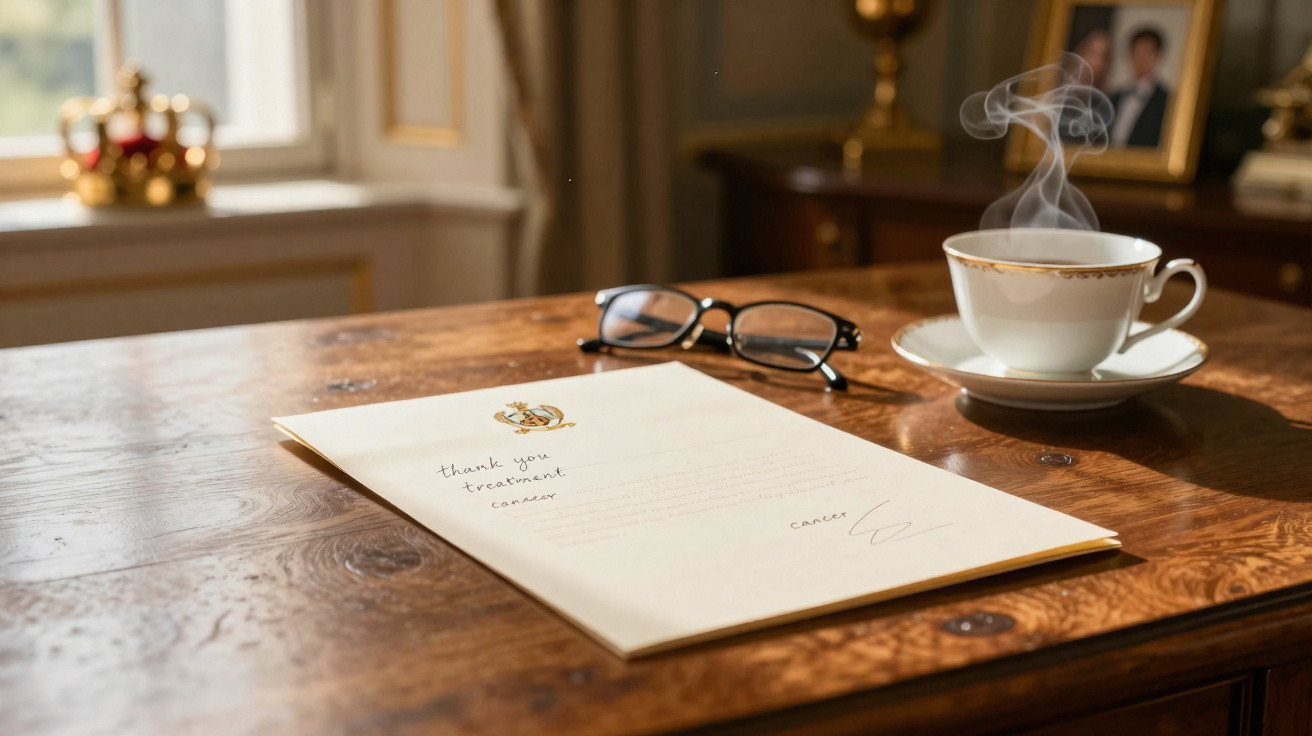
The note was brief and almost traditional in style, set on immaculate royal stationery bearing the crowned monogram. Its language, however, was unexpectedly exposed. King Charles III, brought up within palace walls and schooled in measured, immaculate public phrasing, appeared to write not as a sovereign but as a father, a friend, or a person who had been afraid. He expressed gratitude to strangers for their cards, spoke candidly about his treatment, and acknowledged that their messages had mattered more than they might realise.
For a fleeting instant, the Crown seemed to have a human pulse.
When a monarch suddenly sounds like one of us
At first, the statement arrived without much fanfare: published online beside a familiar royal photograph and signed simply, Charles R. There was no broadcast to the nation and no appearance on a balcony. Instead, it was an unusually personal message from a king who had spent his life keeping his private feelings closely guarded.
Within minutes, it was moving through phones and social-media feeds, appearing in group chats and family WhatsApps. Readers enlarged the text and highlighted the sentence in which he said, “Your good wishes have reduced me to tears.” For someone whose role is, quite literally, to remain composed and carry on, that glimpse of vulnerability felt like a fissure in marble.
Weeks earlier, the Palace had confirmed his cancer diagnosis in a concise, restrained press release. It identified neither the organ involved nor a prognosis, offering only the limited information expected for a 75-year-old head of state. The response immediately spread worldwide. People placed flowers outside Buckingham Palace, while children made crayon crowns and signs saying “Get well soon, King Charles”. Cancer charities recorded an overnight rise in visits to their websites.
After that, an unexpected pattern emerged. People receiving chemotherapy started referring to the King in hospital wards. Nurses began hearing comments such as, “If he can talk about it, maybe I can too.” The illness of a monarch was suddenly present in waiting rooms and hospital lifts, becoming part of tentative, anxious exchanges between people who had never met.
For generations, the British monarchy has relied partly on separation. Its mystery, traditions and pageantry all rest on the sense that royals exist slightly above the disorder of ordinary life. Cancer does not care about that story. It brings kings into the world of scans, blood tests, exhaustion, fear and ill-fitting hospital gowns.
In writing a letter of this sort, Charles made a quietly radical choice. Rather than sheltering behind familiar references to “duties” and “service”, he used words about treatment and uncertainty. By connecting his diagnosis with “all those whose lives have been touched by cancer”, he gently changed a private ordeal into a collective public experience. This is more than public relations. It is an uncommon reminder that institutions designed to project perfection are still led by people who can be hurt.
The quiet power of saying ‘I’m scared too’
Illness carries its own particular silence: the quiet car journey to hospital, the pause while waiting for a call with test results, and the dinner-table stillness when no one knows how to ask, “How bad is it?” Charles’ statement shifted that silence, if only slightly.
He did not offer detailed medical information or make a heroic speech. Instead, he did something more modest, and perhaps more courageous. He said that hearing from others affected by cancer had moved him; that he was listening; and that those messages had mattered during the long, unseen hours of treatment. Sometimes that small opening is all people need.
Consider an ordinary day of chemotherapy: the early alarm, hurried toast and the familiar drive to hospital that feels unreal every time. In the waiting area, patients scroll through phones, flicking between alerts and social feeds in an effort to distract themselves from the drip stand waiting along the corridor.
Then imagine the same headline appearing: “King Charles thanks public as he continues cancer treatment.” A woman in her fifties says quietly, “He’s on it too, you know.” A man in his thirties, still wearing his work shirt, gives a slight nod. No one is healed at once, and nothing removes the side effects. But the atmosphere changes by a small degree. For a moment, an illness that can leave a person feeling painfully isolated appears to be something shared.
There is a reason this emotional response makes sense. Cancer is often framed in our culture as a battle: you “fight”, you “beat it”, you “stay strong”. Yet beneath those headlines sit untidy, draining and un-Instagrammable experiences: nausea, brain fog, mood changes, and the feeling that your own body no longer belongs to you.
When a person as carefully managed as a king lowers his guard, however slightly, it weakens the idea that “strong people” endure treatment with flawless dignity. It acknowledges that this can be difficult and sometimes unbearable, even for somebody with every resource in the world. That candour quietly permits the rest of us to say we are exhausted, frightened, or not “fighting” at all on some days. Let’s be honest: nobody really does this every single day.
What his letter teaches us about talking to the unwell
One element of Charles’ message was especially striking: his repeated gratitude for the “countless” letters, cards and messages. For anyone uncertain about what to say to a friend, parent, partner or colleague with cancer, that is the important lesson.
You do not need sweeping declarations or perfectly crafted words, and you cannot solve the problem. Often, the most restorative act is simply arriving in a person’s inbox or letterbox, even when the words feel awkward. A three-line message saying, “Thinking of you today. No need to reply” can become a lifeline when everything hurts. It could be a silly postcard, a photograph recalling a shared memory, or a five-minute voice note made while walking to the shops. These are small reminders that say, “You are still part of life out here.”
Many people become stuck. Afraid of saying the wrong thing, they say nothing; concerned that a message may intrude, they let weeks pass in silence. From outside, that may seem respectful, but from within it may feel like abandonment.
The King’s emphasis on the value of those messages gently challenges that impulse. In effect, he is saying that awkward kindness still matters, a hastily written card still arrives, and an email sent between meetings may seem minor to its sender but immense to somebody reading it from a hospital chair. If you are unsure, an imperfect message is usually better than vanishing. The true error is allowing your own discomfort to turn into another person’s loneliness.
When Charles wrote that his messages had “brought the greatest comfort and encouragement,” he handed everyone a simple truth: presence beats perfection.
- Send something small
A text, card or email will do. It is fine to keep it short: “I’m here” is the essential message. - Avoid forced optimism
Avoid phrases such as “You’ll be fine” or “Everything happens for a reason.” They may hurt rather than comfort. - Follow their pace
Do not take a lack of reply personally. Illness drains energy, so simply leave the door quietly open. - Offer one concrete help
“I’ll bring dinner on Wednesday” is more useful than “Tell me if you need anything.” - Remember the long haul
Support often dwindles after the first few weeks. A message after three months may matter more than the first rush of contact.
A king, a diagnosis, and the questions we’re left with
Royal communications generally aim to bring a discussion to an end. This one achieved the reverse, raising a set of quiet questions not only about the monarchy, but also about how we approach vulnerability in public life and among those closest to us.
Charles’ cancer will now form part of the background to every future ceremonial occasion: the Trooping the Colour appearance on the balcony, state openings and Christmas broadcasts. People will view his face differently, wondering about his strength and guessing how many hospital appointments lie behind a precisely timed wave.
Beyond the headlines and constitutional discussion, though, something more intimate is taking place. Families are using news of the King to discuss their own diagnoses at the dinner table. Adult children are at last asking parents about treatments they have seldom mentioned. Colleagues who once avoided the C-word are beginning to say it aloud, treating it less as a curse and more as a fact of life.
Somehow, the most protected man in Britain has accidentally normalised one of our most feared conversations. That does not make cancer more just or gentle, nor does it lessen the grief of people who have lost someone to it. It does, however, erode the fortress of shame and silence that surrounds illness. It shows that tenderness, even from a throne, is not weakness to conceal but a language we are all still learning.
| Key point | Detail | Value for the reader |
|---|---|---|
| Royal vulnerability is rare | Charles publicly acknowledged his cancer treatment and emotional response to public messages | Helps readers see that illness can touch anyone and that openness is allowed |
| Small gestures matter | The King highlighted the comfort he found in letters, cards and messages | Encourages readers to reach out to unwell loved ones, even with imperfect words |
| Honest talk breaks stigma | His statement linked his own diagnosis to millions living with cancer | Offers a model for more open, less fearful conversations about serious illness |
FAQ:
- What exactly did King Charles III say about his cancer treatment? He issued a written statement thanking the public for their “wonderfully kind and thoughtful good wishes” and said that their messages had brought him “the greatest comfort and encouragement” while he continues treatment.
- Has the Palace revealed what type of cancer he has? No. Officials have intentionally kept both the precise cancer type and stage private, saying only that it was discovered during treatment for an enlarged prostate and that he is receiving regular medical care.
- Why is this statement considered unusual for a monarch? In the past, royal health matters were either concealed or communicated in highly vague language. Charles’ personal wording, along with his direct mention of cancer treatment and emotional support, represents an unusual degree of openness for a reigning British monarch.
- How are cancer charities responding to the King’s openness? Many organisations have welcomed his decision to speak publicly, reporting increases in website traffic, helpline calls and people presenting for checks since his diagnosis was announced.
- What can I learn from his message when supporting someone with cancer? The key lesson is that straightforward, sincere contact has value. Brief messages, modest gestures and continued presence can offer genuine comfort, even if you cannot find perfect words.






Comments
No comments yet. Be the first to comment!
Leave a Comment