
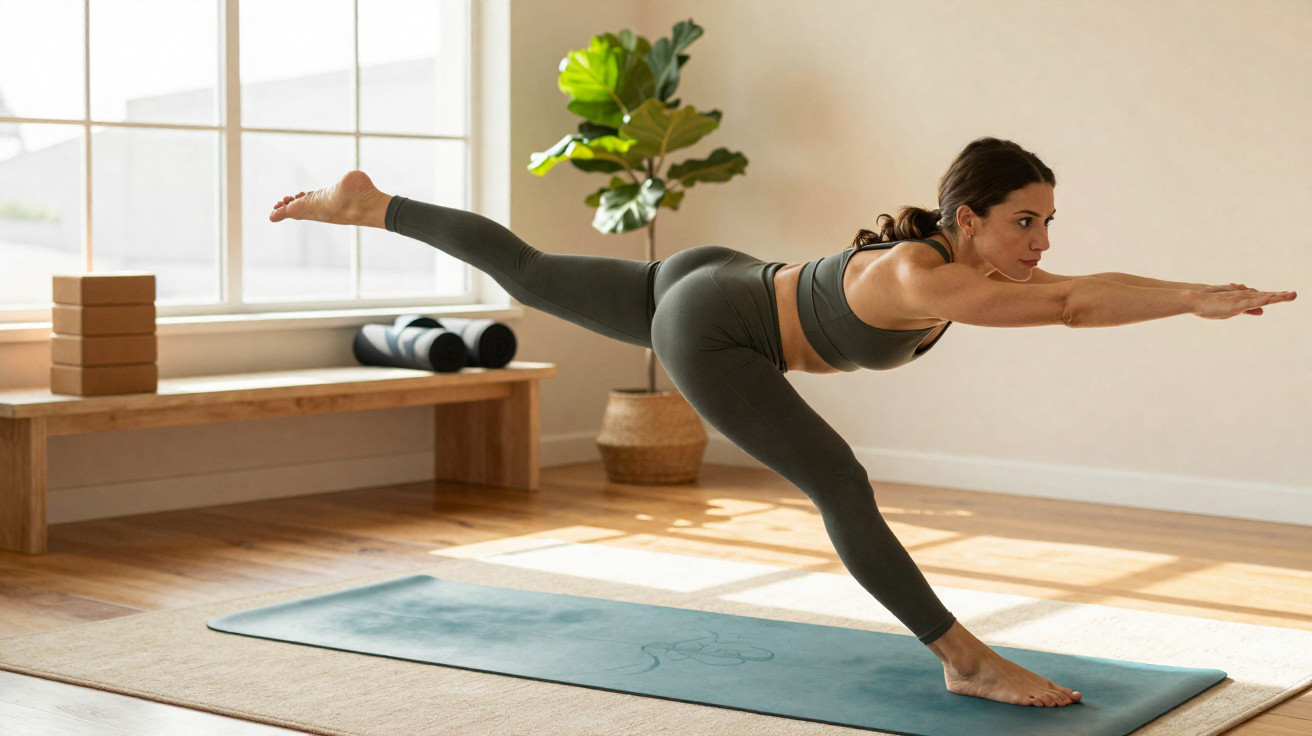
Yoga is an ancient discipline that aims to unite the mind, body and spirit. Its benefits include greater flexibility, improved muscle tone, increased endurance and, naturally, reduced stress. However, it is perfectly acceptable to practise Yoga-or choose particular Yoga poses-for a great booty!
The Gluteals
The gluteal muscles consist of three parts. The gluteus maximus is among the body’s largest and strongest muscles. The gluteus medius sits along the outer side of the buttocks, while the much smaller gluteus minimus lies beneath it. Together, these muscles rotate the thighs inwards and outwards, move the leg backwards and stabilise the femur within the hip socket.
Your gluteals help you remain upright, provide the strength needed for walking uphill or climbing stairs, and can help your back feel better. As the glutes have a direct effect on posture, pain in the back, hips and pelvis can often be linked to weakness or imbalance in the gluteals.
Our sedentary way of life, combined with overexertion in other activities such as running, can often lead to problems.
We all want toned, balanced glutes to encourage good posture. And, of course, a perfectly rounded and lifted booty is pleasing to look at! What we certainly do not want is a flat, shapeless booty.
A strong, balanced backside is essential for a stable and pain-free Yoga practice and everyday life.
Thankfully, Yoga can counteract the effects of modern living. When exercising, we need to be able to stretch, contract and completely relax our muscles, and Yoga provides the ideal environment for this. Almost every standing posture activates the gluteus maximus. Yoga movement patterns are dynamic as well as isometric. Moving into and out of different postures trains the muscles both concentrically, as they shorten and contract, and eccentrically, as they lengthen.
My top 3 Yoga poses for a great booty
1. Utkatasana: Chair pose
Inhale, lifting your arms overhead with the palms facing one another, and draw your shoulders down away from your ears.
As you exhale, bend your knees and aim to bring your thighs as close to parallel with the floor as you can. Your knees should track out over your feet, so ensure you can still see your toes when looking down. Lean your torso slightly forwards over the thighs. Keep your inner thighs drawing towards one another, and press the heads of your thigh bones down towards your heels.
2. Salabhasana: Locust pose
This posture is excellent preparation for backbends. Lie on your stomach with your arms by your sides. Turn your big toes inwards so they touch. On an exhale, lift your head, arms, upper torso and legs from the floor. You will rest on your lower ribs, stomach and the front of your pelvis. Engage your glutes, keep the big toes together and lengthen as far as possible through the backs of your legs.
Reach your arms upwards towards the ceiling and create length through your neck. This asana offers a range of arm variations. Take care not to strain or compress your neck.
3. Virabhadrasana 3: Warrior 3
From Virabhadrasana 1 or a high crescent lunge, shift your weight into the front leg and raise the back leg to form a T shape with your body. Keep the lifted leg parallel to the floor. Your hands may stay in prayer position or extend forwards.
In this posture, the gluteus maximus works concentrically to maintain neutral hip extension and rotation.
These are just a few of the many asanas that can strengthen, stretch and shape your gluteus maximus. Many other asanas target the gluteus medius and minimus more specifically.

Comments
No comments yet. Be the first to comment!
Leave a Comment