
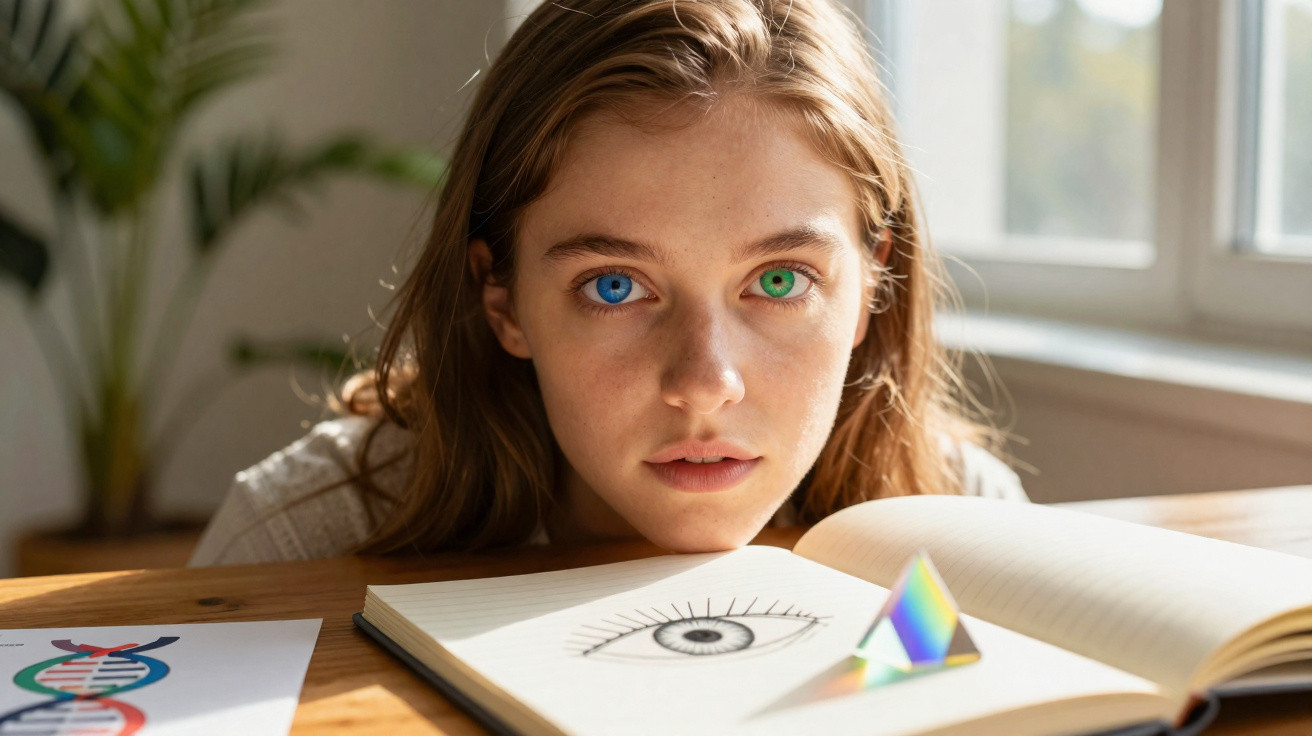
When you are introduced to somebody, their eyes may be the first detail that draws your focus. Perhaps they are a deep, earthy brown, a light blue, or the uncommon green that seems to change with each shift in the light.
Eyes can captivate us, prompting familiarity or intrigue before either person has said a word. They are frequently the first feature we observe in someone and, at times, the one that stays clearest in our memory.
Around the globe, human eye colour covers a broad spectrum. Brown is overwhelmingly the most prevalent colour, particularly across Africa and Asia, whereas blue is most commonly found in northern and eastern Europe.
Green is the rarest eye colour, occurring in only around 2% of people worldwide.
Hazel eyes bring further variation, often seeming to move between brown and green according to the light.
What, then, causes these differences?
It all comes down to melanin
The explanation lies in the iris: the coloured circle of tissue surrounding the pupil. A pigment known as melanin is responsible for much of what we see.
Brown eyes have a large concentration of melanin, which takes in light and gives them their darker look. Blue eyes have very little melanin. Their colour is not produced by pigment; instead, it comes from light scattering inside the iris. This physical phenomenon is called the Tyndall effect and is similar to the process that makes the sky appear blue.
Within blue eyes, shorter light wavelengths, including blue, scatter more efficiently than longer wavelengths such as red and yellow. With so little melanin present, less light is absorbed, so the scattered blue light becomes the colour we see most strongly. The blue shade is therefore created by the interaction between light and the eye's structure, rather than by pigment.
Green eyes arise from a middle ground: a moderate level of melanin combined with light scattering. Hazel eyes are more complicated again. Melanin spread unevenly through the iris forms a patchwork of colours that can appear to alter with the ambient light around it.
What do genes have to do with it?
The genetics behind eye colour are equally intriguing.
Scientists once thought eye colour followed a straightforward “brown beats blue” pattern governed by one gene. Studies now show that the picture is considerably more complicated.
Numerous genes help determine eye colour. This is why children from the same family may have strikingly different eye colours, and why two blue-eyed parents can occasionally have a child with green or even light brown eyes.
Eye colour can change as well. Many babies of European ancestry are born with blue or grey eyes because they have not yet built up much melanin. As pigment slowly accumulates during their first few years, blue eyes can become green or brown.
In adults, eye colour is generally more consistent, although its appearance commonly varies with lighting, clothing and pupil size. Blue-grey eyes, for instance, may look intensely blue, strongly grey or slightly green depending on the ambient light.
Lasting changes are less common, but they can happen with age or as a result of certain medical conditions that alter melanin in the iris.
The truly unusual cases
There are also some especially unusual cases.
Heterochromia - when one eye is a different colour from the other, or when a single iris has two clearly separate colours - is uncommon but visually distinctive. It may be inherited, result from an injury, or be associated with particular health conditions.
Celebrities including Kate Bosworth and Mila Kunis are familiar examples. Musician David Bowie's eyes seemed to be different colours due to a permanently enlarged pupil following an accident, which created the appearance of heterochromia.
Ultimately, eye colour is not merely an oddity of genetics and physics. It shows the way biology and beauty overlap. Every iris resembles a miniature universe: bands of pigment, specks of gold or expanses of rich brown, each catching light in a different way whenever you look.
Eyes allow us not only to view the world, but also to form connections with one another.
Blue, green, brown or somewhere between the three, each pair tells an entirely individual story of heritage, individuality and the understated wonder of being human.
Davinia Beaver, Postdoctoral research fellow, Clem Jones Centre for Regenerative Medicine, Bond University
This article is republished from The Conversation under a Creative Commons licence. Read the original article.





Comments
No comments yet. Be the first to comment!
Leave a Comment