
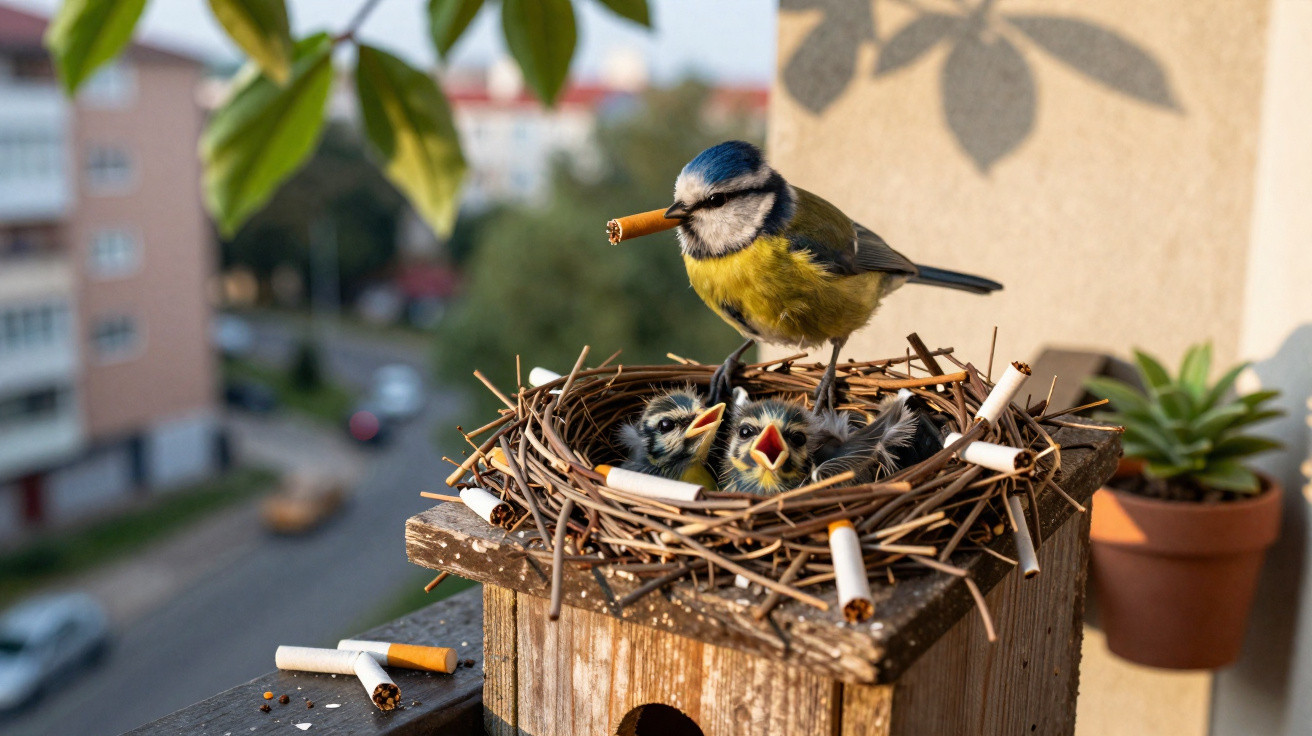
In several cities, birds are increasingly using cigarette filters when constructing their nests. What initially appears to be a nightmare scenario for conservationists has emerged in studies as an ambivalent form of protection: fewer parasites, but fresh health risks from chemicals.
Why birds carry cigarettes into their nests
A blue tit with a cigarette end in its beak may at first seem the perfect symbol of pollution. However, researchers in Poland and Mexico have examined the behaviour more closely and found that it appears to be a strategy rather than mere confusion.
A team at the University of Łódź in Poland studied blue tits living both in urban areas and woodland. The birds had begun regularly bringing cigarette ends into their nests. The researchers set out to establish whether this was chance behaviour or whether it had a measurable effect on the health of nestlings.
The suspicion was that birds use nicotine and other substances in filters as a natural weapon against parasites.
Cigarette filters contain thousands of chemical compounds, including nicotine, which can repel or kill many insects. Some birds seem to be taking advantage of precisely this effect, albeit unknowingly.
Polish experiment: three nest types and surprising findings
The Łódź researchers offered blue tits three different nest types:
- a wholly natural nest made from typical materials such as moss, feathers and plant debris
- a nest made using materials that had been sterilised beforehand
- a nest to which researchers added two cigarette ends
Once the chicks had hatched, the scientists waited 13 days before examining three nestlings from each nest. Among other factors, they assessed the birds' state of health, parasite load and various blood values.
Their observations were as follows:
| Nest type | Health of the chicks | Parasite load |
|---|---|---|
| Natural nest | poorest | significantly more fleas and ticks |
| Sterile nest | better | fewer parasites |
| Nest with cigarette ends | also better | fewest parasites |
Chicks raised in natural nests had the poorest health outcomes. Nestlings from the sterile nests and those containing cigarette ends were noticeably fitter. Most strikingly, nests containing ends had far fewer parasites, especially fleas and ticks.
Nests with cigarette ends were the most free of parasites – a clear benefit for the chicks, at least in the short term.
Observations from Mexico: birds actively seek out filters
Researchers led by biologist Constantino Macías García in Mexico have reported very similar behaviour. There, finches and sparrows in particular deliberately pull cigarette filters apart. They remove small pieces and incorporate them into their nests.
In Mexico City, biologists often found eight to ten cigarette ends in a single nest. The filter fragments lay among the nestlings, directly against their delicate bodies, which were still largely without feathers.
In one experiment, the scientists placed additional ticks in some nests. The birds' response was unambiguous: females flew off to collect more cigarette filters, apparently attempting to reinforce their chemical “defensive layer”.
The more parasites were in the nest, the more intensely the birds searched for cigarette filters.
In many cases, the chicks had a more stable start in life: hatching was more frequently successful, while the time needed to develop a complete covering of feathers was shorter. Studies also suggested that the nestlings' immune response was more effective.
Toxic protection: how nicotine stops parasites
Why do cigarette filters help against parasites of all things? To biologists, the explanation is straightforward: nicotine is a powerful neurotoxin for many insects and other small organisms. It is also accompanied by further chemical residues that deter parasites.
For birds, this chemical mixture becomes a double-edged tool:
- The number of parasites in the nest falls substantially.
- Fewer parasites mean less blood loss and stress for the chicks.
- The immune system requires less energy, leaving reserves available for growth and feather development.
- At the same time, harmful substances enter the bodies of the nestlings.
In densely populated cities, where parasite pressure and litter pollution are high, this chemical protection may provide a short-term advantage. Birds are not choosing between “good” and “evil”; instead, they appear to respond to a simple link: where filters are present, fewer pests trouble them.
The downside: genetic damage caused by chemicals
The Mexican studies also reveal a darker aspect of this behaviour. Blood tests on chicks raised in nests containing large quantities of cigarette waste indicated genetic damage. Researchers see a connection with chemical residues from the filters.
These alterations affect, among other things, the genetic material inside cells. Their long-term consequences remain unclear. They may include shorter life expectancy, fertility problems or a permanently weakened immune system in adulthood.
Birds benefit in the short term from chemical protection, but may pay for it later through invisible long-term damage.
The researchers stress that long-term data are still lacking. Many songbirds do not live to an old age in any case, while systematically tracking wild animals over several years is exceptionally difficult.
What this reveals about animals' adaptability in cities
The birds' behaviour offers a striking example of how animals adapt to human environments. Where they once had only twigs, animal hair and plant fibres available, they now encounter plastic, paper – and cigarette litter.
Biologists describe this as cultural adaptation: one animal happens upon an advantage, and others copy the behaviour. In this way, an unusual nesting material can spread within a few generations without any change to the animals' genetic makeup.
Cities therefore become testing grounds for evolution. Some species learn to make use of human rubbish, while others fail to do so and disappear from urban areas.
An opportunity for research, a warning for policy
For science, this behaviour raises new questions:
- How severe is the genetic damage caused by chemicals from filters in reality?
- Which species use cigarette waste, and which avoid it?
- Could such effects alter urban bird populations in the long term?
The message for policymakers and urban planners is much clearer: cigarette ends remain a major environmental problem. They end up in soil and waterways – and now deliberately in animal homes as well. What may look like a practical “use” by birds should be viewed not as mitigation, but as a warning sign.
What these findings mean for people's everyday lives
Although the studies provide a fascinating insight into birds' adaptive strategies, the best “contribution” people can make remains reducing the amount of toxic material released into the environment. Cigarette waste is a particularly tangible example.
People who smoke can at least prevent cigarette ends from being carelessly discarded on streets, in parks or by lakeshores. Every thrown-away cigarette can become a potential building block for a bird's nest, with all the consequences described for animals, as well as for soil and waterways.
For people interested in nature, the studies also offer a compelling detail to look for when watching birds. Anyone checking nest boxes in towns and cities, or observing sparrows nesting on balconies, can keep an eye out for foreign materials. If filter remnants appear, this points to high parasite stress and to birds' remarkable but risky ingenuity.
Further research projects will ultimately show whether the short-term protection provided by toxic substances is a curse or a lifeline for the species affected. Only one point appears certain: cigarettes do not belong in the environment – even when birds try to make the best of human rubbish.






Comments
No comments yet. Be the first to comment!
Leave a Comment