
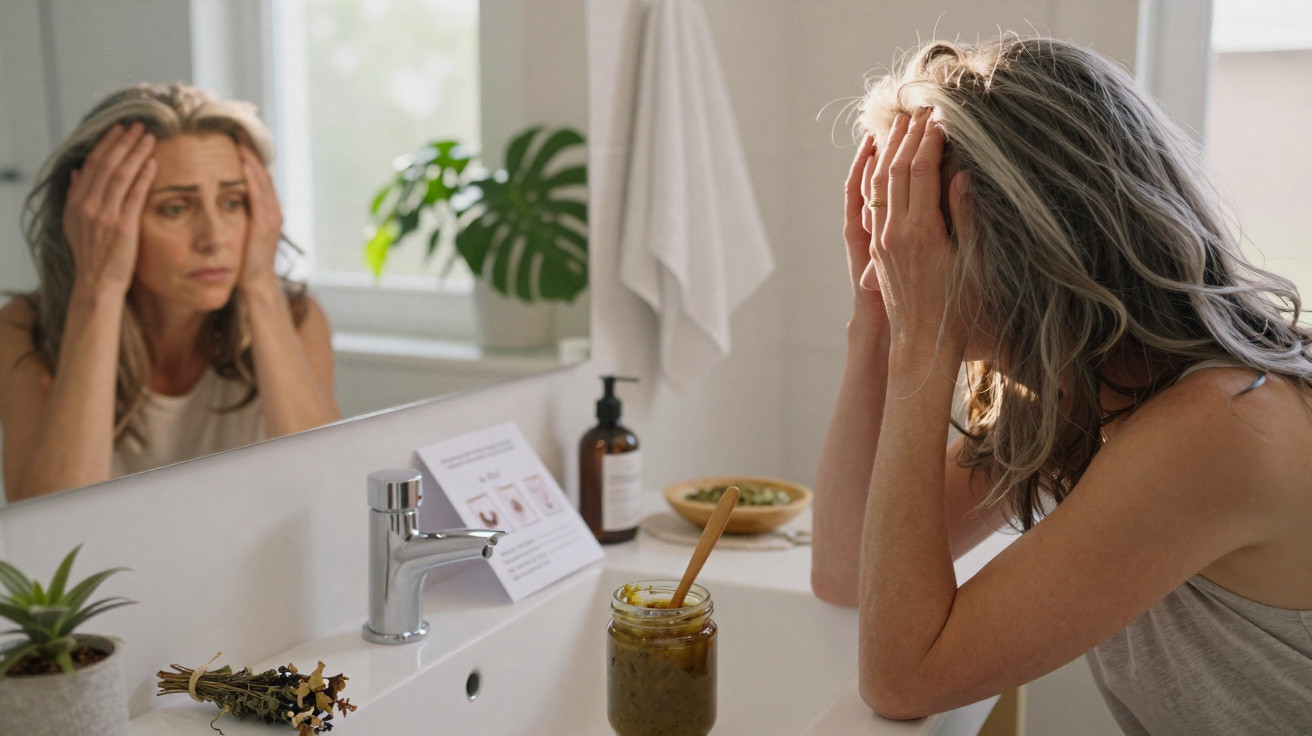
On a Tuesday morning in a busy Paris salon, a woman in her early fifties flicks through TikTok as her colourist prepares her regular dye. Her finger pauses over a video: a grey-haired influencer works a brownish paste into her roots and laughs, “No chemicals, no regrets, ten years younger.” The comments are erupting. Some call it miraculous; others warn of danger. The woman tips her head to one side. Her hair is fine, and her tolerance for three-hour colour appointments is finer still. Yet the word “natural” catches her attention immediately. Henna and herbal masks in place of ammonia fumes? It seems almost implausibly appealing.
She glances up at her reflection, where her roots gleam beneath the fluorescent lights.
A thought murmurs from somewhere within: could this be the final colour treatment you ever have?
When “natural” sells youth in a jar
The disputed technique being discussed everywhere appears straightforward: conceal new grey growth with plant-derived powders, oils and homemade mixtures said to tint hair rather than harm it. Henna, indigo, amla, coffee, black tea, rosemary oil and a splash of apple cider vinegar “for shine” - the ingredients resemble a raid on a Pinterest-inspired cupboard. On social media, the before-and-after videos are mesmerising. Grey roots disappear. Hair seems fuller, glossier and more youthful. The hashtag “naturalgraycoverage” captures scalp transformations as they happen.
With inflation, worries about health and exhaustion with chemical colouring all rising, this DIY route to younger-looking hair without side effects sounds like the answer many people have been hoping for.
There is only one snag: experts are far from unanimous.
In Berlin, dermatologist Dr Lea W., who sees patients with ongoing scalp conditions, says a stream of “natural disasters” has entered her clinic. She recalls a 32-year-old graphic designer, committed to an eco-conscious lifestyle, who replaced salon colouring with an online henna-indigo combination. Her first application caused no trouble. The second, prepared “extra strong” in the hope of quicker coverage, resulted in furious red plaques behind her ears and around her hairline.
Meanwhile, in New York, a trichologist describes the reverse experience: clients who abandoned conventional dyes for thoroughly tested herbal blends and experienced less breakage and shedding. Two settings, two outcomes, both described as “natural”.
The same label can lead to profoundly different results.
What, then, is happening beneath all that plant-coloured froth? Grey hair is not purely a matter of colour; it also changes structurally. As melanin production declines, hair commonly becomes drier, more porous and often finer. This alters how every pigment, whether synthetic or botanical, adheres to the strand. Plant dyes such as henna coat and bond with the hair shaft’s outer layer. For thick, dark, untreated hair, this layer may offer reinforcement and protection. For delicate, heavily processed or exceptionally fine hair, however, repeated build-up may pull strands down, alter their texture and at times contribute to breakage.
There is also the obvious concern: products called “natural” are seldom made from plants alone. Metallic salts, preservatives and highly concentrated essential oils can find their way into “herbal” packaging, which is when dermatologists become wary.
The natural grey coverage method dividing doctors - and tempting weary scalps
The well-known grey-coverage routine causing the greatest dispute resembles a ritual. First, cleanse the hair using a mild shampoo and towel-dry it until it remains slightly damp. Next, make a paste with henna or cassia for warmer shades, or combine henna and indigo for deeper coverage. Some users include coffee or black tea for added richness, while others stir in a teaspoon of oil to “feed” the fibre. The mixture is worked into the roots section by section, then covered with cling film and a towel before being left for between one and four hours.
Afterwards, the paste is rinsed away with cool water only, without shampoo, before a final vinegar or herbal-infusion rinse. The intended effect is a veil of naturally coloured-looking hair, with greys disguised rather than uniformly wiped away.
On video, the process can look almost like an act of self-care.
But then there are the shortcuts - and the mishaps. People order the first “natural henna” they find on Amazon, despite an oddly neon image on the packet. Because they are “in a rush”, they miss out the allergy patch test. They keep the paste on overnight “for extra intensity”, sleep in a shower cap and wake with a hot, burning scalp. Others put plant dyes straight onto hair that has already been bleached, relaxed or chemically straightened, with unpredictable colour reactions and a straw-like feel as the result.
Most of us know that point at which impatience overrides care and a beauty ritual becomes a minor experiment over the bathroom basin.
The TikTok video never includes the 45 minutes spent rinsing, while you wonder whether your hair will make it through.
Medically, the disagreement between specialists is less about plants themselves than the circumstances in which they are used. Dermatologists firmly opposed to the approach cite genuine, documented hazards: allergic contact dermatitis caused by lawsone, henna’s pigment; irritation from essential oils; and metallic-salt contamination that may react poorly with subsequent salon treatments. More supportive trichologists focus on tightly managed use: pure, laboratory-tested powders, brief processing times and rigorous patch testing.
A Paris-based dermatologist put it to me this way:
“People hear ‘natural’ and think ‘harmless’. For some scalps, regular chemical dye is actually safer because it’s standardized and predictable. With plant mixes bought online, you don’t always know what you’re putting on your skin.”
Within professional circles, discussion repeatedly returns to three questions:
- What is actually in the box?
- What type of hair and scalp is involved?
- Who, if anyone, is overseeing the process?
Remove the marketing language, and the issue is a straightforward conflict between the wish to look younger and biology’s constraints.
Between appearance, safety and the right to stay grey
For anyone still considering this method, the first consideration should not be the powder but the scalp. People with eczema, psoriasis, hair-dye allergies or extremely fine, fragile hair fall into a higher-risk group. The first essential measure is a proper patch test: apply a small amount of fully mixed paste behind the ear or inside the elbow, and leave it for 48 hours - not five minutes. If no issue arises, the first use should be on a small, concealed section of hair rather than across the entire head.
Accounts from careful users have a different tone: shorter processing periods, no harsh heat and several weeks between treatments instead of “root panic” every ten days. The aim becomes less about “erasing grey” and more about “softening the contrast”.
That change in mindset can transform the whole experience.
The all-or-nothing mentality is where many people run into difficulty. They move from monthly salon dyes to a complete DIY plant coating, anticipating instant, even coverage from root to tip. In practice, it is more complicated. Botanical pigments are translucent: they merge with the existing colour rather than repainting it. On very pale grey hair, the initial outcome may be a warm, golden highlighted effect rather than an exact recreation of the original shade. On very fine hair, coat after coat can leave strands feeling rigid or dry.
To be frank, no one really follows this routine every single day.
The most hair-friendly habits are often the least “Instagrammable”: combining approaches, leaving longer intervals between applications and accepting a few visible greys at the temples.
Across both sides of the argument, one point continues to emerge: what suits one scalp may quietly damage another. A London trichologist told me, with equal parts amusement and concern:
“Half my week is spent calming patients who think they’ve done something terrible to their hair. Most of the time, the hair will recover. The problem is the panic, and the sense of failure when ‘natural’ doesn’t turn them into a 25‑year‑old again.”
Beneath the technical discussion sit more emotional concerns:
- How much time and effort would you exchange for hair that appears “younger”?
- Are you seeking coverage, or control - the reassurance that ageing will not take you by surprise?
- Can you live with a visible transition phase, in which grey hair blends with plant tones rather than resembling a shampoo advert?
Some people pass through this stage and emerge proudly silver, using only a gentle herbal gloss for shine. Others choose two hours in the salon over mixing paste in the kitchen. Neither decision carries moral superiority; they are simply different ways of dealing with the person in the mirror.
The real scandal may not be on your scalp
A walk along any pharmacy aisle reveals the same bold claims: “100% natural coverage”, “No chemicals”, “Safe for sensitive scalps”. The small print tells a less clear-cut story. This contentious grey-coverage method, part DIY practice and part marketed miracle, lies where imprecise regulation, persuasive packaging and genuine anxieties about ageing meet. What separates doctors and dermatologists is not simply the plant powders; it is the distance between the polished promise and the untidy reality of people’s bathrooms.
Ultimately, the more useful question may not be “Is this method good or bad?” but: “What are you ready to risk - time, money, comfort, a little bit of health - for the illusion of unchanged hair?”
Perhaps the genuine revolution will arrive when appearing with visible grey is no longer seen as rebellious, but simply as one choice among many.
Until that point, the argument continues, one root touch-up at a time.
| Key point | Detail | Value for the reader |
|---|---|---|
| Understand what “natural” actually means | Plant dyes may contain metallic salts and potent essential oils | Helps prevent products that irritate the scalp or harm hair over the long term |
| Match the method to your hair and scalp type | Fine, grey or previously bleached hair responds differently to coating pigments | Lowers the chance of breakage, dryness or unusual colour outcomes |
| Put patch tests and gradual use first | 48-hour skin tests and partial applications before complete coverage | Makes it possible to experiment safely without risking your entire head of hair |
FAQ:
- Question 1 Is plant-based grey coverage genuinely safer than traditional hair dye?
- Question 2 Could henna or herbal dyes cause my hair to fall out?
- Question 3 What should I do if my hair already has salon colour or bleach on it?
- Question 4 How long does natural grey coverage really remain visible?
- Question 5 Is embracing grey hair preferable to continuing to cover it?





Comments
No comments yet. Be the first to comment!
Leave a Comment