
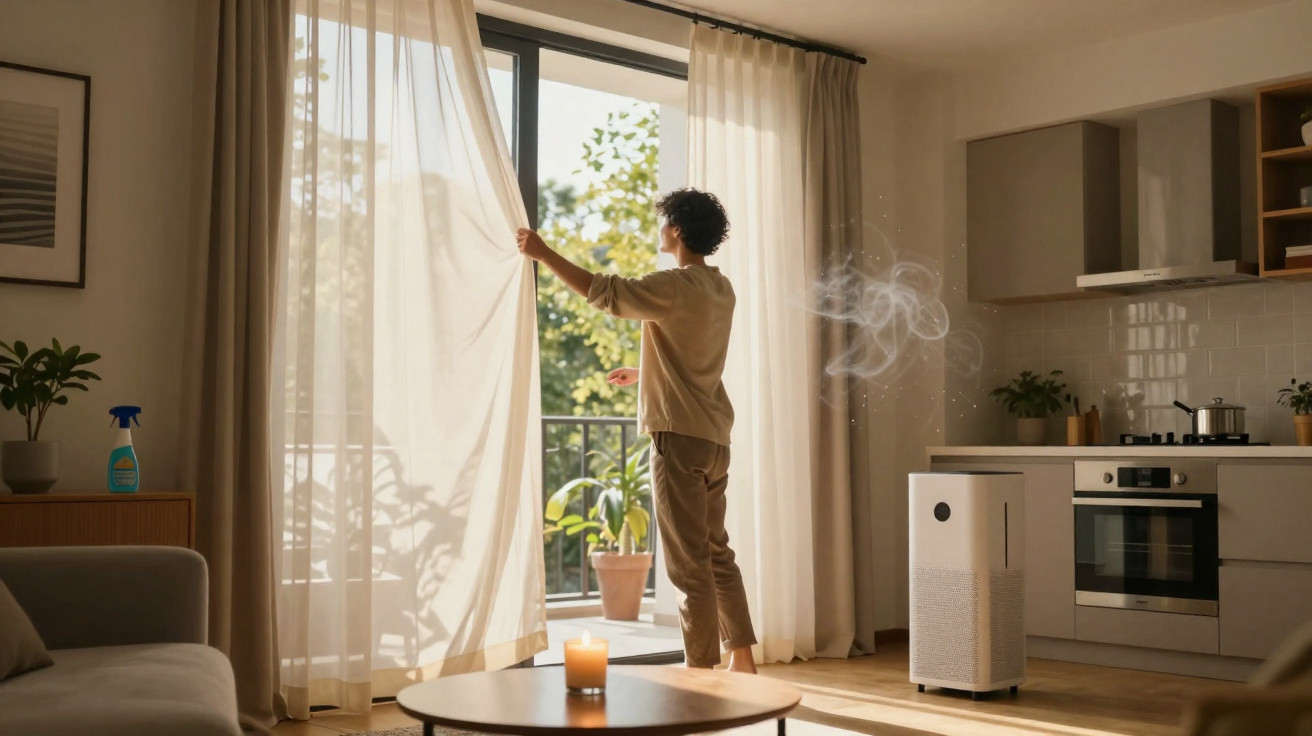
Closed windows, silence outside and a sense of sanctuary.
Meanwhile, the air indoors fills with invisible particles.
The belief that the home is a safe haven from traffic and industrial pollution remains widespread. Yet science has been revealing a different picture: a lit hob, intensive cleaning, a burning scented candle and even a hot shower create a mix of gases and particles that may have a greater impact on health than outdoor air.
The enemy created indoors
International bodies have been raising the alarm. In 2021, indoor air pollution was linked to around 2.9 million premature deaths worldwide, mainly associated with cardiovascular disease, stroke and respiratory problems. This is not a remote risk: it is the air surrounding families every day.
A significant share of this issue lies in countries where cooking still relies on wood, charcoal or agricultural waste. Homes in these places often have limited ventilation, and fine-particle concentrations can reach one hundred times the level regarded as acceptable. Women and children, who spend longer near the cooker or brazier, are consequently exposed for more consecutive hours.
In many homes, smoke from the kitchen itself has a greater effect on health than traffic pollution outside.
However, this is not solely an issue for rural areas or lower-income countries. In cities, including well-finished flats with sound insulation and air conditioning, the risk takes a different form but remains present.
When modern comfort becomes a source of pollution
In developed countries, as well as in major Brazilian urban centres, household pollution is chiefly connected to choices around comfort and lifestyle. Gas heaters, fireplaces, indoor barbecues, poorly ventilated cookers, scented candles and incense release irritating particles and gases whenever they are used.
Studies in European homes show a clear pattern: peaks in ultrafine particles occur precisely when residents are active. This means while bread is being toasted, meat is browning in a frying pan or a scented candle burns beside the sofa. Research cited by scientific societies indicates that domestic activities such as cooking, toasting and candle burning account for about 65% of daily exposure to indoor particles.
Even everyday cleaning and personal-care products add to the problem. Air fresheners, multipurpose cleaners, polishes, hair sprays and perfumes release volatile organic compounds, known as VOCs. In many homes, concentrations of these compounds are between two and five times higher than outdoors, driven by a lack of fresh-air exchange.
What pollutes household air most
- Cooking on a high heat, frying or grilling without an effective extractor hood.
- Burning candles or incense, or using fireplaces and indoor barbecues.
- Using spray cleaning products or heavily fragranced products in enclosed spaces.
- Lighting cigarettes, shisha or heated tobacco devices indoors.
- Keeping windows closed for prolonged periods, especially during these activities.
The stronger the “product smell” in the air, the greater the likelihood that VOCs are circulating through the rooms.
Why we are so exposed without realising it
The main reason is straightforward: time spent indoors. Most people spend a large part of the day in enclosed settings - at home, work, on transport or at school. In many cases, more than 80% of waking hours are spent under a roof. Small, repeated emissions build up into a constant cloud of pollutants.
Another factor is reliance on appearances. Air may look clean, with no visible dust, but that says nothing about microscopic particles and odourless gases. Many of these pollutants do not cause immediate irritation; their effects can instead emerge over the years, through more frequent asthma attacks, worsening rhinitis, tiredness, headaches and increased risk of chronic illness.
How to reduce pollution without giving up comfort
Air-quality specialists point to an approach based on three areas: tackling sources, improving ventilation and using technology to support respiratory health.
Addressing pollution sources
The first step is to eliminate or reduce the biggest emitters. This includes replacing old, smoky appliances with more efficient models that have better extraction. In regions that still use wood or charcoal, switching to mains gas, LPG or electricity, whenever these options are available, immediately lowers particle levels.
Changes in daily habits also make a difference:
- Avoid frequent frying and favour methods such as baking, steaming or using a pressure cooker.
- Switch on the extractor hood whenever the cooker is in use, and leave it running for a few minutes after cooking has finished.
- Cut back on candles and incense, reserving them for occasional use.
- Choose less fragranced cleaning products, preferably liquids rather than sprays.
- Never smoke indoors, even when windows are open.
Ventilation: opening the home at the right time
Inadequate ventilation is the quiet ally of household pollution. When air is not renewed, emissions from a flame, a cleaning product or the new plastic in recently bought furniture continue circulating.
A few measures can help reverse this:
- Open windows on opposite sides of the property to create airflow, especially while cooking and immediately afterwards.
- Ventilate utility areas and bathrooms thoroughly, as chemical products often build up there.
- Avoid sealing the home all the time in the name of saving on air-conditioning, alternating this with periods of natural ventilation.
An open window at the right time cuts more pollution than many expensive air purifiers used incorrectly.
When technology comes into play
New buildings are already being fitted with mechanical ventilation systems and high-efficiency filters. In older houses and flats, portable devices may help, provided they are selected carefully.
| Tool | How it helps | Points to consider |
|---|---|---|
| Extractor hood / fan | Removes smoke and steam directly at the source while food is being prepared. | It needs ducting to the outside and sufficient power for the cooker. |
| Air purifier with a HEPA filter | Captures fine particles in bedrooms and living rooms. | It does not remove gases; filters must be replaced regularly. |
| Air-quality sensor | Identifies particle spikes and encourages ventilation at critical moments. | It does not solve the issue on its own; it serves as a warning. |
Terms worth a quick explanation
Two concepts appear frequently in these studies: fine particles and volatile organic compounds. Understanding the basics helps when interpreting recommendations and news on the subject.
Fine particles, often classified as PM2.5 or ultrafine particles, are tiny pieces of solid matter or liquid droplets suspended in the air. Because they are so small, they can travel deep into the respiratory system, reaching the lung alveoli and, in some cases, the bloodstream. This explains their connection with diseases affecting the heart and blood vessels.
Volatile organic compounds, meanwhile, are carbon-based molecules that evaporate easily. They come from paints, varnishes, solvents, fuels, fragrances, plastics and even new furniture. In enclosed spaces, they may cause irritation, headaches and allergies and, with prolonged exposure, contribute to more serious conditions.
Practical situations inside a typical flat
Imagine a small flat, typical of large cities. In the morning, the resident takes a hot shower and leaves the bathroom closed, with steam and personal-care products in the air. Next, they make breakfast by frying eggs over a high heat without turning on the extractor hood. Later, they clean every room using fragranced cleaner, keeping the windows shut to “stop dust coming in”. In the evening, they light a scented candle in the living room while watching a series.
None of these actions seems extreme. Taken together, though, they create hours of exposure to particles and VOCs at concentrations far higher than those on the pavement outside the building. Small changes - using the extractor fan, opening windows at strategic times, changing some products and reducing candle burning - can significantly alter this situation.
Another common situation involves children and older people, who spend more time at home. Bedrooms with poor ventilation, soft toys collecting dust, excessive use of harsh cleaning products and windows that are nearly always closed because of concerns about noise or safety create a more hostile microenvironment for those with more sensitive lungs.
The home remains a sanctuary, but it can only fulfil that role when the invisible air around us is also included in everyday care.





Comments
No comments yet. Be the first to comment!
Leave a Comment