
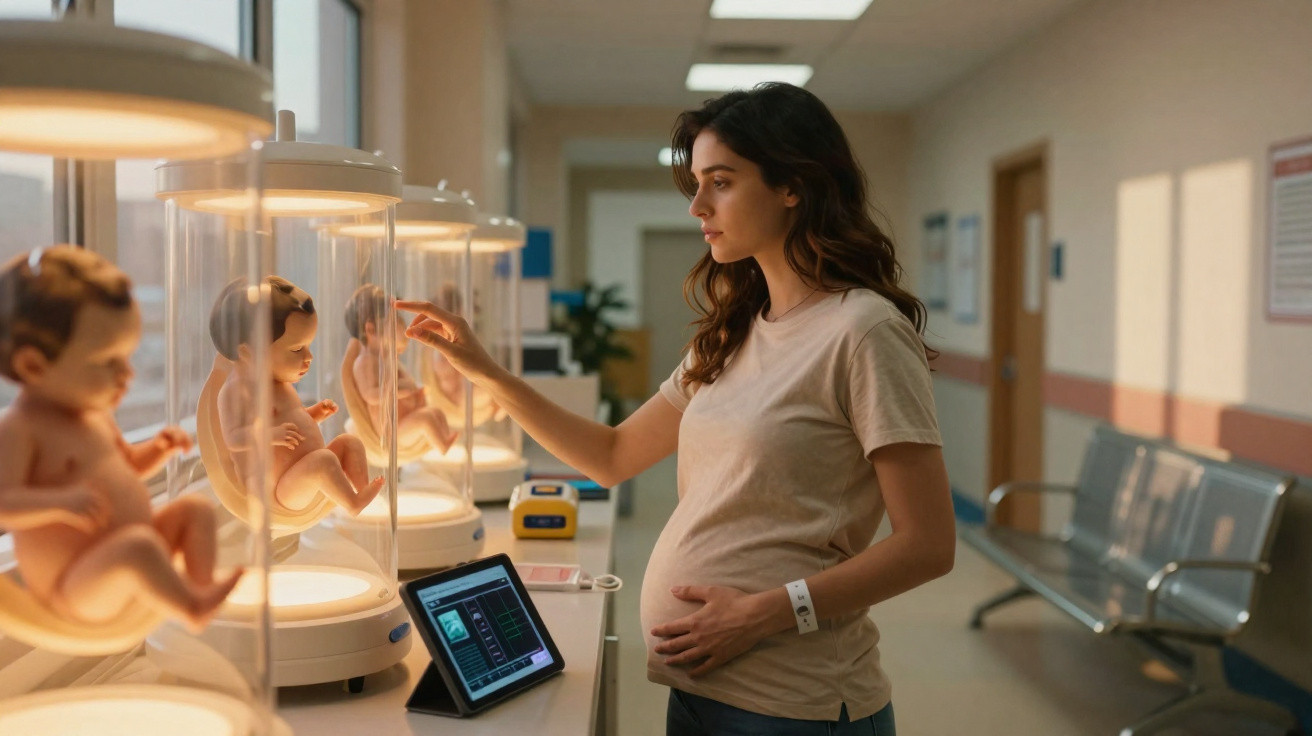
On a grey Tuesday morning in Tokyo, a woman in a navy suit stands before a glass tank. Inside, a pinkish foetus moves lazily beneath flawless artificial light. Nurses pass smoothly around the transparent pod, monitoring sensors, fine-tuning hormones and altering the faint glow designed to mimic dawn. Rain has left her hair damp; the loan she took to get here has done the same to her eyes. She can afford one cycle of high-tech fertilisation. She cannot afford a pod, gene editing or another attempt.
Elsewhere in the room, a Californian couple watches their own pod on a tablet and smiles into a video call. Their future child’s heart rate, oxygen level and estimated IQ potential are all displayed as data.
Two pregnancies. One room. Two entirely different futures.
When birth stops being random and starts being purchased
Walk through a leading fertility clinic today and you can feel the shift. Birth is no longer merely a private, complicated and uncertain experience. It is becoming a service, a subscription, a premium level that some people can obtain - and others cannot.
Behind the white walls and gentle ambient music, an invisible sorting system is already operating. Which genes are retained. Whose eggs are frozen. Who receives another opportunity at 38, 42 or 47. Who does not.
The new frontier of human reproduction is not being decided through protests or in parliaments. It is taking shape quietly, one contract at a time, in small consultation rooms offering payment plans.
The figures sketch out a stark pattern. Global fertility is declining so rapidly that the UN now forecasts that many countries will see their populations halve within a century. Sperm counts have fallen by more than 50% since the 1970s. Urban pollution, endocrine disruptors, delayed parenthood and chronic stress - the whole mixture - are undermining natural conception.
Meanwhile, the fertility industry is expanding rapidly. Pre-implantation genetic testing has shifted from a niche option to standard practice for affluent patients. Start-ups are developing artificial wombs, companies sell “embryo selection for polygenic traits”, and cryobanks promote “elite donor” packages featuring polished photographs and SAT scores.
One part of humanity is quietly becoming infertile. Another is purchasing time, technology and choice.
This is the point at which “genetic privilege” ceases to sound like science fiction and begins to resemble routine administration. Picture two children born in 2040. One is gestated in a laboratory-controlled artificial womb, from screened embryos with genes edited for disease resistance. The other is born in an NHS-style public hospital to parents who have never entered a fertility clinic, in an area where sperm counts are plummeting and endocrine pollutants contaminate the water.
The first child starts life with a risk profile refined like that of a luxury car. The second arrives with whatever chances genetics and the environment have dealt them.
Extend that difference across cities, social classes and countries, and reproduction becomes another dimension of inequality. It is no longer simply about who can secure an education or a mortgage - but who gets to exist in the first place.
Artificial wombs as a lifestyle choice, infertility as background noise
Imagine the first mass-market wave of artificial wombs. They will not be introduced as emergency treatments for vulnerable pregnancies. They will be sold like the newest phone: effortless, secure and aspirational.
At an understated clinic in Singapore or Dubai, a concierge explains that your baby can “skip the risks of pregnancy” and “gain the benefits of controlled gestation”. There is no morning sickness, dangerous labour or leave from work. Every week, a 3D stream of your gestating child is available to share through a private app.
The sales material will not say that the earliest adopters of this technology will be those already privileged enough to create yet another advantage for their children.
The pattern is already visible in elite IVF. In Los Angeles, a couple spends six figures to fertilise a dozen eggs, test every embryo for chromosomal abnormalities, screen for hundreds of genetic diseases and choose one with a marginally better predicted chance of avoiding diabetes and depression. In Lagos or Dhaka, another couple waits in an overcrowded clinic and receives only this advice: “try for another year and come back”.
There is a harsh symmetry to this. Environmental harm, low pay and insecure housing all damage fertility most severely among poorer groups. At the same time, the wealthiest quietly construct a parallel reproductive system that is protected from those pressures. Better food. Cleaner air. Accurate cycle tracking through apps and wearables. Eggs frozen at 28. Private insurance funding IVF at 38. Emerging technology, including artificial wombs, fitting neatly into the same progression.
One world struggles to conceive at all. The other begins refining the children it chooses to bring into the world.
Remove the glossy marketing and the underlying logic is straightforward. If reproduction can be optimised, managed and outsourced, the market will distribute it according to ability to pay. That is what markets do. The womb itself becomes a premium feature.
We are therefore drifting towards an unusual divide. On one side is natural pregnancy, increasingly shaped by pollution, stress and insecure work - alongside greater rates of miscarriage and involuntary childlessness. On the other is technologically mediated birth, with artificial wombs as the ultimate enhancement, enclosing gestation within data, patents and private ownership.
Let’s be honest: few people read the ethics section of glossy clinic contracts. The small print determining whose embryos are stored, discarded, edited or implanted is treated much like a mobile phone plan. Click. Sign. Next. That is how power shifts quietly.
Small acts in a system that wants to forget bodies
What can you do when the future of birth seems to be slipping beyond ordinary people’s control? Major policy debates matter, but they move agonisingly slowly. Everyday life does not.
One practical step is to focus on fertility’s “before”, rather than waiting for the point of crisis. That means discussing sperm health, egg reserve and endocrine disruptors as readily as step counts or sleep. Not to cause alarm, but to build literacy. It means knowing that some plastics release chemicals that interfere with hormones; that vape clouds and laptop heat on laps are not harmless; and that night shifts combined with chronic stress can disrupt cycles.
Compared with artificial wombs, this may sound distinctly unglamorous. Still, basic body literacy is a quiet form of resistance within a system that regards the body as obsolete hardware awaiting replacement.
There is also a gentler response: reject the shame surrounding infertility. We have all experienced the moment when someone casually asks, “So, when are you having kids?” over dinner, while you are barely managing to hold yourself together. The unstated belief is that fertility represents a personal failure or moral decision, rather than a sign of wider environmental and economic harm.
Speaking openly - even when it is uncomfortable - about failed embryos, low sperm counts, endometriosis or miscarriages transforms private grief into a shared social reality. Suddenly, “infertility for the poor” is not an abstract term. It is your friend working three jobs without insurance. Your cousin who discovered too late that her ovarian reserve had disappeared. Your colleague discreetly injecting hormones in the office toilet.
The more commonplace such stories become, the more difficult it is for policymakers and technology companies to claim that fertility is merely a lifestyle choice that can be “fixed” through a product designed for the top 10%.
A reproductive rights advocate I interviewed in São Paulo put it bluntly: “If we let birth become a luxury experience for the few and a biological gamble for the rest, we’re not heading into a high-tech future. We’re walking backward into a caste system with better branding.”
- Ask what’s being optimised
When you encounter news about artificial wombs or “genetically healthier embryos”, stop and ask: optimised for whom, and according to whose values? - Track where the money goes
Private investment pouring into elite fertility technology while public hospitals reduce maternity services is no accident. It reveals a hierarchy of priorities. - Defend messy, embodied pregnancy
Even if you would never choose to have children, protecting the right to carry a pregnancy safely and without pressure to “upgrade” to a pod belongs to the same struggle. - Support boring, local wins
Clean-water legislation, air-quality standards and secure housing are not separate from reproduction. They are the true foundation for who gets to be born healthy. - Watch the language
When the media casually labels some babies “low risk” or “genetically advantaged”, it is not simply describing them. It is the soft launch of a hierarchy.
A future where birth is both code and blood
Take a step back and the scene becomes almost surreal. In one part of the world, scientists are growing mouse foetuses in rotating artificial wombs, testing how far laboratory-based gestation can be pushed. Elsewhere, midwives in underfunded clinics reuse equipment and turn patients away because there are too few beds. These are both chapters of the same story.
We are moving into an age in which being born will be influenced as much by code, data and corporate strategy as by bodies, blood and chance. That does not inevitably mean dystopia. Artificial wombs might save extremely premature babies. Genetic tools could eliminate diseases that have troubled families for generations. The issue is not whether the technology exists, but who directs it, who finances it and who has a place at the table.
In a world of declining fertility and expanding reproductive technology, the quiet struggle concerns something fundamental and untamed: whether the right to be born remains a shared human baseline or becomes yet another product line in a premium catalogue.
| Key point | Detail | Value for the reader |
|---|---|---|
| Genetic privilege is emerging | Wealthy parents already use embryo selection and may soon use artificial wombs to optimise offspring | Helps readers understand how class divisions are being inscribed into biology itself |
| Fertility is collapsing unevenly | Pollution, stress and insecure work affect poorer populations most severely, driving hidden infertility | Reframes infertility as a social and environmental issue rather than a private failure |
| Everyday choices still matter | Body literacy, reducing infertility stigma and supporting public-health protections help counter high-tech inequality | Gives readers realistic ways to exert influence in a system that can feel too vast to affect |
FAQ:
- Question 1 Are artificial wombs already being used on humans?
- Answer 1 Not yet. Current artificial womb experiments are confined to animals and extremely premature lamb or mouse foetuses in tightly controlled laboratory conditions. Human use would demand major medical trials, new laws and intense ethical debate, but research is clearly moving in that direction.
- Question 2 What do people mean by “designer babies” in real life?
- Answer 2 At present, “designer” generally means choosing embryos without certain diseases or with preferred characteristics through genetic screening before implantation. Full-scale editing for intelligence or beauty remains far from reality, but selecting between embryos using complex risk scores is already occurring among wealthy patients.
- Question 3 Is fertility really collapsing, or is this media panic?
- Answer 3 There is genuine evidence behind the concern. Sperm counts have declined sharply across many regions, the age at first pregnancy continues to rise and some countries have birth rates far below replacement level. At the same time, many people who want children struggle to conceive, particularly in polluted and economically stressed settings.
- Question 4 Will this only affect rich countries?
- Answer 4 No. The technology will probably debut in wealthy countries and enclaves, but environmental harm and economic stress cross national borders. Poorer communities in both the Global North and South may experience rising involuntary childlessness while elites everywhere gain access to advanced reproductive tools.
- Question 5 Is there anything ordinary people can do about these trends?
- Answer 5 Individually, learning about reproductive health early, limiting exposure to obvious hormone disruptors and discussing infertility openly can all help. Socially, supporting policies that protect air, water, workers’ rights and public healthcare does more to support fair, healthy births than any futuristic gadget.






Comments
No comments yet. Be the first to comment!
Leave a Comment