
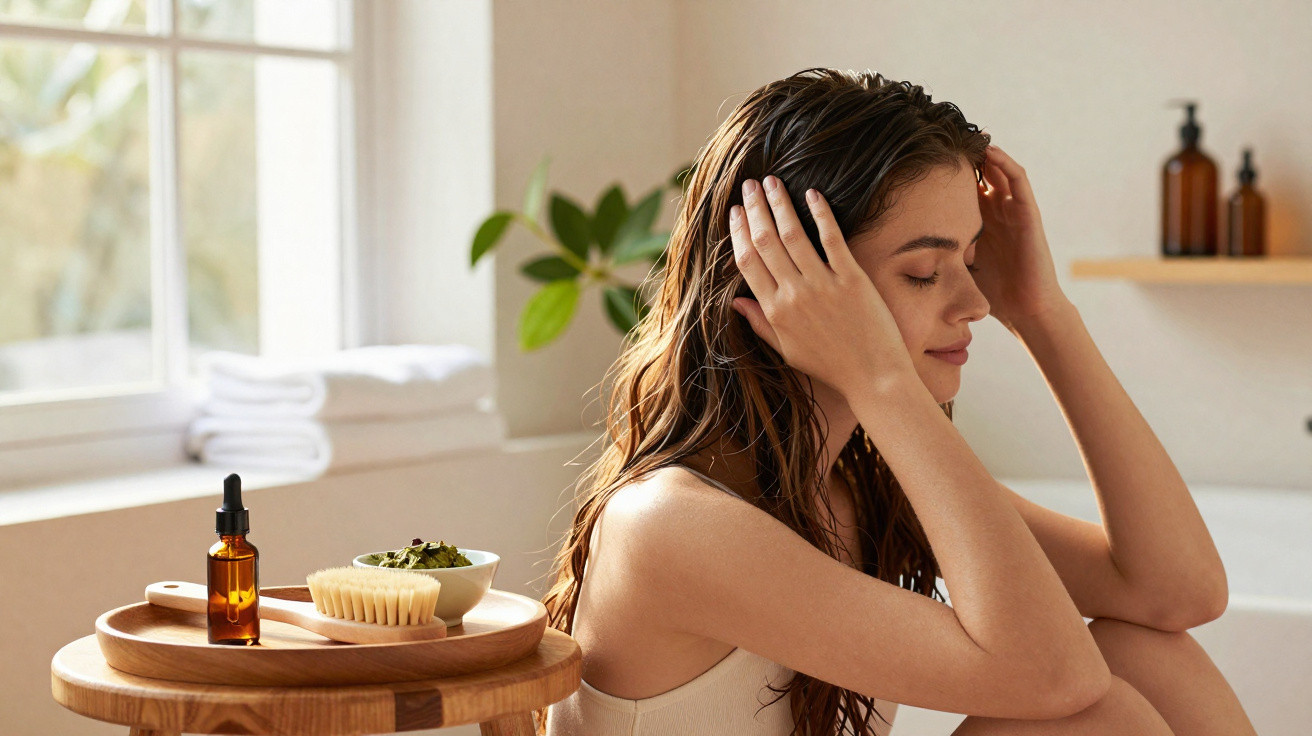
Sunday evening. Your hair is twisted into a weary bun that has somehow survived since… Thursday, if we are honest. You glance at yourself in the bathroom mirror and see that your roots are limp and oddly smothered, despite washing your hair two days earlier. Running your fingertips over your scalp, you can feel product buildup: a fine layer that should not be there. It is hardly surprising your hair looks worn out.
The water starts running, steam fills the room, and an idea suddenly makes sense: what if you gave your scalp the same luxurious care as your face? A proper detox, at home. No expensive salon basin or forced small talk. Just you, your roots and a small promise to yourself.
Tonight, your bathroom is your scalp spa.
Why your scalp is quietly suffocating
The skin beneath your hair sits only a few millimetres away from your forehead. It sweats, becomes oily, gets clogged, flakes, and responds to stress and pollution. Yet, because you rarely look at it, it is easy to forget it is there until you experience itching, hair loss, or that dull, greasy, flattened appearance that can show up on the very day you wash it.
We have all had that realisation: your lengths look perfectly fine, but your roots feel weighed down and miserable. Usually, that is not a “bad hair” issue. It is your scalp discreetly asking for a reset.
Imagine this: you faithfully spend money on serums, collagen and costly shampoos “for volume”. You experiment with rice water, biotin gummies and heatless curls. Still, the hair at your crown appears finer than it did last year, while your ponytail feels less full in your hand. Late at night, you find yourself scrolling with equal parts panic and resignation, searching for “sudden hair thinning”, while your scalp remains… ignored.
Then you see a stylist on TikTok carefully scraping a client’s scalp with a small tool, as the camera closes in on minute white flakes of buildup. The comments say things such as “I didn’t know my scalp could look like that” and “So THAT’S why my roots are flat.” Suddenly, it makes sense.
This is what happens: every day, sebum, sweat, pollution particles, dry shampoo, styling products and dead skin cells gather around the hair follicles. Your scalp attempts to correct the imbalance, often by making even more oil. Follicles may become partly blocked, meaning hair has to grow through a sticky sort of tunnel rather than a clean, open route. In time, this can contribute to finer, weaker strands.
A regular scalp spa at home will not magically alter your genetics, but it can help restore circulation, oxygen and balance, giving every hair a cleaner and healthier setting in which to grow. Think reduced congestion and more room to breathe. Literally.
How to create a scalp spa ritual at home
First, set aside an hour when you do not need to hurry. This is not a rushed pre-shampoo scrub five minutes before a Zoom call. Treat it as a small evening of self-care.
On dry hair, reach for a mild scalp scrub, or make one yourself by mixing a spoonful of fine sugar or salt with a dollop of lightweight conditioner or aloe gel. Loosely part your hair with your fingers and place the mixture directly on your roots. With the pads of your fingers, use small circular movements from your front hairline down to the nape of your neck. Take your time. Apply enough pressure to create movement, never pain.
Stay at this stage for 5–10 minutes. Once your hands begin to feel tired, you are halfway through.
Your next stage is to detox and calm the scalp. Wash away the scrub using lukewarm, rather than very hot, water. Next, work a clarifying shampoo into the scalp only, massaging again to remove residue. Concentrate on the roots and allow the lather to travel over the lengths, instead of roughly scrubbing them. Rinse well, then end with cooler water for a gentle toning effect on the blood vessels.
Once you have washed it, pat your hair dry gently with a towel and apply a water-based scalp tonic or serum to towel-damp roots. Add a few drops to each section, then massage them in with your fingertips or a silicone scalp brush, paying particular attention to the temples and crown. Many people first spot thinning in these areas, so show them extra care.
The temptation is to overdo everything and end up irritating your scalp. That means scrubbing too often, using rough salt, layering on peppermint oils or adding random kitchen ingredients to your shampoo. Your scalp is skin, not a laboratory.
Keep the frequency gentle. If you regularly use dry shampoo and styling products, once a week is more than enough for a thorough detox. Every fortnight may be sufficient for finer hair or sensitive scalps. Honestly, nobody truly does this every day. Doing it less often can make it feel like a meaningful ritual, rather than one more task on an endless to-do list.
The aim is not for your scalp to feel squeaky or tight, but for that fresh feeling of “my roots can breathe again”.
“Once I started treating my scalp like my face, everything changed,” says Marie, 32, who struggled with flat, greasy roots and random shedding. “I stopped expecting miracles from shampoos and focused on circulation and detox instead. Three months later, my baby hairs along the hairline were wild.”
- Use lukewarm water – Extremely hot water may irritate the scalp and increase oil production.
- Choose gentle tools – Use only soft silicone scalp brushes or your fingertips, never your nails.
- Limit heavy oils on roots – Castor and coconut oils can work well, but use very small amounts and rinse them out thoroughly.
- Keep scrubs occasional – At most, once a week for most people; once a month for sensitive scalps.
- Watch your styling habits – Tight buns, helmets, caps and aggressive brushing can also influence scalp comfort and circulation.
Living with your scalp, not against it
When you begin to pay attention to your scalp, small patterns become noticeable. You may find it itches more when you are stressed. Your roots might become greasy faster after several nights of poor sleep. Your parting can look wider when you have relied too heavily on dry shampoo and postponed wash day “just one more time”.
Building a scalp spa ritual at home is not about pursuing flawless, advert-worthy hair. It is about forming a relationship with the part of your body that quietly produces one of your most noticeable features. A clean scalp with good circulation can make hair appear thicker and more buoyant, yes. It also creates a chance to slow down and quite literally hold your own head in your hands.
You may begin for volume or regrowth. You may continue because of the unexpected calm that comes with a slow, rhythmic massage beneath warm water. Perhaps the next time you see your reflection with your hair swept into a casual bun, you will spot a difference: your roots will not seem tired. They will look alive.
| Key point | Detail | Value for the reader |
|---|---|---|
| Scalp detox clears buildup | Removes product residue, excess sebum and dead cells around follicles | Creates a healthier environment for thicker, stronger hair growth |
| Massage boosts circulation | Gentle, regular massage with fingertips or a soft brush | Supports nutrient delivery to follicles and enhances hair density over time |
| Consistent ritual, not extremes | Weekly or biweekly scalp spa with mild products | Realistic routine that’s easy to sustain and actually delivers results |
FAQ:
- How often should I do a scalp spa at home? Most people do well with once a week if they use styling products and dry shampoo, or every two weeks for sensitive or very dry scalps. Listen to your own roots: if they feel tight, itchy or overloaded, that’s your sign.
- Can a scalp detox really help with hair loss? It can support healthier growth by clearing buildup and improving circulation, especially if your scalp is congested. It won’t fix hormonal or genetic hair loss alone, but it often makes existing hair look fuller and can reduce shedding linked to irritation.
- What’s the best product for a scalp spa at home? Look for a gentle scalp scrub or exfoliating shampoo without harsh sulfates, plus a lightweight tonic or serum with soothing ingredients like niacinamide, panthenol or tea tree in low doses. The technique matters more than the price tag.
- Is oiling the scalp good or bad? Light oiling can be helpful for dry or flaky scalps when done with small amounts and properly washed out. Heavy oils left on for days can clog follicles and attract buildup, so go easy and keep it as a short pre-shampoo step.
- How long before I see thicker hair from scalp care? Some people feel fresher roots immediately and notice better volume after a few washes. For visible changes in thickness or baby hairs, think in terms of 8–12 weeks. Hair grows slowly, but the small choices you repeat quietly add up.





Comments
No comments yet. Be the first to comment!
Leave a Comment