
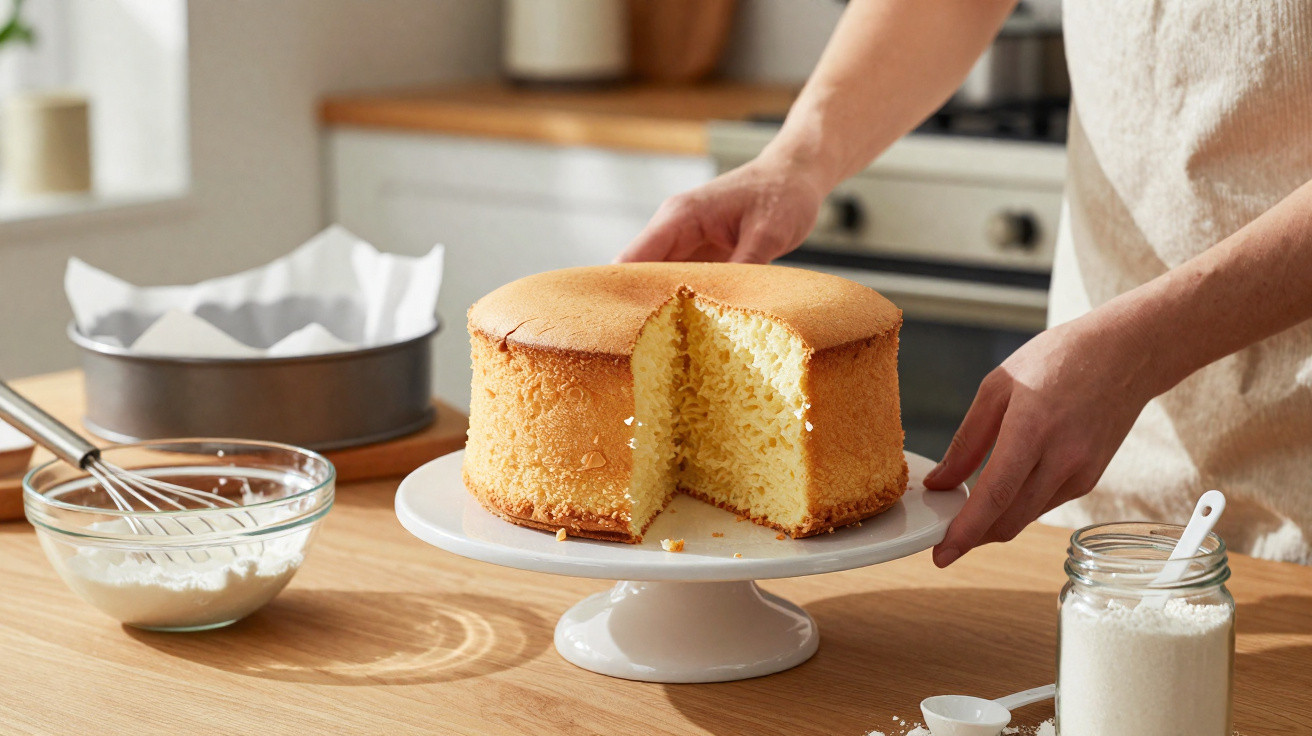
The unassuming genoise - that feather-light European sponge - is proof. Its secret is simple: eggs provide the rise, while clever starches create the framework. If you have ever cut into a gluten-free cake layer only for it to crumble, you will know that sharp disappointment. Consider this the answer: a soft crumb, a resilient texture and tidy slices that stay intact. There is no odd finish and no obscure flour blend to hunt down. All you need is a bowl, a whisk and a careful touch. It is the sort of recipe you tape inside a kitchen cupboard - the reliable one for when guests are on their way. Ready for a genoise that truly floats?
The kitchen was barely awake as I broke the first egg into a glass bowl. Steam rose from a pan of water at a gentle simmer while the sugar settled like snowfall. Whisk, whisk, whisk. As the mixture heated, its sound shifted: sluggish first, then energetic, then airy. When I raised the whisk, a ribbon dropped back into the bowl and rested briefly on top before disappearing. The batter looked as though it were breathing. I sifted in the flour and folded it through as gently as if tucking in a child, then waited anxiously. The timer flashed. When I opened the oven, the cake had risen above the edge of the tin. The batter had simply… floated.
The subtle secret of gluten-free genoise
Genoise can feel intimidating precisely because it is so straightforward. There is nothing to disguise a mistake. Its height comes neither from baking powder nor from gluten development. The lift comes from air, not gluten. Eggs are the driving force: warm them, whip them into a shiny foam, then handle that foam with the utmost care. Rather than attempting to copy wheat, the gluten-free approach is to support the egg structure with fine starches that remain light. When the proportions are right, you get a tender crumb, a clean bite and slices that resemble clouds filled with tiny, even bubbles. It is unexpectedly gratifying.
I once made two sponges for a friend's birthday - one traditional and one gluten-free. Everyone served themselves, chatted away and lost track of which cake was which. The gluten-free sponge went first. The warmed, whipped eggs had expanded to four times their original volume, and the batter had a satin-like sheen. I used equal parts white rice flour and potato starch, sifted them three times, then incorporated them with a large spatula. No gum and no complication. Vanilla simple syrup kept the cake beautifully soft. Someone asked whether I had added almond flour; I had not. It was merely air, carefully supported by the right starches. That is the entire secret.
Put simply, wheat gluten works as a net that captures gas, whereas eggs achieve it through foam. You therefore replace that gluten “net” with exceptionally fine, low-protein starches that will not disrupt the foam. Rice flour gives a refined, delicate crumb, while potato or corn starch provides extra rise and a pleasingly clean finish. Sugar reinforces the foam, heat relaxes the proteins so they whip to a greater volume, and a small trickle of melted butter contributes flavour without flattening the mixture. You are creating a structure of bubbles and film rather than elastic strands. Keep it warm, be gentle, and the structure remains sound. That is all there is to it.
Gluten-free genoise recipe, method and practical tips
For one 20 cm round cake, tall enough to split, you will need: 4 large eggs (200 g without shells), 120 g sugar, 60 g fine white rice flour, 60 g potato starch (or 50 g cornflour plus 10 g potato starch), a pinch of salt, 1 tsp vanilla, 20 g unsalted butter, melted and cooled (optional), and simple syrup made from 100 g water and 100 g sugar. Warm the eggs and sugar over a gentle bain-marie to about 40–43°C, whisking throughout. Move the mixture to a stand mixer and whisk for 6–8 minutes, until pale, thick and tripled in volume. The ribbon should sit on itself for 3 seconds. Sift the flours three times. Fold them in, a third at a time, using a wide spatula. Pour the butter down the inside of the bowl, fold twice more, then bake at 170°C for 25–28 minutes.
Most of us have experienced a sponge collapsing and wondered where it went wrong. In most cases, the cause is one of three things: the batter was too cool, the folding was too forceful, or the flour was too heavy. Warm foam is pliable, allowing it to stretch rather than burst. Work with a metal spoon or large spatula: cut through the centre, sweep along the base, rotate the bowl by a quarter turn, then repeat. If possible, weigh the eggs and sugar for reliable results. Admittedly, that is not something anyone does every day. For important occasions, though, the scales are worthwhile. If your kitchen is cold, warm the bowl first with hot water and dry it thoroughly afterwards.
Some bakers use a small amount (1/4 tsp) of xanthan gum as reassurance, but I seldom find it necessary with an equal rice flour-to-starch mix. Whip warmer than you think, fold gentler than you dare. Let that be your rule. For a dairy-free version, leave out the butter; the cake will still be wonderfully light. Position it on the middle shelf and avoid opening the oven during the first 20 minutes. Once the layers are cool, brush them with vanilla syrup to deepen the flavour and soften the crumbs. If you intend to build a cake with cream, refrigerate the sponge overnight; it cuts more neatly and holds steady beneath the knife.
“Treat the batter like it’s full of tiny balloons. Your job is not to pop them.” - a pastry chef who hated wasted foam
- A reliable ratio: 60 g rice flour + 60 g potato starch for one 20 cm cake.
- The ideal whip: the ribbon remains visible for 3–5 seconds and the mixture is at body temperature.
- Folding technique: cut, scoop, turn; stop as soon as the streaks have nearly disappeared.
- Flavour options: lemon zest in the syrup, coffee syrup for tiramisu-style flavour, or orange blossom for a lighter spring cake.
Serve, share and personalise your gluten-free genoise
A genoise is an open canvas. Brush it with espresso syrup and layer it with mascarpone for a tiramisu-inspired cake. For a summery version, choose strawberries, lightly whipped cream and a squeeze of lemon. Chocolate lovers can sift 20 g cocoa into the flour mixture and remove 20 g starch to maintain the balance. Alternatively, leave it plain, divide it into two layers and allow a quality jam to do the work. Good cake is a conversation starter. Once the crumbs appear, people begin sharing stories: their grandmother's baking rituals, a cake they miss or a treat they once thought unavailable to them. That is the understated magic of this recipe - a gluten-free genoise that does not draw attention to itself but opens up the table to everyone.
| Key point | Detail | Benefit for the reader |
|---|---|---|
| Warm-whipped eggs | Heat to 40–43°C for maximum foam stability | Greater rise without chemical raising agents |
| Gluten-free blend | 50% fine rice flour + 50% potato/corn starch | A light crumb that cuts cleanly |
| Gentle folding | Cut, scoop, turn; stop at the first sign of an even mixture | Avoids deflation and dense areas |
FAQ:
- Can I make it dairy-free? Yes. Omit the melted butter and use a neutral oil spray for the tin. The sponge remains airy and tender.
- Do I need xanthan gum? No. The egg foam supplies the structure. If your flour blend is coarse or you are making a very tall stacked cake, 1/4 tsp xanthan can improve stability.
- Why did my genoise deflate? It is usually caused by over-folding, cool foam or underbaking. Work at the warm ribbon stage, use fewer folds and bake until the centre springs back.
- Can I bake it ahead and freeze? Yes. Cool it completely, wrap it tightly and freeze for up to one month. Defrost it, still wrapped, in the fridge overnight to retain moisture.
- How do I add cocoa or nuts? For chocolate, replace 20 g starch with 20 g cocoa. For nut flour, exchange up to 20 g rice flour for ground almonds and add 1/8 tsp xanthan.




Comments
No comments yet. Be the first to comment!
Leave a Comment