
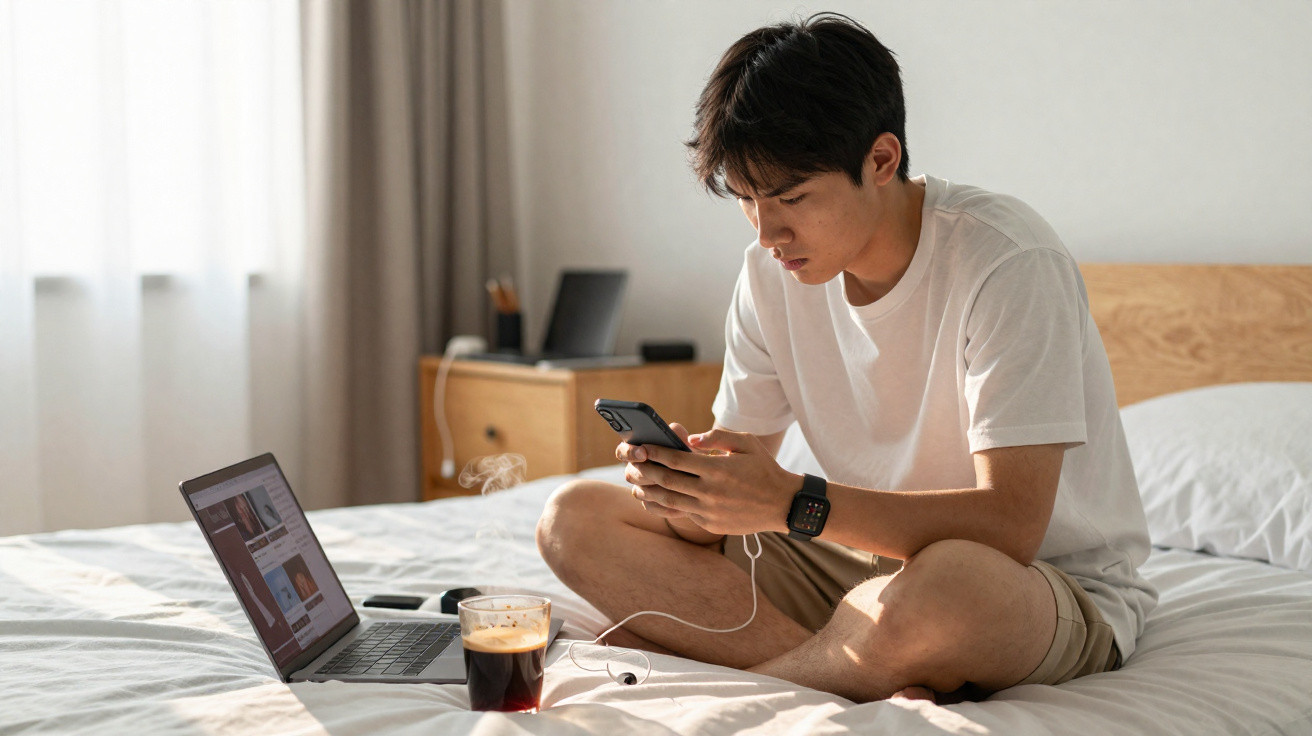
The kettle is on, the toaster springs up, and before you have even taken your first mouthful of coffee, your thumb is already reaching for your phone.
Notifications flash like miniature warning lights, pulling your focus from the space you are actually occupying. You scroll, skim, tap twice, half-read an email you will forget within ten minutes, then open the news “just to check”. At 7:13am, your heart rate is slightly higher than it ought to be, although you scarcely register it. You tell yourself you are “catching up”. Your nervous system has a very different name for it. The oddest thing is that this everyday impulse does not seem risky at all. It seems… ordinary. Familiar. Innocent. But the low buzz beneath your skin suggests otherwise.
The small ritual quietly putting you on edge
Most people begin the morning with a screen rather than a stretch. It is one automatic sequence: reach, unlock, scroll. It happens so quickly that the brain hardly recognises it has made a decision. Your body is only just coming round and your breathing is still measured, yet your mind is immediately dropped into headlines, opinions and vaguely urgent messages. The calm interval between sleeping and waking, when your nervous system ought to recalibrate, becomes instantly overcrowded. What appears to be a harmless habit of getting updates is, in reality, a steady stream of tiny stresses. One tap after another.
Imagine a person on a commuter train at 8:02am, looking down at their phone. They open their inbox “just to see”. The red badges are already there: 37 unread emails, with three labelled “high priority”. There is a Slack message from a manager in another time zone. Then comes a news alert about something terrible and distant that they are unable to influence. Ten minutes on, they are not simply heading to work; mentally, they are putting out fires. Nothing genuinely urgent has happened. Nevertheless, the body reacts as though it has. Their shoulders tighten, their jaw sets and their stomach performs that uncomfortable twist.
This is straightforward biology in modern-day clothing. Whenever you look for something that could cause stress - emails, news or social notifications - you activate the brain’s threat-detection system. It is rather like repeatedly pressing your own internal doorbell. The brain begins to associate mornings with danger, inboxes with danger and silence with danger. Anxiety is not merely something that arises; it is something practised. The daily act of “just checking” becomes an ongoing, low-level search for threats. And anxiety thrives when the brain is continually on watch.
Why your brain keeps reaching for what makes it anxious
The particularly harsh part is that looking at your phone does more than generate anxiety. For a brief moment, it can also ease it. You experience a flicker of discomfort, refresh your notifications, and receive a split-second reward: something new, a like, a message, the feeling of “being on top of things”. That small moment of relief is what makes the pattern compelling. The behaviour then repeats. You feel a little bored, unsettled or lonely, and your hand reaches for your pocket. This is not “bad discipline”. It is a loop.
At first glance, it may seem insignificant. Only a few seconds at a time. Yet anxiety is rarely a dramatic explosion; more often, it is a persistent drip. Consider an office worker who opens their work email 40 times a day “just in case”. They hardly ever discover anything that is truly urgent. Even so, their shoulders seem permanently raised towards their ears. When their phone vibrates, their heart gives strange little jolts. They wake at 3am worrying about an email that has not even been sent. Nobody around them would necessarily describe their situation as a major problem. But if you asked how relaxed they felt on an average Tuesday, their reply would be quietly devastating.
There is a clear logic to it. Each act of “just checking” is a small gamble with your peace of mind. Your brain begins to anticipate stress before it arrives, because that is the lesson you have repeatedly given it. The nervous system is never allowed to switch off completely. Rather than moving through periods of activation and rest, you are left with permanently unsettled waters. Physically, that can mean increased cortisol, tighter muscles and shallower breathing. Mentally, it means your usual level of calm gradually falls. You think you’re just staying informed. Your body thinks you’re bracing for impact all day long.
How to gently interrupt the anxiety reflex without disappearing offline
The answer is not a digital-detox fantasy in which you put your phone in a drawer and relocate to the countryside. Let us be honest: nobody really does that every day. A much more achievable step is changing when and how you allow your brain to meet the flood of information. One effective adjustment is postponing your first “anxiety check” of the day. In practice, that means avoiding email, news and social feeds for the first 20–30 minutes after you wake up. You can still use your phone for an alarm or music if necessary. You simply do not stimulate your threat system straight away. It may sound minor, but it gives your brain a gentler landing each morning.
Another useful change is to make “checking” something scheduled rather than instinctive. Choose two or three brief periods to look at emails or the news deliberately, instead of making a hundred random micro-checks throughout the day. This gives your nervous system predictable periods of activation rather than unending shocks. Before each check, add one small grounding practice - three deep breaths, a stretch or noticing your feet against the floor. You will still receive the information, but it will not catch you unprepared. If a hectic week causes the whole plan to fall apart, that is not failure; it is information. Make an adjustment and begin again.
“Anxiety thrives in the gap between what we feel and what we notice. Once you notice the habit, you’re already changing it.”
A few familiar pitfalls are worth stating openly, because they are deeply human. One is the “doom-scroll after one bad message” cycle. You spot a mildly stressful email and, minutes later, find yourself immersed in worst-case news stories, almost as though your brain is attempting to make your feed reflect your mood. Another is the bedtime habit: one final look that becomes forty-five minutes of alert, restless scrolling. After a difficult day, that urge can feel almost impossible to resist. At a human level, it is generally a search for reassurance, distraction or the sense that you are not being left out.
- Create one or two “no-check zones” each day: the first 20 minutes after waking and the final 30 minutes before bed.
- Move high-stress apps, such as news and email, away from your home screen so they are one swipe further away.
- Pay attention to your body’s cues when you reach for your phone: a tight chest, shallow breathing or a tense jaw.
- Replace one daily reflex-check with a neutral action: have a drink of water, stretch or look out of the window.
Giving your nervous system room to breathe again
Once you begin to recognise this everyday reflex, it is difficult to ignore it again. You will notice yourself in the lift, in a queue or at the traffic lights, opening the same three apps without truly wanting to. That is not something to feel guilty about; it shows that you are becoming aware within your own routine. From that point, small experiments are available to you. You miss one check. You change a notification setting. You leave your phone in a different room for ten minutes. Nothing dramatic occurs, except this: your thoughts become fractionally quieter. Your shoulders lower by a centimetre.
People who make gentle changes to this one behaviour often come to a disquieting realisation. They were not “naturally anxious” in the way they had assumed. They had been living under a continual review of everything that could be wrong, urgent or disappointing. That was what the endless checking amounted to: an ongoing, self-appointed risk report. Once they make even small spaces of time without their phone, they start to experience a different baseline. Not bliss or permanent zen, but slightly more distance between a thought and their response. In that space, anxiety no longer controls the entire show.
This daily reflex will not disappear in a night. It may have taken years to form. But every time you pause before checking, and every time you choose “not right now”, you offer your nervous system a new message: the world can wait for a moment, and you can remain safe. Some mornings will be rushed and chaotic, while some nights will still finish with scrolling in the dark. That is all right. Within that very human imperfection, one quiet question is worth holding on to: if this small reflex can heighten my anxiety without my realising, what else could shift if I finally begin to notice it?
| Key point | Detail | Why it matters to the reader |
|---|---|---|
| Morning “just checking” | Looking at emails, news or social media as soon as you wake activates the brain’s threat system | Helps explain why the day can begin with tension already present |
| The anxiety–relief cycle | Checking your phone causes stress while also delivering an addictive micro-relief | Names a pattern that keeps anxiety going in everyday life |
| Realistic micro-changes | Delaying the first connection, creating “no-check zones” and setting specific checking periods | Offers practical actions that can be used immediately without abandoning digital life |
FAQ:
- How can I tell whether my checking habit is actually increasing my anxiety? You might spot subtle clues: feeling tense after using your phone, struggling to relax when it is not nearby, or reacting sharply to every notification. If your mood regularly drops after “catching up” online, the habit is likely contributing to your anxiety.
- Do I have to stop using social media altogether to feel better? Not necessarily. Many people experience relief simply by changing the timing and frequency: checking less often, using it more intentionally and taking breaks after waking and before sleeping. Completely giving it up is not the only way towards calmer days.
- What if my work genuinely means I need to be contactable early? In that situation, try a small buffer. Even five phone-free minutes after waking, together with clear times to check in, can reduce the constant feeling of urgency without affecting how responsive you are.
- How soon might I notice a change in my anxiety levels? Some people notice a difference within days, while others need a couple of weeks. Consistency matters more than perfection. Small choices, repeated often, gradually and quietly retrain your nervous system.
- Is this only about phones, or does it apply to other habits as well? The same principle applies to any habit that persistently “checks for threat” - work chats, news websites and even step counters. The question to continue asking is: does this habit usually leave me feeling more settled or more on edge?





Comments
No comments yet. Be the first to comment!
Leave a Comment