
The steak had rested on the kitchen worktop for an hour, leaving a dark red ring of moisture on the chopping board. A faint trace of last night’s garlic dinner lingered in the house, while the late-afternoon sun cast a bar of light across the floor tiles. You could practically imagine the sound of it hitting the pan, picture the ideal crust and taste the rosy middle. It was an everyday scene, almost film-like in its simplicity: meat on the counter, a glass of wine close by, quiet music playing.
In that moment, nobody is thinking about bacteria multiplying unseen.
Why thawing at room temperature seems “normal” – and why it carries a hidden risk
Many home kitchens are still shaped by habits passed down through generations. Meat is taken from the freezer, put on the worktop and left there for hours while everything else carries on: children’s homework, pressing emails, a quick look at your phone. When you eventually remember it, the meat has softened, become flexible and is ready to cook.
It seems convenient. It appears to save time. It can feel like the way “everyone does it”.
On a hectic weekday evening, that shortcut can seem completely harmless. You are hungry, the day has been exhausting, and a frozen packet of chicken thighs appears to defrost far more quickly on the counter than it would in the fridge. You unwrap it, put it on a plate and leave it there “only for a little while”. Three hours later, the chicken is fully thawed and glistening, yet the invisible issue that came with it cannot be seen.
The kitchen may still look spotless. The risk is not.
While meat sits at room temperature, this is what is happening. Once its surface rises above 5°C, it enters the well-known “danger zone”, roughly between 5°C and 60°C, where bacteria flourish. Pathogens such as Salmonella and Campylobacter need no invitation: on a damp, protein-rich surface, they can double and double again every 20–30 minutes. The middle of the meat might remain frozen, but its outer layer has essentially become a warm incubator.
Cooking does destroy many germs, but it does not necessarily eliminate every toxin they may have produced.
The fridge-thaw method that protects your kitchen
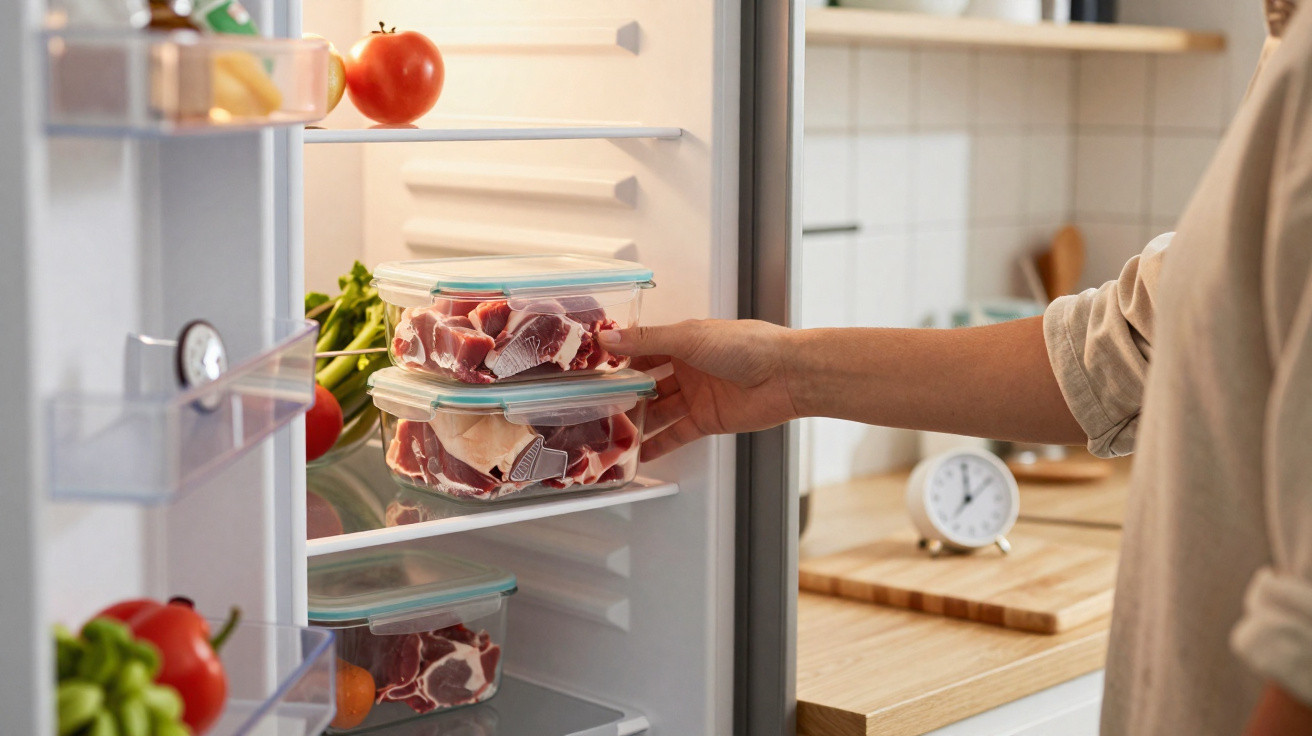
Defrosting meat in the refrigerator may sound exceptionally dull, which is precisely why it is effective. Move the frozen packet from the freezer into the fridge, set it in a shallow dish or on a tray to collect any drips, then leave it for several hours or overnight. The chilled air keeps the whole cut below the danger zone, preventing bacteria from getting a chance to multiply.
It is deliberately slow: a safety net arranged in advance.
Once it becomes familiar, fridge-thawing can turn into a modest routine that reshapes the way you cook. Plan your meat one or two meals ahead, transfer it to the fridge the previous evening and allow time to do the unobtrusive work. On a Sunday, you could set aside several packs for the coming week: chicken for Monday and beef mince for Tuesday. Then, on Wednesday morning, you can take out a safely defrosted steak that is ready to sear, without any last-minute stress.
Let’s be honest: nobody really manages this every single day.
However, when you do, dinner can feel easier, calmer and safer.
There is another important part of the thawing story: cross-contamination. Meat left sweating on a warm worktop can release juices onto wooden boards, cloths and utensils, depositing bacteria behind. When it is thawed in the fridge, the meat remains contained in one cold area, inside a dish that captures those juices. This means fewer contaminated surfaces and fewer unseen risks on handles, tea towels and children’s fingers.
The science is straightforward, but its effect can be quietly significant.
Everyday ways to make safe thawing manageable
The simplest way to maintain fridge-thawing is to link it with a task you already do. Look in the freezer when you set up the coffee machine, pack a school bag or brush your teeth before bed. Take out the following day’s meat, place it in a bowl or container on the bottom shelf of the fridge, and leave it there.
While you sleep, let the cold air and the passing hours do the “work”.
It is also helpful to divide large packs before freezing them. Split bulk purchases into meal-sized portions in freezer bags or containers. Smaller pieces defrost more rapidly in the fridge, so you are not faced with a solid 2 kg joint that needs 48 hours to thaw. If time is short, thin pieces such as steaks, fillets or mince patties can be particularly useful: they can thaw in the fridge in hours rather than days.
As an added benefit, this approach also reduces food waste when plans change at the last minute.
“Food poisoning rarely looks dramatic in your kitchen. It looks like a quiet plate of dinner, and the consequences arrive long after the dishes are done.”
There is a subtle emotional burden behind all of this. On a screen, bacteria may be little more than figures; in real life, they can mark the difference between an enjoyable family meal and a night curled up in the bathroom. On a deeply human level, no one wants to be the person who served the food that made everybody ill.
- Defrost meat in the fridge on a tray, never directly on a shelf.
- Store raw meat beneath ready-to-eat food to prevent drips.
- Use thawed meat within 1–2 days, particularly poultry and mince.
- Throw away meat that has been at room temperature for longer than 2 hours.
- Wash your hands and surfaces after handling raw meat that is thawing.
A small safe-thawing habit that changes how your kitchen feels
On paper, the guidance is clear: never defrost meat on the worktop at room temperature; always thaw it in the refrigerator. In everyday life, though, it meets tired evenings, spontaneous invitations and forgotten packs hidden at the back of the freezer. Every kitchen contains that gap between what we know and what we genuinely do.
At a deeper level, it concerns how we manage unseen risks in a place that should feel secure.
We have all experienced the moment when a packet of chicken has been out “too long” and you hesitate over whether to cook it regardless. Your nose tells you it seems fine, the clock suggests otherwise, and you are stuck between hunger and doubt. Moving to fridge-thawing will not remove those uncertainties immediately, but it makes them less frequent. In time, it can shift the inner question from “Will this be okay?” to “I know how I handled this.”
That understated confidence is a kind of reassurance you can taste, even though you cannot see it.
When you discuss this with friends or relatives, the same accounts tend to emerge: the unpleasant weekend illness after a barbecue, the “24-hour virus” that was probably not a virus, or the child who became ill while everyone else was fine. These incidents stay with people, even when they never clearly connect them with thawing routines or room-temperature shortcuts. Safe thawing is not about fear; it is about bringing small daily decisions into line with what science and those lived experiences already tell us.
One tray in the fridge means one less silent gamble on your plate.
| Key point | Detail | Benefit for the reader |
|---|---|---|
| Danger zone | Bacteria multiply rapidly between 5°C and 60°C, especially on meat left at room temperature. | Understand why the worktop can seem convenient while genuinely increasing the risk of food poisoning. |
| Refrigerator thawing | Slow thawing below 5°C keeps meat outside the danger zone and limits microbial growth. | Provides a simple, repeatable method that works with real life and unexpected changes of plan. |
| Practical organisation | Portion meat before freezing, move it to the fridge the night before and use a tray to contain juices. | Offers concrete actions that turn theory into everyday habits. |
FAQ:
- Can I ever thaw meat on the counter if my kitchen is cool? Even in a cool room, the surface of the meat can warm into the danger zone long before the centre thaws. Fridge-thawing remains the safer choice, whatever the season.
- Is it safe to thaw meat in warm water? Warm water accelerates thawing, but it also raises the temperature of the outside layers to conditions that suit bacteria. If you use water, it should be cold, the meat should be sealed, and the water should be changed regularly.
- How long can thawed meat stay in the fridge before cooking? Most thawed meat can remain in the refrigerator for 1–2 days, although mince and poultry should be cooked sooner rather than later.
- Can I refreeze meat that was thawed in the fridge? If it was safely thawed in the fridge and kept cold, it can technically be refrozen, although its texture may deteriorate slightly.
- Doesn’t cooking kill all the bacteria anyway? Cooking kills many bacteria when the temperature is high enough, but some toxins created while meat was in the danger zone are heat-stable and may still make you ill.





Comments
No comments yet. Be the first to comment!
Leave a Comment