
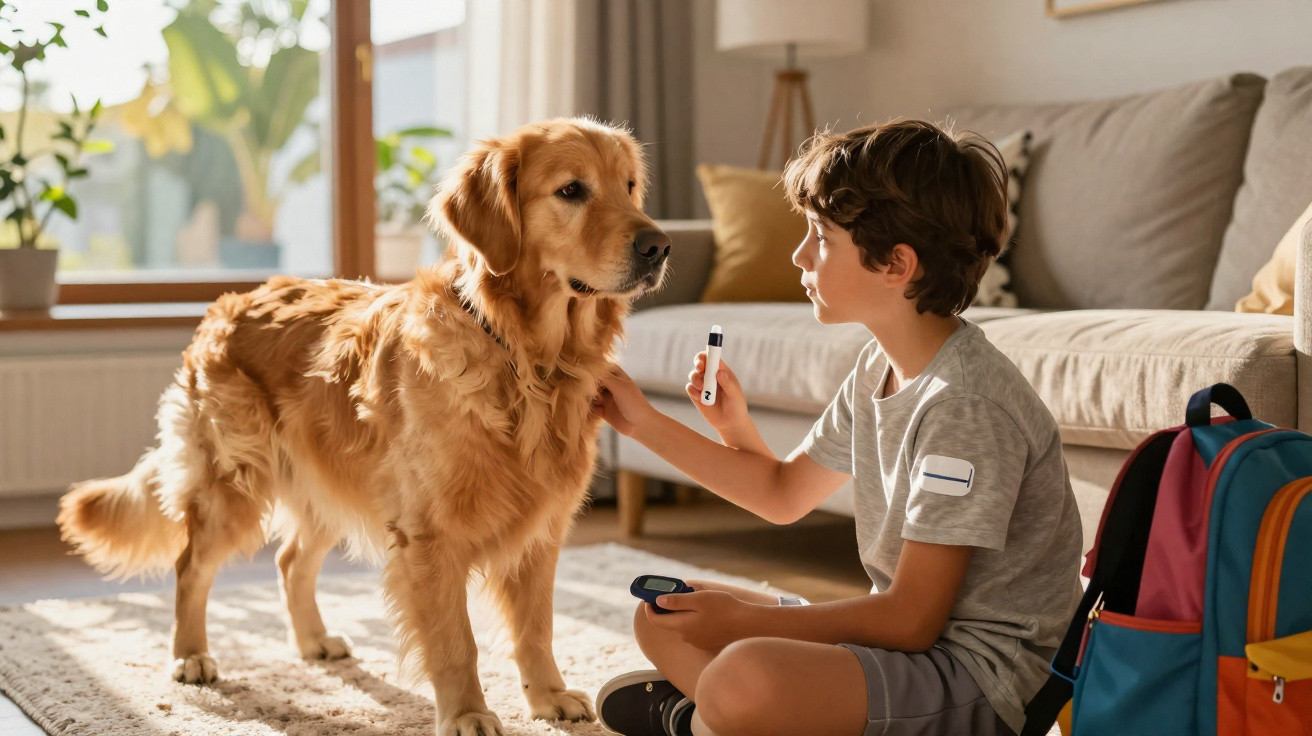
In a short Instagram clip, a scene unfolds that would usually seem more at home in a film: a specially trained assistance dog raises the alarm after detecting a dangerous change in the blood glucose of a child with type 1 diabetes. What may initially look like “strange behaviour” is in fact a life-saving moment that has prompted a strong emotional response on social media.
Dog becomes suddenly restless and spots the danger first
At first, the footage appears entirely ordinary. A young boy is sitting in the living room, quietly watching television, while the family dog rests beside him. Then the atmosphere changes. The dog starts circling the child anxiously, nudging him and refusing to leave his side. To anyone watching, it could appear to be a burst of playfulness, but a silent emergency is unfolding.
The four-legged companion is a diabetes alert dog. It has been trained to identify changes in the child’s scent that may indicate blood glucose that is either too low or too high. Before any monitoring device has sounded an alarm, the dog’s nose has already picked up that something is wrong.
The dog responds before the child even realises that his blood glucose is becoming dangerously unstable.
In the video, the dog repeatedly tries to get close to “its” child, keeps its eyes fixed on him and is clearly persistent. Only once the message has been understood does it settle down and move into the next stage.
After the alert comes comfort: the dog rests its head on the boy’s knees
Once the adults understand the warning and check the child’s blood glucose, the dog switches from alert mode to comfort mode. It presses close to the boy, gently lays its head on his knees and simply stays there. There is no barking and no more agitation, only closeness.
It is precisely this combination of highly accurate scent detection and emotional connection that makes these dogs so remarkable. They do not merely save lives; they can also give children a sense of safety and reassurance, particularly when their body is behaving unpredictably and everything feels uncertain.
What diabetes alert dogs can do
Diabetes alert dogs are not simply ordinary family pets that happen to notice something. Their abilities are the result of intensive training, which generally takes many months. The aim is to ensure that the dog reliably recognises specific scents produced during blood glucose fluctuations and signals them through a clear, learned behaviour.
- Early detection: Identifying sharp drops in blood glucose (hypoglycaemia) or rises in blood glucose (hyperglycaemia).
- Alert behaviour: Nudging, jumping up, pacing around the room or barking, depending on the training.
- Night-time watch: They can respond during the night, especially if monitoring devices fail or do not trigger an alarm.
- Support for the family: The dog can alert other family members if the child is no longer able to respond.
Although sensors and insulin pumps are now highly advanced, a dog’s nose remains a fascinating “bio-sensor”. Many families say that their dog warns them considerably earlier than technology or common symptoms such as shaking, sweating or confusion.
How diabetes alert dogs detect dangerous blood glucose fluctuations
Scent is the key. When blood glucose levels become unstable, the chemical composition of sweat and breath changes. Humans cannot detect these changes, but they are highly noticeable to a trained dog.
During training, specialist trainers often use scent samples taken from affected people at different blood glucose ranges. The dog learns to associate particular smells with a reward and later signals them independently. Over time, this response becomes increasingly dependable because the dog quickly learns how its person smells when danger is approaching.
The animal stores its person’s unique “scent fingerprint” - including every warning sign.
Typical alert signals used by an alert dog
The exact signals differ according to the trainer and family. Common behaviours include:
- Repeated, insistent nudging of a hand or leg
- Intense staring and restless movement around the room
- Jumping onto the bed during night-time fluctuations
- Fetching a designated item, such as a wristband or bell
- Going to find the parents if the child does not respond
Why children with type 1 diabetes benefit so much
For families affected by type 1 diabetes, life involves constant testing, calculations and uncertainty. Children do not always notice low blood glucose early enough. At times, they may simply ignore the warning signs because they want to continue playing or watching television. This is where assistance dogs provide an additional layer of protection.
Many parents sleep more peacefully when a well-trained alert dog sleeps in the child’s bedroom. In everyday life, the animal can also ease some of the constant fear of sudden blood glucose instability. Children often form an especially close bond of trust with their dog and may feel less “different” from their friends.
At the same time, these dogs need clear routines, regular refresher training and a stable connection with the family. They are not simple aids, but sentient animals with physical and emotional needs.
Training, costs and risks: what families should know
The route to getting a diabetes alert dog is a long one. Reputable trainers emphasise that not every dog is suitable. Personality, health and motivation are all crucial factors. Training usually begins when the dog is still a puppy.
Key points to clarify in advance include:
| Aspect | What it involves |
|---|---|
| Training duration | Often 12 to 24 months of intensive training |
| Costs | Several thousand euros, depending on the provider and scope |
| Suitable breeds | Retrievers, Poodles and Spaniels are common choices - temperament and health are what matter most |
| Ongoing support | Regular refresher sessions and training checks are necessary |
| Legal status | In many cases, assistance dog status, with special rights in everyday settings |
Anyone considering getting such a dog should investigate very carefully who they are working with. There are unscrupulous providers who charge large sums while placing dogs with incomplete training. In the worst case, a family may depend on a dog that does not respond in a genuine emergency.
When technology and animals work together
An alert dog is not a replacement for an insulin pump, a continuous glucose monitoring system or medical care. The best outcomes come when every element works together: modern medical technology, trained parents, an informed support network and a dog that can raise an early alarm with its nose.
Many families report that their dog notices fluctuations even when sensors are still in the “green range” or are being calibrated. In these situations, parents often choose to be cautious, carry out another test and make adjustments in good time. This can help prevent severe hypoglycaemia involving loss of consciousness or seizures.
More than a helper: an emotional anchor for the entire family
The living-room clip also reveals something else: there is a powerful bond between the child and the dog. The animal is not only a medical assistant, but also a playmate, a source of comfort and a constant companion. For children who sometimes feel excluded because of their condition, such an animal partner can become an important emotional anchor.
Anyone thinking about training, or having a dog trained as, an alert dog should consider this side alongside all the medical questions: dogs need time, attention, training and plenty of affection. When those conditions are met, the kind of relationship seen in the video can develop - one that may save lives in situations like this and make daily life with a chronic condition considerably easier.




Comments
No comments yet. Be the first to comment!
Leave a Comment