
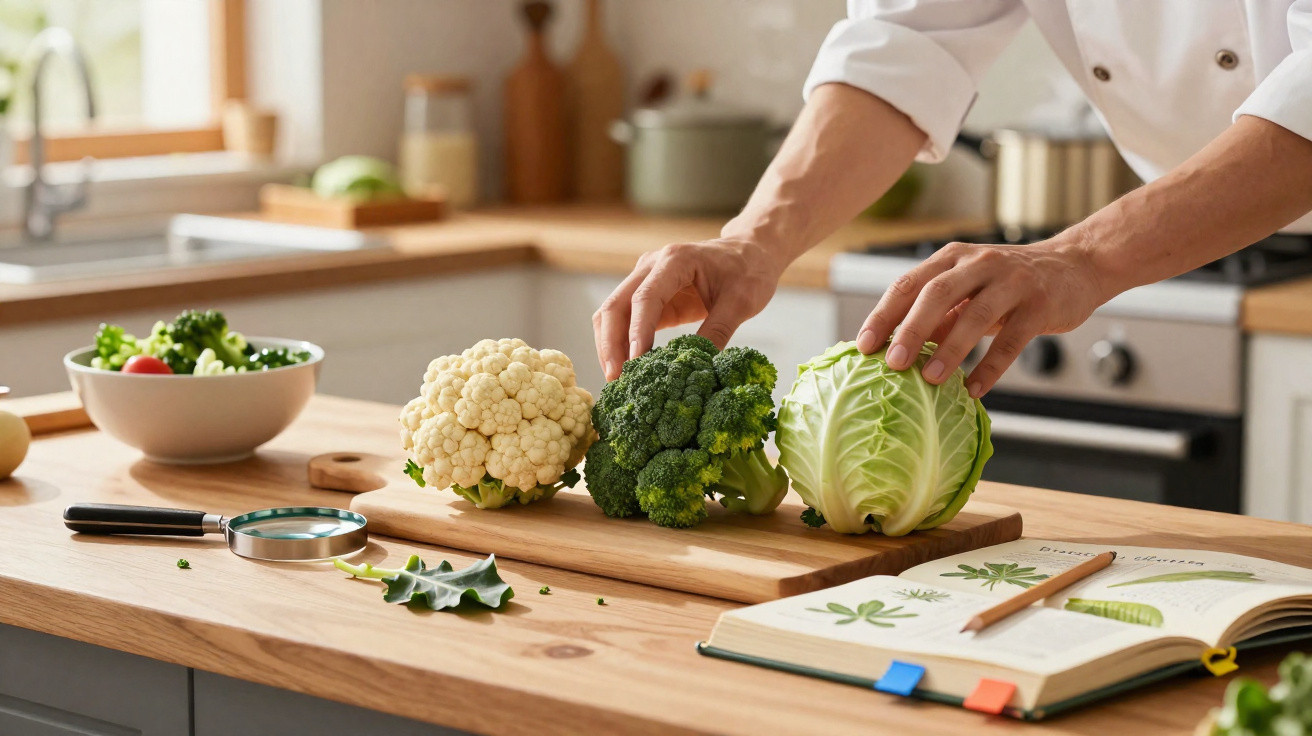
At the market, the woman ahead of me studied the vegetables with visible uncertainty. Her hand hovered over the cauliflower, then the broccoli, while she glanced towards the cabbage stacked beside them. They belong to the same family and sit in a similar price bracket, yet they bring completely different character to a meal. Half uninterested and half entertained, the stallholder eventually said: “You know it’s basically the same plant, right?” She laughed, assuming he was teasing, and bought a little of each to be safe.
Outside on the pavement, I searched for it on my phone. That was the moment the rabbit hole began.
These three supposedly different vegetables reveal, rather quietly, how little we may know about the food that reaches our plates.
Once you notice it, it is hard to forget.
So, one plant or three different foods?
Cauliflower, broccoli and cabbage resemble relatives whose lives have gone in wildly separate directions. One is white, tightly packed and almost sculptural. Another is green and branching, like a miniature tree. The third is round and layered, rather like a leafy brain. It is easy to place them in separate categories: “I hate cabbage but I love broccoli”, or “Cauliflower? Only in gratin, thanks.”
For decades, however, botanists have made the same point: all three come from one species, Brassica oleracea.
They share the same original plant and the same genetic foundation.
The difference lies in the features people chose to develop over hundreds of years.
Imagine a rough, salt-tolerant wild plant growing on Atlantic coastal cliffs. That is the ancestor. In ancient Greece and Rome, growers noticed that certain plants produced thicker leaves, larger buds or tighter centres. Each generation kept seed from the specimens they most wanted to reproduce.
There were no laboratories or sophisticated technology involved-only observation, patience and persistence.
Over time, this one “wild cabbage” developed into the forms now known as broccoli, cauliflower, kale, Brussels sprouts, cabbage and kohlrabi. They are one species, with different parts exaggerated, much like adjusting a video-game character feature by feature.
The key change was the plant part selected for maximum development. For cabbage, growers favoured ever-tighter heads of leaves. For cauliflower, they selected flower buds until they created the dense white dome. With broccoli, they encouraged the stems and clustered green buds.
From a genetic perspective, they remain remarkably close. Think of them as separate versions of the same software, modified through centuries of human determination.
When broccoli and cauliflower go into your basket, then, you are not truly choosing between two species. You are selecting two possible outcomes from the story of one plant.
That small detail leads to a far larger question: how much of what we describe as “natural” has actually been shaped by human hands?
Broccoli, cauliflower and cabbage in the kitchen
Understanding that they are one species can alter the way you cook them. When broccoli becomes the green, open form of cauliflower, and cabbage its leafy, enclosed form, the same cooking approaches start to make sense across all three.
You can roast them alike, steam them alike and add each of them to the same stir-fries.
For a straightforward option, cut them into similarly sized florets or strips, coat them in olive oil with salt, pepper and a little garlic, then roast at 220°C for 20–25 minutes.
The result is an aromatic tray with caramelised edges, and broccoli, cauliflower and cabbage no longer seem to require three entirely separate recipes.
Instead, they become one broad, adaptable cooking playground.
The amusing part is that many people believe they dislike one of these vegetables simply because they have only encountered it boiled beyond recognition in a school canteen. We have all experienced that occasion when the whole house smells of overcooked cauliflower and regret.
Try combining all three on one tray instead: cabbage strips, broccoli florets and small cauliflower pieces. Once they are cooked, finish with a splash of soy sauce or lemon.
You will have crisp cabbage edges, tender broccoli stems and cauliflower tops with an almost nutty flavour.
It is still one plant, yet it delivers textures and tastes that can seem like three separate dishes.
The emotional trap is genuine: vegetables are often treated as fixed identities. “Broccoli kid”, “Cabbage hater”, “Cauliflower phase”. In truth, nobody necessarily thinks this way every day, but alternating them as though they were seasonal moods can help.
A nutritionist I spoke to put it this way:
“From a health perspective, the question isn’t ‘broccoli or cabbage?’ It’s ‘how often do you invite this plant family to your plate in any disguise?’”
Whether you choose broccoli, cauliflower or cabbage, the nutritional package is broadly similar:
- Fibre that helps steady blood sugar and keeps you satisfied for longer
- Vitamin C amounts that can compete with some fruits
- Plant compounds associated with a reduced cancer risk
- Few calories alongside a high “satiety per bite” ratio
- Flexibility across salads, soups, roasts and curries
Seeing them as one large team rather than three opponents can make supermarket decisions feel easier, rather than more complicated.
How to buy, cook and eat them without losing your mind
At the shop, begin with sight and smell. Choose broccoli with sturdy stems and dense, deep-green florets. For cauliflower, seek a tight head free from greyish marks and any powerful odour. A good cabbage should feel weighty and have crisp, squeaky leaves.
Then try a simple weekly rule: choose any two forms of the plant. Make one your “quick cooking” option and the other your “slow comfort” option.
For instance, use broccoli in speedy wok meals during the week and cabbage in a soup that simmers for hours on Sunday. Alternatively, blend cauliflower into a smooth purée, while roasting broccoli until its tips are charred.
It is one plant family, two moods and one shopping list.
Many people feel they must follow an exact recipe for every vegetable, which is where the pressure starts. A whole cabbage goes into the fridge and the outer leaves begin to wilt, bringing guilt with them. A cauliflower is bought, half used for a gratin, then forgotten until the remainder browns.
A gentler method is to treat them as modular ingredients. Prepare everything on the day you get home, store it in glass containers and use it over the course of the week.
Add a small handful of shredded cabbage to a salad. Stir several broccoli florets into pasta. Put two thin cauliflower slices in a sandwich.
Use small amounts repeatedly, rather than creating one heroic “healthy” meal and then eating pizza for three days.
During a harvest break, one farmer told me:
“People think they need to reinvent the wheel for each vegetable. We grow one plant in many costumes. The kitchen can do the same.”
Here is a compact strategy to remember:
- Choose smaller heads if you live alone or do not cook often
- Chop and store them as soon as you arrive home, rather than doing it “later”
- Put stems and cores into soups or stock instead of discarding them
- Combine varieties in one dish for contrast and to avoid boredom
- Lightly steam and freeze leftovers for emergency stir-fries
That is how one botanical species can quietly become a week of adaptable, low-stress meals.
The larger story in your vegetable drawer
Discovering that cauliflower, broccoli and cabbage are one species affects more than shopping habits. It shows how heavily edited our understanding of food can be. We imagine we are choosing among different products when, often, we are simply choosing variations on one human-shaped idea.
It also shifts the way we see farmers. They do more than “produce vegetables”; over centuries, they have formed shapes, colours and structures like exceptionally patient sculptors.
The next time you slice into a cabbage, you are holding more than a round bundle of leaves. You are holding the history of human preferences, climate, soil and innumerable small choices made by people whose names you will never know.
This one plant that became many offers another unexpected benefit: fewer choices. When broccoli is unavailable, take cabbage. If cauliflower is reduced, use it in a dish where you would usually choose broccoli.
Once the mental barriers between them disappear, menus become more open, budgets have more room and those “I don’t know what to cook” moments become less frequent.
Perhaps that is the quiet revolution concealed in the modest green crates at the supermarket: understanding what we eat is not about learning diets by heart.
It is about recognising the unseen links between our plates, our routines and the wild plants from which it all began.
| Key point | Detail | Value for the reader |
|---|---|---|
| Same species | Broccoli, cauliflower and cabbage are all Brassica oleracea | Cuts confusion and broadens recipe options |
| One technique, many uses | Roasting or stir-frying works for all three | Reduces time and mental effort in everyday cooking |
| Prep once, eat all week | Chop, store and combine varieties in small amounts | Reduces waste and encourages more consistent healthy eating |
FAQ:
- Question 1 Are broccoli, cauliflower and cabbage genuinely the same plant?
- Question 2 Which is the healthiest choice for everyday meals?
- Question 3 If they are one species, why do they look and taste so different?
- Question 4 Can one be substituted for another in recipes?
- Question 5 What stops them smelling so strong during cooking?



Comments
No comments yet. Be the first to comment!
Leave a Comment