
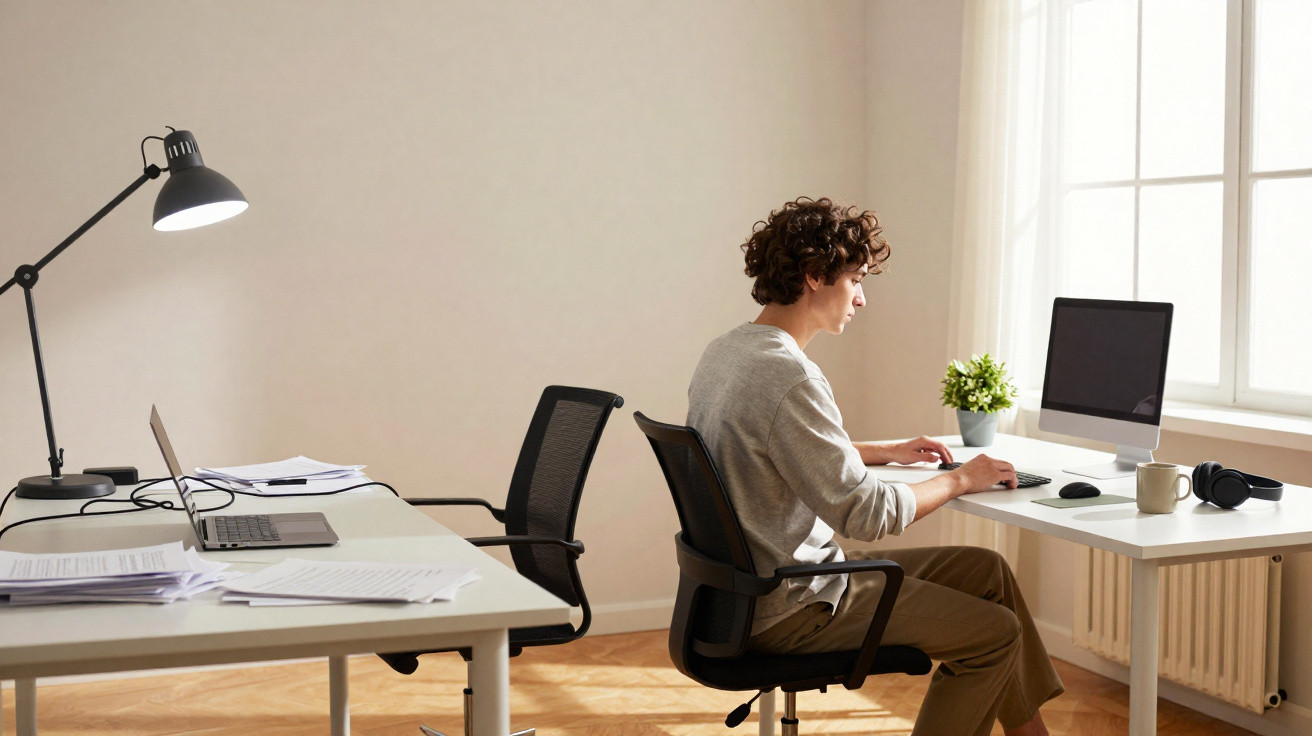
The laptop is open, the coffee is still hot, and the to-do list looks impressively ambitious.
Two hours pass. The cursor continues to flash on the very same line, while your shoulders have started to feel like concrete. The working day has barely begun, but you are exhausted already. Perhaps you have blamed your self-control, your role or your phone. But what if the issue has been sitting quietly in front of you all along: your home office setup?
There is the chair that felt “good enough”, the desk that happens to be a kitchen table, and the gentle lighting that feels comforting in the evening but leaves your mind sluggish at 3 p.m. We seldom examine these things because they simply fade into the background.
That is precisely the problem. The space you use to work each day may be steadily sapping your concentration, mood and energy without you realising it.
When your home office works against you
Most home offices were never planned as offices. They are improvised spaces: a bedroom corner, a place beside the boiler or the only available area close to a socket. Initially, it can seem practical and even inventive. You sit down, open the laptop and decide it will be fine.
A few weeks later, however, odd habits begin to surface. You begin the morning with purpose, then catch yourself browsing social media at 10:30 a.m. for “just a minute”. Your back starts to ache, your neck becomes tense and your thoughts feel hazy before lunch. You criticise your discipline rather than the chair causing you to slump or the screen positioned too low.
The reality is that a poor setup does not usually announce itself loudly. It works quietly, taking 5% of your attention here and 10% of your energy there. By 4 p.m., an entire hour may have disappeared into discomfort and distraction.
There is a reason workplaces pay so much attention to lighting, desk height and chair positioning. For decades, ergonomists have made the same point: small physical pressures accumulate like interest on a bad loan. One study from the American Academy of Orthopaedic Surgeons linked badly designed workstations with a sharp increase in neck and shoulder complaints among computer workers.
At home, those details are easy to dismiss. We perch on bar stools for eight hours because they “look nice”. We fold ourselves over laptops on low coffee tables, wrapping our shoulders around the keyboard. It may appear acceptable on a video call, but your body is working hard simply to hold that position.
The impact on productivity is subtle. Minor discomfort creates more micro-breaks. Tangled cables and stacks of paper draw your gaze, pulling your attention away from the work in front of you. Every lapse in concentration means your brain must make the climb back to the task. By Friday, you may have put in long days while still feeling behind.
The invisible productivity killers in your home office setup
Begin with a straightforward question: how many separate “jobs” does your workspace perform? When your desk also serves as the dining table, the children’s craft area and the place where Amazon parcels are opened, your brain receives conflicting messages. You sit down to prepare a report but find yourself thinking about spaghetti sauce stains instead.
Visual mess turns into mental interference. The unfinished tax return in the corner, three unused notebooks and a headphone lead curled around your mug each take small pieces of your attention. It may not seem significant at the time, yet it gradually erodes deep work: the level of focus you are actually paid to deliver.
One clear role per space is an unexpectedly effective principle. A desk that is clearly designated “for work” helps your brain move into a different state, even when it sits in the same room as your bed or sofa. This mental separation is a quiet but meaningful boost to productivity.
People who move from working “wherever I can sit” to using an intentional workspace often tell a similar story. Consider Sarah, a marketing manager who worked from a bar stool in her kitchen for two years. She assumed her inability to concentrate was simply pandemic fatigue.
Following a friend’s suggestion, she set up a small desk in one corner of her bedroom. She propped her laptop on a stack of old cookery books, bought a second-hand office chair and positioned herself towards the window rather than the fridge. Within two weeks, she noticed that she was completing in five hours what had previously taken eight.
Her role had not changed, nor had her tools. The important difference was that her body had stopped battling the furniture. Her eyes were no longer constantly pulled towards unwashed dishes. Her brain understood: this corner means “we’re working now”. The environment took on some of the effort that her willpower had previously carried alone.
On a deeper level, your home office is continually communicating with your nervous system. Lighting affects how alert you feel. A study from the Journal of Environmental Psychology found that people working in rooms with natural light reported greater productivity and a better mood than those working solely under artificial lighting.
Noise is another quiet disruptor. Even modest household sounds, such as the washing machine, traffic in the corridor or a television in the distance, add to cognitive load. Your brain continues to track them in the background, just in case. That difficult-to-identify feeling of being on edge often comes from here.
Posture matters too. When you curl over a screen, your lungs cannot expand fully. Less oxygen means less energy. Across several hours, that compressed, slumped stance communicates “low power mode” to your body. This is not only about discomfort: your physical position also affects your mental state. A home office that encourages an open, upright posture is quietly telling your brain that it is time to be switched on.
How to redesign your home office for genuine focus
You do not need a Pinterest-perfect office to notice an improvement. Focus first on three factors: height, light and line of sight. Start by placing your screen approximately at eye level. A laptop stand, a stack of books or anything else that raises it can prevent you from looking down all day. Your neck will benefit, and your concentration should last longer.
Next, set your chair so that your feet rest on the floor and your hips sit slightly higher than your knees. If money is limited, a firm cushion and a small box beneath your feet can achieve much of the same result. Finally, face a wall or a peaceful view. Looking directly into a busy hallway gives distraction a permanent invitation.
These adjustments can sound almost overly simple. That is exactly the point. Lasting productivity improvements tend to come from repeatable habits, rather than miracle solutions.
Many people try to solve productivity with apps and routines before considering the chair beneath them. There can be a sense of embarrassment in admitting that your setup is not helping, particularly when you feel fortunate simply to be able to work from home. You may tell yourself that you should feel grateful rather than be fussy about desk height.
Treat that inner voice kindly. Wanting a workspace that does not leave you with a headache does not make you “high maintenance”. It makes you human. When your body is in pain, your brain has a harder time functioning. That is not a weakness; it is biology.
Let us be honest: nobody truly follows those big, ideal daily routines every day, where everything is tidied, meditation is completed and lemon water is drunk before 8 a.m. On some days, the bed will win or the sofa will prove too tempting. The aim is not perfection. It is to shift the odds towards a reasonably productive day more often than not.
“Your environment will beat your willpower over the long run. If you want consistent focus, don’t make your brain fight the room it’s in.”
Think of your home office as a silent colleague. You want it working with you. A few practical anchors can help:
- Create a clear “end of day” ritual: shut the laptop, stack your papers and switch off one particular lamp.
- Restrict personal items on the desk to 2–3 objects that genuinely improve your mood.
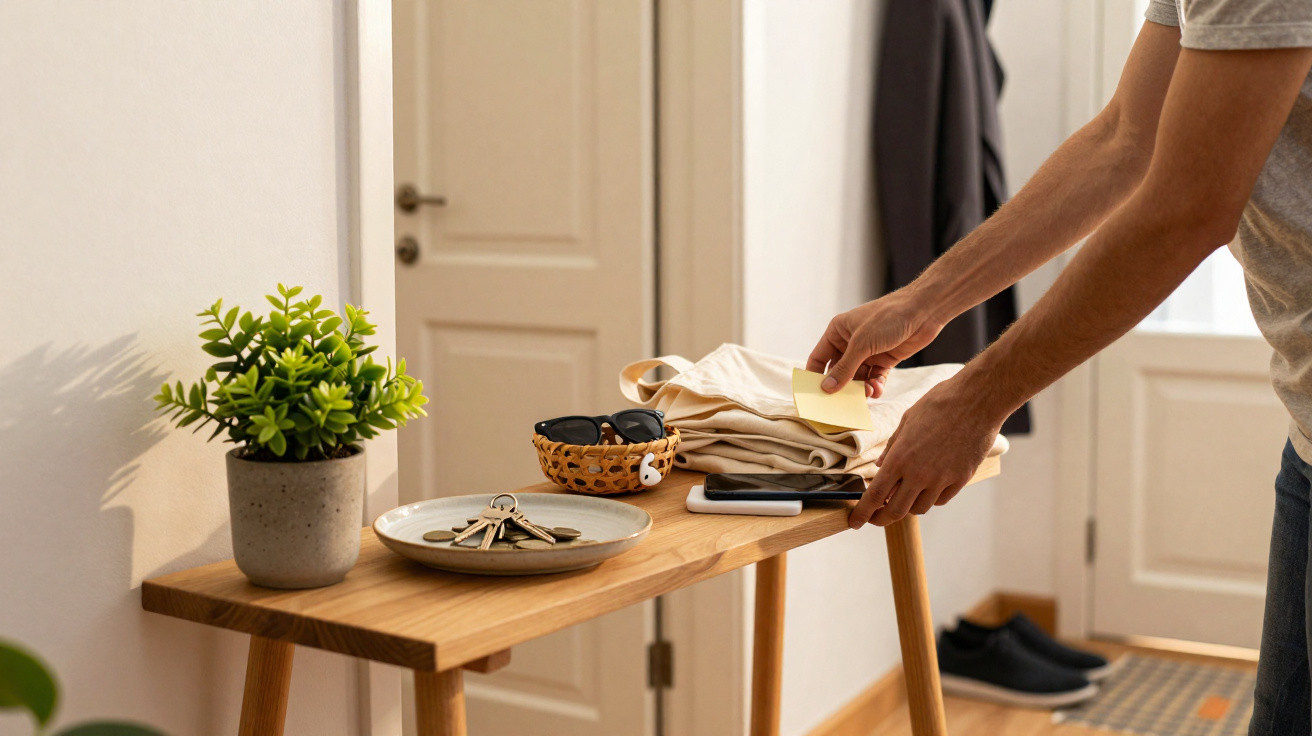
- Give cables, chargers and miscellaneous items a single home in a small tray or box.
- Set a 5-minute “reset timer” after lunch to stretch, clear away cups and reopen your task list.
- Protect at least one daily focus slot by putting your phone in another room.
None of this costs money. It does, however, require a brief pause between “I’m done with this task” and “I’m onto the next one”. In that pause, you quietly prepare the space for more effective work.
A home office that works for you rather than against you
Your home office does not have to resemble a magazine feature to alter how you work. It needs to account for the way your body and brain genuinely function on a tired Tuesday afternoon, when your inbox is overflowing and part of your mind is already considering dinner.
On a good day, an effective setup disappears from view. You are not thinking about the chair or the lighting. You are simply absorbed in the flow: typing away, making a useful contribution on a call or working through a problem. That unobtrusive support is the real benefit.
On a difficult day, your space can support you. It might be a chair that encourages you to sit upright, a desk free from yesterday’s disorder, or a small plant or photograph reminding you that you are a person rather than merely an inbox. A carefully considered environment quietly limits the damage at those times.
We have all had the moment at 4 p.m. when we see our reflection in the laptop screen - hunched over, frowning and slightly ghost-like - and think, “This can’t be it.” Reconsidering your home office is a practical, grounded response to that feeling. It is not about making an impulsive purchase, but gradually rearranging what surrounds you every day.
You may initially spot only minor changes: slightly less back pain, fewer purposeless scrolling sessions and a clearer mind after lunch. Then, one day, you shut your laptop at a sensible hour and realise you have completed what you intended to do. That is your space quietly giving something back.
| Key point | Detail | Why it matters to the reader |
|---|---|---|
| Ergonomics matter more than you think | Chair height, screen level and posture directly affect concentration, pain and tiredness | A few affordable changes can unlock hours of stronger focus |
| Signals from your space shape your mindset | Having one clearly defined “work zone” tells your brain when it is time to focus | It helps create a mental divide between work and home, even in a small flat |
| Rituals beat motivation | Brief, repeatable habits, such as resetting your desk and using end-of-day rituals, make productivity more stable | They reduce decision fatigue and make productive days more common |
FAQ:
How do I create a productive home office in a very small space? Choose one location - even half a table - and treat it as your dedicated “work island”. Make use of vertical space with shelves or wall hooks, and use a small box to store work items when you finish. Consistency is more important than size.
Do I really need an ergonomic chair, or is that just marketing? You do not need an expensive model, but you do need support. In the long term, a chair with a firm back, adjustable height and a seat that allows your feet to rest flat is better than any bar stool or sofa.
What if I can’t work near a window? Use a bright, indirect desk lamp with a daylight-style bulb, positioned slightly to the side of your screen. During breaks, try to get real daylight; even 10 minutes beside a window in another room is useful.
How can I reduce distractions when my family is at home? Agree visual signals, such as headphones on meaning “please don’t talk”, establish clear “quiet slots”, and move your most demanding work into those periods. A white noise app or an ordinary fan can help mask background sound.
Is it worth separating my work and personal laptop or desk? If possible, yes. Separate devices, or at least separate profiles, help your brain change modes. At the very least, use a different browser or desktop for work and close it completely when you finish.




Comments
No comments yet. Be the first to comment!
Leave a Comment