
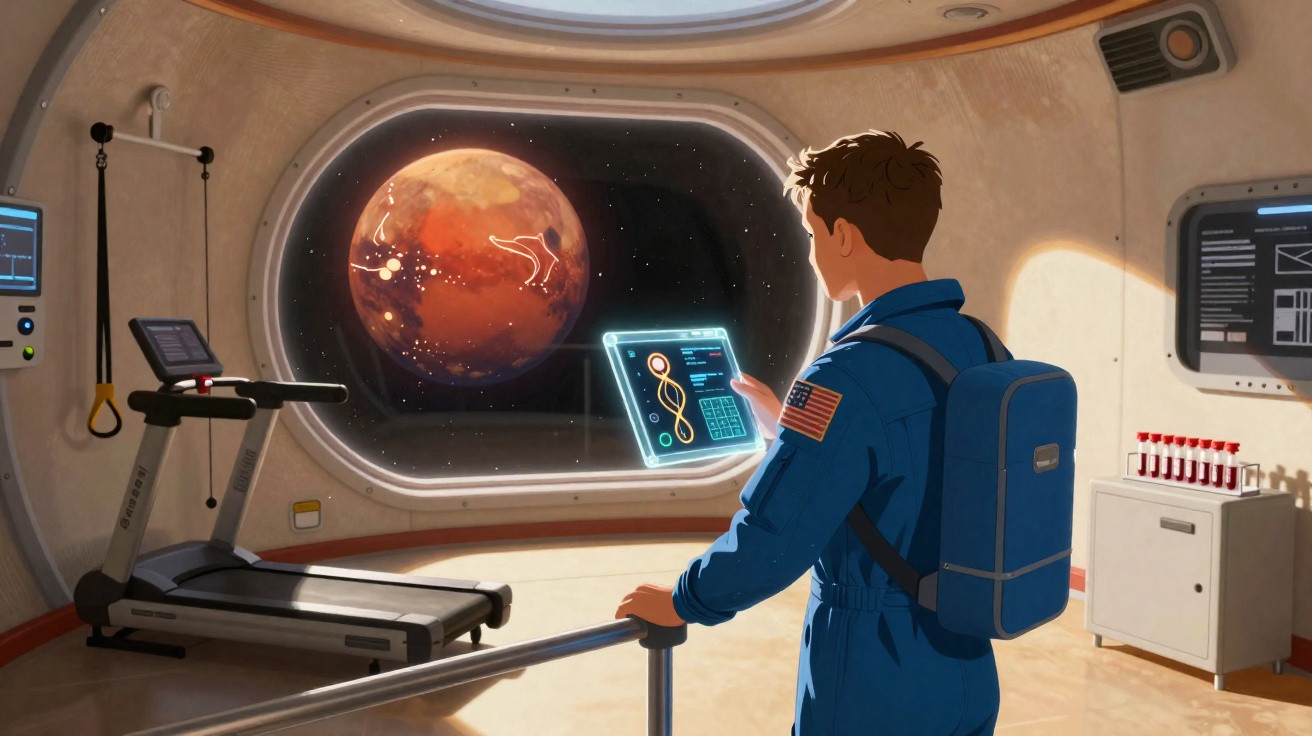
NASA and the China National Space Agency (CNSA) intend to send astronauts to Mars as soon as the next decade.
Such an ambitious objective demands extensive planning and research, as well as advance anticipation and preparation for every possible difficulty. Astronaut health and safety rank among the most important considerations.
Beyond the risks linked to lengthy journeys - including radiation exposure and the effects of extended time in microgravity - Mars itself presents further concerns.
As well as heightened radiation exposure, Mars has gravity equivalent to roughly 38 per cent of Earth's gravity.
This could create long-term health risks. An international research group is now investigating how Martian gravity could influence a crucial element of human health: skeletal muscle.
Skeletal muscle is the body's most plentiful tissue, making up more than 40 per cent of total body mass, and it is vital for both movement and metabolic health. It is also particularly sensitive; reduced gravity may lead to significant declines in muscle strength, mass and performance. Establishing how this tissue responds in the Martian environment is therefore essential.
How Martian gravity affects skeletal muscle
The research team included scientists from the Institute of Medicine at the University of Tsukuba, the Tohoku Medical Megabank Organization, the Advanced Research Center for Innovations in Next-Generation Medicine (INGEM), Beth Israel Deaconess Medical Center, Brigham and Women's Hospital, the Japan Aerospace Exploration Agency's (JAXA) Space Environment Utilization Center, and several universities.
Their findings were published in the journal Science Advances.
For the experiment, the researchers examined the effects of lower gravity on skeletal muscle tissue in 24 mice sent to JAXA's Kibo experimental module.
The mice were subsequently housed in JAXA's Multiple Artificial-gravity Research System (MARS), a centrifuge-based device. Over 28 days, they experienced four gravity levels: microgravity, 0.33 g, 0.67 g and 1 g.
Before launch, the mice underwent testing at NASA's Kennedy Space Center, which is also where they were returned for post-flight sampling.
Scientists at the Metabolism and Muscle Biology Lab (MMBL), within the Department of Nutrition at the University of Rhode Island (URI), then examined these samples. Professor Marie Mortreux, who heads the MMBL, explained in a Rhody Today news report:
"While we can simulate spaceflight on Earth in humans, it's extremely complicated and costly. We have centrifuges that can be used to temporarily expose humans to certain gravity levels, but it is not homogeneous nor constant.
We used gravity levels that were equally separated to have a better picture of the dose-response of each system to gravity. The test group that was exposed to 0.33g was extremely close to Martian gravity (0.38g). Our findings for that group can be translated into actions to enable Mars exploration."
The gravity threshold for preventing muscle loss
After the mice returned to NASA's Kennedy Space Center, Mortreux and her team assessed their weight, strength and movement. The analysis found that 0.33 g reduced spaceflight-induced muscle atrophy, while 0.67 g prevented it completely.
The researchers also used electrical impedance myography (EIM) to measure the mice's forelimb grip strength. Those measurements indicated that 0.67 g was enough to preserve muscle performance.
Taken together, the findings showed that 0.67 g represents a critical threshold for reducing muscle atrophy resulting from long-duration spaceflight.
An examination of the mice's blood plasma also found 11 metabolites with gravity-dependent changes. This indicates that they may be potential biomarkers for tracking astronauts' physiological adaptations.
Earlier partial-gravity research and Mars missions
The study extends earlier work Montreux carried out with Professor Mary Bouxsein, a study co-author, at Harvard Medical School.
Bouxsein created a ground-based partial-gravity mouse model in the early 2010s, while Montreux developed a partial-gravity rat model at Harvard. Consequently, both researchers are highly familiar with the effects of varying gravity levels on musculoskeletal tissue.
"Since this mission aimed to assess gravity as a continuum, we were perfectly positioned to see if our ground-based results had similar outcomes when reduced mechanical loading was applied in orbit," said Montreux.
"Working with an international team was challenging and exciting. I think my experience working in Italy, France, and the United States prepared me for those big-scale collaborations."
One conclusion from the research is that future Mars missions must account for limiting skeletal muscle loss throughout the lengthy journey between Earth and Mars.
Astronauts must conduct regular scientific operations, meaning they need to retain mobility and muscle strength. The same is true for their physical condition after they return to Earth.
The results indicate that rotating toruses would be a sensible feature in future spaceflight designs, along the lines of NASA's Non-Atmospheric Universal Transport Intended for Lengthy United States Exploration (NAUTILUS-X) and comparable concepts.
This article was originally published by Universe Today. Read the original article.






Comments
No comments yet. Be the first to comment!
Leave a Comment