
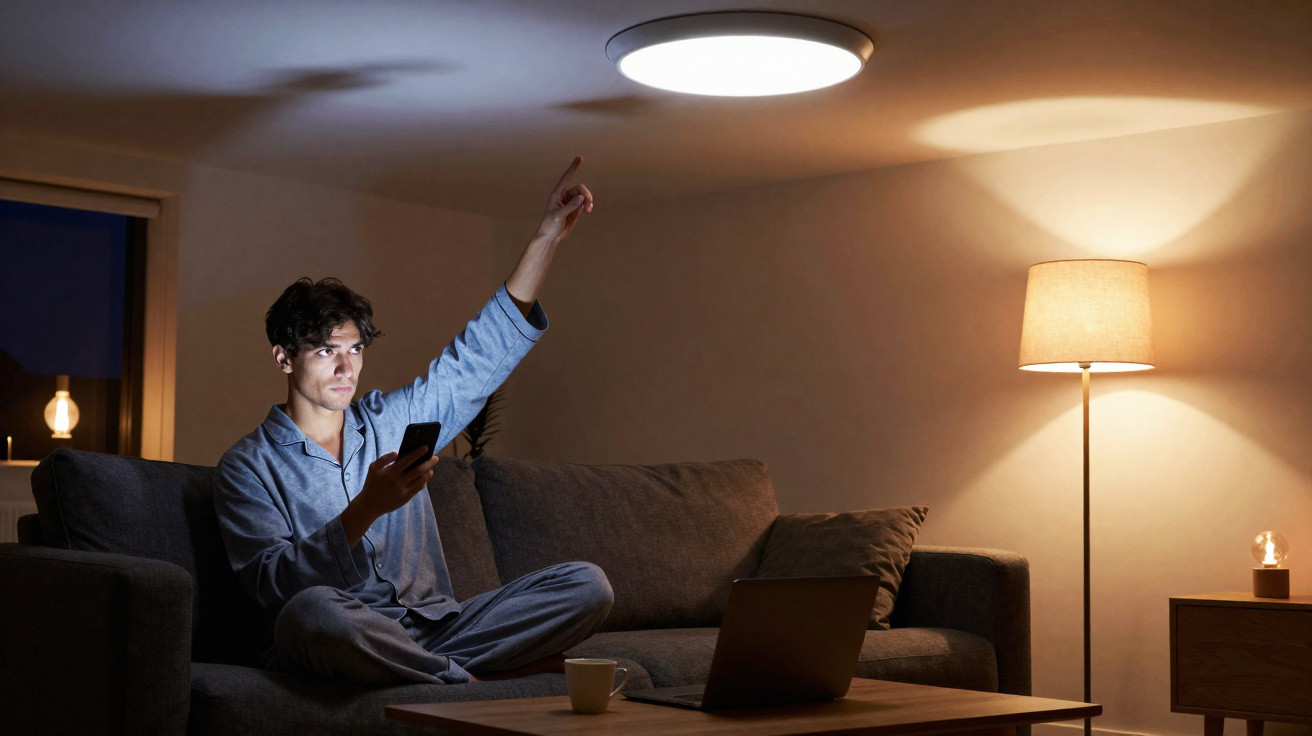
It may begin for you exactly as it began for me.
It is late, and a “quick” look at your phone somehow becomes 30 minutes. The laptop is still lit up on the coffee table, while the kitchen is as brightly illuminated as a supermarket at 10pm. Your body feels worn out and your eyes are slightly sore, but your mind will not switch off. Then you are in bed, looking at the ceiling, oddly alert and faintly robbed, as though somebody had slipped caffeine into your chamomile tea.
By morning, you are moving through a haze of repeated snooze buttons, leaden arms and that peculiar cotton-wool sensation behind your eyes. Perhaps you tell yourself that you simply stayed up too late, that stress is to blame, or that it is merely “one of those weeks”. But the cycle continues even when, on paper, you have spent enough time in bed. Something is disrupting the cues that tell your body when to rest and when to become alert. More disconcerting still, it all seems entirely normal while you are living through it.
The quiet villain in your living room
Let us identify the likely offender immediately: bright, cool artificial light indoors during the evening, particularly from LED ceiling fittings, screens and “daylight” bulbs. This is not about every type of lighting, nor the gentle lamp in the corner. It is the distinctly clinical, blue-tinged brightness found in so many contemporary homes and workplaces-the sort retailers use to keep you alert enough to carry on browsing. You know the one: it makes your kitchen look brilliant on Instagram while convincing your brain that midnight is still some distance away.
We tend to treat lighting as either practical or decorative. It goes up while you cook and comes down when you want a room to feel “cosy”. To your brain, however, light is not decoration; it is information. When intense, cool light reaches your eyes in the evening, it tells the body clock deep within your brain that it is nearer lunchtime than bedtime. Your system discreetly puts its sleep routine on hold and changes to “day mode”, because its most trusted timing signal has been contradicted.
Your internal clock-the circadian system-is particular, but dependable. It once followed instructions almost exclusively from the sun: strong blue-rich light in the morning and warm darkness at night. Now it must make sense of a chaotic sequence of household lighting choices: kitchen spotlights at 10pm, a phone in bed, bathroom mirror lighting at 1am. Gradually, its understanding of timing begins to shift. You will not spot the precise point at which it moves; one day, you simply realise that you feel permanently out of step with yourself.
The light you feel versus the light your brain sees
There is an odd mismatch at work. You may be exhausted on the sofa, yawning into your sleeve, while your brain continues to interpret the moment as daytime because of the light entering your eyes. That is because the circadian system pays little attention to whether you subjectively feel sleepy. Instead, it closely follows a set of light-sensitive cells in the eyes. These cells do not help you distinguish shapes or colours; their role is to assess brightness and send updates about the time of day to the brain’s master clock.
Known as intrinsically photosensitive retinal ganglion cells-IPRGCs, if acronyms appeal to you-they are particularly responsive to bluish light. That includes the sharp white light emitted by LEDs, laptops, televisions and smartphones. Their response is far from subtle. Expose them to bright, cool light at 9 or 10pm and they send one clear instruction: “It’s still daytime, keep the melatonin low.” Melatonin is the hormone that quietly tells your body: “Night now. Power down. Start the maintenance shift.” When that message fails to arrive properly, you may still get to sleep, but the entire night can unfold slightly out of sequence.
That is why so many people describe themselves as “tired but wired” in bed. Both body and mind may feel spent, yet the hormonal cues have not aligned. You may wake more frequently overnight, find your sleep light, and experience dreams that are vivid or unsettled. The following day, you struggle through work while caffeine carries the burden your biology was designed to manage without charge. It is not necessarily dramatic enough to send you straight to a doctor. Instead, it is a gradual and almost silent erosion of your resilience.
The invisible jet lag of staying home
Jet lag is usually discussed as the consequence of a long-haul flight. Yet powerful evening light indoors can create a small, self-imposed version of it without requiring you to leave the sofa. Each night, your lighting choices push your body clock a little later, only for an early alarm and a dark commute to challenge it again the next morning. Your body is effectively attempting to inhabit two time zones simultaneously: the natural one and the LED one.
This has a term: social jet lag. Late bedtimes and early mornings are usually responsible, but evening light exposure quietly widens the divide. You could go to bed at a sensible time, while your circadian clock still considers bedtime to be one or two hours later because it received “daytime” signals at 10pm. When your alarm sounds at 7, your biology therefore hears 5. It is hardly surprising that getting up can feel as if you have been hauled from sleep in the middle of a dream.
The body’s grumpy morning meeting
Internally, the outcome resembles a poorly managed office meeting. Cortisol-the hormone that ought to rise early in the morning to make you feel alert-can become mistimed. Melatonin remains when it should have moved on. Your digestive system is not fully prepared for breakfast, mood regulation trails behind, and concentration feels blurred. It is not severe enough to send you to A&E; it is simply enough to leave you feeling a little less like yourself, day after day.
Most of us have snapped at somebody we love over something trivial, then later asked ourselves, “Why did I react like that?” Sleep deprivation is often blamed, and often with good reason. Yet there is a more subtle issue too: it is not only about the quantity of sleep, but whether your internal clock is working alongside you or against you. Bright indoor light at the wrong time quietly pushes that clock off beat, before retreating into the background as though it were blameless.
The trap of “daylight” indoors
There is an ironic element to this: many of us buy “daylight” bulbs deliberately because we assume they are the healthy option. They are marketed as natural, stimulating and useful for concentration. During the morning and early afternoon, that can often be true. In the grim grey of a British winter, when the sun seems unwilling to appear before 10am, a brightly lit kitchen or office with cool white light can improve your mood.
The difficulty arises when those same bulbs remain on into the evening. Since they are ordinary household lights rather than a specialist device, their use feels unremarkable. No label warns that “Using this at 10pm may trick your brain into thinking it’s midday in June.” You are simply tidying, washing up or sending a few final emails, with your home lit like a showroom. Your eyes adapt, the brightness of your phone becomes part of the general glow, and there is no obvious “aha” moment to show that you have crossed a biological threshold.
Realistically, hardly anyone wants to go round changing bulbs every day or fit a complicated lighting system that requires a degree to use. Life is untidy: people fall asleep in front of the television, and children leave every light blazing across three rooms. This is precisely what makes this form of light disruption so stealthy. It does not depend on any extreme behaviour. It only requires you to be an ordinary, slightly exhausted person who prefers decent lighting.
The quiet difference of warm light
The curious thing is that you probably already recognise what improvement feels like, without having connected it to lighting. Think of an evening in a pub with low lamps, a campsite illuminated only by a fire and lantern, or a friend’s home with soft table lamps rather than ceiling lights. After those evenings, you return home and fall asleep as easily as a stone sinking through water. There is no drama and no prolonged scrolling; you simply drift off.
Those settings are filled with warm, low-level lighting that says “sunset” to the circadian system instead of shouting “office”. The signal shifts, and your biology follows. You probably do not notice why those evenings feel different; you only know that they do. Once the pattern becomes clear, it is difficult not to recognise it throughout your own home.
The phone in your face at midnight
Any discussion of light also needs to address screens. The standard advice is to stay off your phone before bed, and most of us agree that it sounds sensible before scrolling anyway. Yet the phone is not always the complete issue on its own; it is the combined effect. A bright ceiling fitting, a large television and a phone held close to your face create a three-tiered source of circadian confusion.
Screen light is especially potent because it sits so close to your eyes and receives your direct attention. Even with “night mode” enabled, it may still be bright enough to activate those light-sensitive cells significantly. You are under the duvet, the room somewhat dim but the screen shining, thumb flicking upwards. Your body thinks, “We’re in bed, this looks like a sleep signal,” yet your retina is calling out “Nope, still day, don’t start the sleep chemistry yet.” Your brain is receiving two contradictory messages at the same time.
There is a reason putting the phone down feels so difficult: its light is itself helping to keep you awake. It is rather like attempting to relax beneath a spotlight. You are unlikely to experience a dramatic surge of alertness; instead, you do not quite pass the invisible line into genuine drowsiness. You remain in a peculiar semi-alert state until the phone lands on your face and you reluctantly accept that it is time to stop.
Small changes that feel weirdly big
The encouraging news is that you do not need to redesign your entire home to prevent this particular kind of light from taking over your evenings. Several targeted adjustments can have a surprisingly noticeable effect. Consider dimmer switches for the main lights, inexpensive warm-toned lamps, or even a simple rule that harsh overhead lighting is switched off after, for example, 9pm. Rather than viewing it as “optimising sleep”, see it as gently giving your body an honest account of the actual time.
A straightforward approach is to give your home a “second lighting mode”. Day mode means bright, cool lighting with everything switched on. Night mode uses side lamps, warmer bulbs, fewer sources of light and brightness lowered by a couple of levels. At first it can seem rather theatrical, as if you are arranging a set, but your brain responds well to consistency. Within a week or two, you may find yourself becoming “sleepy on schedule” in a way you have not experienced for years.
With screens, perfection is unrealistic. At times, you will look at WhatsApp at 10pm. You will watch several episodes of a series. Life happens. But altering the balance-watching from further away, reducing the brightness and leaving the phone across the room while you genuinely try to sleep-removes some of the impact. When you find yourself blinking at a glowing rectangle at 1am, you will at least understand what you are giving up: not only tonight’s rest, but tomorrow’s sense of timing.
When light starts to feel like a choice again
Once you begin to notice it, evening light no longer fades into the background. It becomes more like the weather: something you can observe, react to and work with. You may notice that the warm circle cast by a bedside lamp feels different from the harsh glare of a bathroom mirror. You can feel the small inward release that comes with switching off the main overhead light. You might even begin to appreciate the little ritual of “dimming the day” before bed, rather than merely collapsing into sleep.
There is a subtle power in that. You cannot control your manager, your children, the news cycle or the neighbour’s puppy barking at 6am. But you can choose whether your living room feels more like a surgery or a sunset at 10 at night. That choice gently influences the signals your brain receives, which affects how you sleep, which in turn affects how you take part in your own life the following day. It is a sequence of small decisions that accumulates.
You do not require blue-light glasses, costly technology or an impeccably arranged bedroom. What you need is slightly greater honesty between your home lighting and your body clock. Once they begin telling the same story again, sleep may no longer seem so mysterious or elusive. It was already there, waiting, while your lights continued quietly saying “day” long after night had started.






Comments
No comments yet. Be the first to comment!
Leave a Comment