
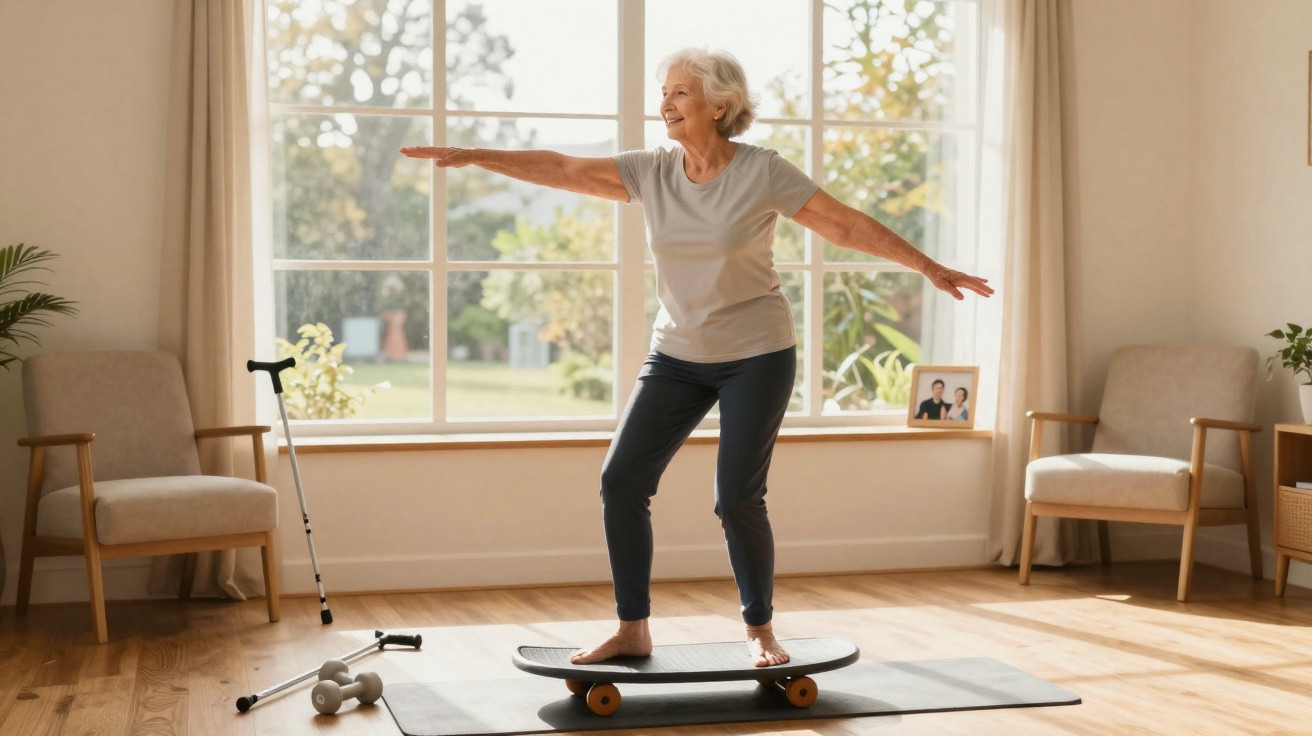
78 years old, with a short grey haircut and colourful trainers. Her right foot hovers a few centimetres above the floor, while her arms stretch out like wings. A young trainer stands beside her, ready to step in, but there is no need. After ten seconds, she puts her foot down again, laughs and says, half proud and half disbelieving: “I used to trip over the kerb while shopping – now I train on one leg.”
Anyone watching this scene in the small rehabilitation studio immediately sees that it is about more than a little exercise. It is about freedom.
And about the fear of a fall that can change everything.
Why falls after 75 are not “bad luck” – but a training issue
The same story is heard in every sports hall and every class for older people. “It was only a small slip in the bathroom.” Or: “I just caught my foot on the edge of the rug.” Suddenly, someone is on the floor: a broken hip, hospital, a lengthy rehabilitation period and, sometimes, a walking stick afterwards – or a lingering uncertainty in the mind.
We rarely discuss how quietly these fractures enter a life. There is no dramatic accident, no car crash. Just lost balance at the wrong moment. This is precisely where exercise after 75 becomes interesting.
The figures make these quiet moments painfully tangible. Studies show that from the age of 75, around one in three people falls at least once each year. Among people over 80, the proportion rises further still. Behind every number is a face, a home with curled carpet edges, runners and slippery tiles. After the first fall, it is often not only a walking frame that arrives, but a new way of living: slower, more cautious and more fearful.
On many geriatric wards, doctors say that the real “enemy” is not the broken hip, but the loss of confidence in one’s own body. Carrying a laundry basket up the stairs as before? Unthinkable. Popping to the local café on impulse? Too risky. Eventually, the sofa becomes the safest place. That is where the gradual retreat from life begins – invisible, yet very real. Let us be honest: nobody truly does every day what is set out in those leaflets full of exercises for older people.
The sober truth is that balance is not fate; it is a skill. Skills do not merely age – they become rusty when they are not used. Muscles lose strength, nerves transmit signals more slowly, eyesight deteriorates and the inner ear becomes more sensitive. The body receives less information and takes longer to respond. Those who move very little are, without realising it, practising stumbling rather than regaining their footing.
This is exactly where balance training comes in. Essentially, it is a conversation with your own body: “How quickly can you steady yourself again? How do you respond if someone gives you a gentle nudge? What do you do if the surface suddenly becomes uneven?” Every small exercise sharpens those responses. Suddenly, the kerb is no longer the enemy.
How to train balance after 75 – without becoming a competitive athlete
The good news is that preventing falls does not require a gym membership or a mirrored studio. It can start in everyday life: in your own kitchen, beside the dining table or in the hallway. A traditional starting point is to hold on to a chair, stand on one leg for ten seconds, then switch sides. Progress gradually: close your eyes on occasion, remove your hands from the chair, or draw a few small circles with the heel of the raised foot.
Those who feel secure can raise the difficulty in a playful way. Brush your teeth while standing on one leg. Put on your socks standing up rather than sitting down. Walk along a line on the living-room floor, heel to toe, as in a balance test. What sounds simple on paper suddenly becomes genuine training for the joints, muscles and ability to react. Balance is like an old friend: if you call regularly, the connection remains strong.
Of course, all of this sounds far easier than it feels on the first attempt. Many older people feel “too wobbly” after only a few seconds and stop. That is human. We all know that moment of thinking: “I cannot do this; I am too old for it.” This is exactly when patience is needed – and sometimes someone standing beside you who does not laugh when you wobble.
One common mistake is trying to do too much too quickly: stepping straight onto unstable cushions, copying wild online exercises, or practising alone at home without anything to hold on to. That can cause more anxiety than it relieves. Small, repeatable routines with clear safety measures are better: for example, always keeping one hand on the edge of a table and wearing sturdy shoes rather than slippers. And yes, there are days when it simply does not work. On those days, it is perfectly fine to let the body rest.
Martin, a 42-year-old physiotherapist who has worked with very elderly people for more than 15 years, puts it this way:
“People often think of balance as circus tricks on a beam. In reality, it is about whether you can still hold on in the bus when it brakes suddenly. Every second in which you do not fall is a moment of independence gained.”
Clear, memorable building blocks work well in practice:
- Stand on one leg 1–2 times a day, with one hand on a piece of furniture.
- When shopping, turn around deliberately and slowly instead of pivoting in a rush.
- During television advert breaks, stand up briefly and shift your weight from one leg to the other.
- Attend a sport or rehabilitation class for older people once a week, where you can practise under guidance.
- Reduce trip hazards at home: carpet edges, cables and loose mats – every hazard removed is a small victory.
Balance as an approach to life – not merely an exercise
After spending longer with people such as Hannelore, it becomes clear that this training changes not only how they walk, but how they view themselves. Someone who feels able to climb stairs better again also looks in the mirror differently. Suddenly, she is not only “the old woman afraid of falling”, but a person actively working on her own safety.
This internal shift is quiet but powerful. It appears in the sentence: “I walk to the bakery on my own again.” Or when someone no longer stays seated at a grandchild’s birthday party, but dares to go along to the playground. Balance training, then, restores not just stability in the joints but stability in everyday life. And yes, sometimes the thought alone is enough: “I have practised; I can do this.”
Naturally, an 88-year-old will not become a ballet dancer. Some damage remains, and some pain does not disappear. Anyone who has already fallen carries that experience in their body. Even so, every tiny improvement can matter: one step without holding on, one kerb without a racing heart, one shower without constant panic. Between “never going out alone again” and “marathon fit” lies a broad, quiet space – and that is exactly where the real lives of most people over 75 take place.
Perhaps that is the real point: preventing falls does not mean removing every risk from life. It means trusting yourself again to widen your own world instead of shrinking it year after year. Anyone who practises balance is, in essence, sending themselves a message: “I am not giving up on myself yet.” That attitude, that quiet stubbornness, can sometimes achieve more than any list of technical aids.
| Key point | Detail | Benefit for the reader |
|---|---|---|
| Balance can be trained | Simple everyday exercises, such as standing on one leg or turning slowly, are enough to begin | Shows that active fall prevention remains possible after 75 |
| Falls have psychological consequences | Fear and withdrawal after a fall are often more dangerous than the injury itself | Helps people understand their own insecurities and address them purposefully |
| Small routines rather than grand plans | Build brief, regular prompts into daily life instead of following complex programmes | Makes starting realistic and suitable for everyday life, without pressure or an expectation of perfection |
FAQ:
- Question 1 How often should I do balance exercises if I am over 75?
- Question 2 Which exercises are safest for a beginner?
- Question 3 Can I still train my balance if I have osteoarthritis or have had hip surgery?
- Question 4 Does a walking frame help prevent falls – or does it make me less active?
- Question 5 How can I find a good sport or fall-prevention class for older people?




Comments
No comments yet. Be the first to comment!
Leave a Comment