
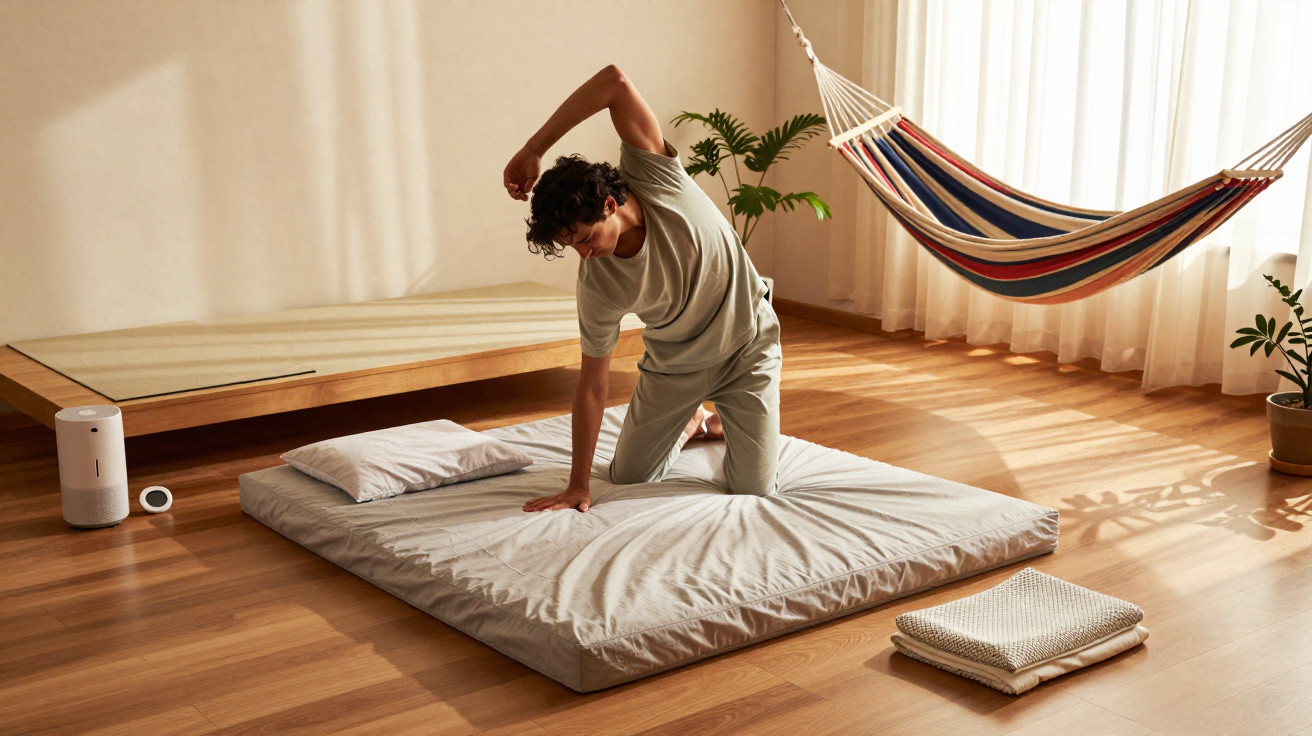
Rather than a conventional bed, it might be a hard, stripped-back platform, a suspended mesh or a slim futon rolled up as tightly as a yoga mat. On TikTok and Reddit, people record themselves getting rid of their beds, convinced they have found the answer to sleep, back pain and even productivity. Others recoil at the thought, holding on to their deep memory foam as if it were a lifeline. Sleep doctors are watching too, intrigued but concerned. Is this an understated bedroom revolution, or a looming health catastrophe unfolding in slow motion?
The first thing that strikes you is how quiet it is.
There are no creaking springs and none of the familiar sag as a mattress envelops your body. Instead, there is the stark impact of meeting an unyielding surface. In a compact city-centre studio, Mia, a 29-year-old software engineer, lies on a timber platform topped with a 3 cm latex pad. Her phone is just centimetres from her face, casting flickering blue light over the ceiling. She browses a forum called “Bedless Living”, where users exchange pictures of minimalist sleeping arrangements as though they were collector's cards.
Mia presses “post” on her first-night update, then draws the duvet up to her chin. The floor feels unfamiliar and her back feels unprotected, but she shuts her eyes regardless. If this works, she tells herself, I’m never going back.
She has no idea which way this experiment will go.
Why people are abandoning traditional beds - and what it does to the body
Spend a few minutes on Instagram Reels and you are likely to see the same image: a tall mattress being hauled to the kerb, an empty room and a caption about “freeing your spine”. A radical bed alternative can take many forms. It may be a Japanese futon put away during the day, a wooden slatted base with a thin topper, a camping mat laid on the floor, or a woven hammock strung diagonally across a room. Their shared principle is simple: less padding and greater support.
Supporters claim that, after an adjustment period, their posture improves, their persistent back pain eases and they wake feeling alert rather than weighed down and foggy. The message can sound almost evangelical, while also resembling a form of sleep boot camp.
A familiar story emerges when speaking with these “bed minimalists”. Mark, a graphic designer from Manchester in his thirties, says years spent hunched over a laptop gave him searing lower-back pain. His sagging king-size mattress, meanwhile, felt like wet bread. Frustrated one evening, he pulled it into the hallway and slept on a folded duvet on the floor. He woke up stiff, yet strangely…aligned.
Within a week, he had bought a firm futon and a basic pine frame for less than £200. After three months, he used an inexpensive sleep ring to monitor the results: more deep sleep and fewer awakenings. Whether this came from the harder surface, his expectations or simply from giving up doomscrolling and treating bedtime as a ritual is difficult to establish. Still, his account reflects small clinical trials in which people moving from an excessively soft surface to a medium-firm one saw chronic lower-back pain scores improve within four weeks.
In theory, the reasoning is straightforward: spines benefit from neutral alignment, while extremely plush mattresses can hold the body in an awkward hammock-like shape. Firmer, thinner options can distribute pressure more evenly and encourage straighter positioning. But people are not anatomical diagrams. Side sleepers with pronounced hips can experience intense pressure at the shoulders and knees. Those with joint conditions or little body fat may wake with numb arms and painful hips. Sleep specialists caution that swapping a soft bed for a wooden platform overnight is much like attempting a marathon after a weekend as a couch potato.
Adaptation does happen. Muscles accommodate change, and small movements during the night can build stabilising muscles. Some sleepers say their “first two weeks of misery” eventually became unexpectedly comfortable, grounding sleep. Others retreat to their previous mattress and swear never to repeat it. The boundary between a useful challenge and gradual injury can be narrow.
How to try radical bed alternatives without ruining your sleep
If you are drawn to the idea, approach it as a measured trial rather than a religious conversion. Begin with your existing setup. For one week, sleep on the firmest area of your mattress, remove bulky toppers and note how you feel each morning. If your back improves without your shoulders protesting, take the next step: use a firm sleep surface with limited cushioning, such as a 5–8 cm futon or latex pad on a stable base.
Alter only one factor at a time: first the surface, then pillow height and then sleeping position. Allow around ten nights for each adjustment unless pain rises sharply. Simple, low-cost aids can help: place a folded blanket beneath your hips, a small pillow between your knees or a rolled towel beneath your neck. This is not about “proving a point”; it is a personal field test.
The errors people most often admit to involve changing everything at once in a burst of enthusiasm. The mattress is removed, the platform is built, the pillow is discarded and bedtime is brought forward - all during one weekend. For a nervous system already strained by work and screens, that is a considerable upheaval. Physically, a sudden switch to an extremely hard surface can reactivate old injuries you had forgotten. Emotionally, it may feel as though you have taken away your own source of comfort.
The trend can also create tension in relationships. One partner may want a futon on the floor while the other prefers a soft, cloud-like bed. Some couples reach a compromise through split arrangements, or a firm central mattress with extra toppers. Others discreetly retain the old guest bed as a fallback. Let’s be honest: nobody really does this every day without occasionally going back when tiredness hits.
Sleep researchers, who have spent years trying to convince people to maintain regular bedtimes, view this radical minimalism with mixed emotions. “I love that people are finally questioning their sleep environment,” says Dr. Laura Campos, a clinical sleep psychologist in Barcelona.
“But if the new setup is so uncomfortable you dread going to bed, you’re trading one problem for another.”
There is a cultural dimension as well. Some people describe floor sleeping as “more natural”, referring to traditional Japanese, Korean and certain Indigenous practices. Others point out that these traditions belong to complete lifestyles, with different furniture and patterns of daily movement, rather than simply a replacement mattress. The equipment cannot do all the work by itself.
- Make the transition gradually, progressing from soft to medium-firm before attempting anything “extreme”.
- Shield pressure points with small cushions rather than thick toppers.
- Monitor your mood and energy as well as back pain for at least two weeks.
Where the radical bed alternative sleep experiment could go next
The argument around radical beds is not truly about timber versus springs. It concerns who decides what “good sleep” should look like. For decades, that story was shaped by mattress advertising and showroom sales pitches. Today, millions are turning their bedrooms into test spaces, combining sleep-science guidance, TikTok tips and feedback from their own sore shoulders. Some settle on Japanese-style futons stored in a cupboard every morning. Others choose hybrid arrangements: low platforms, modular toppers and adjustable pillows.
There is a quietly defiant quality to rejecting the huge, elevated bed as the standard symbol of adulthood. It creates room for practical questions: how much do we actually need in a bedroom? Is comfort always softness, or can it also mean feeling grounded, cool and secure? What if the real “hack” has nothing to do with the surface, but instead lies in winding down, lowering the lights, managing stress or discussing different rest needs with a partner?
On a Sunday evening, three weeks into sleeping on her minimalist platform, Mia sits on the edge of her almost bedless room. Her phone shows fewer late-night scrolling sessions, while her sleep tracker suggests more consistent nights. Her back has not been magically healed, but it no longer throbs at 3 a.m. She is not prepared to dispose of the old mattress in her friend's garage, though she is equally unhurried about bringing it home.
Somewhere between a health revolution and a risky craze, this movement is creating an unusual moment of reflection. Before climbing into whatever we sleep on tonight - a deep mattress, futon, hammock or folded blanket on the floor - one question remains suspended in the darkness: does our bed actually work for us, or is it merely something we have never dared to challenge?
| Key point | Details | Why it matters to readers |
|---|---|---|
| Move gradually towards firmer surfaces | Progress from soft to medium-firm for 1–2 weeks before attempting a very firm platform or thin futon. Add temporary layers, such as blankets or thin toppers, then remove them gradually rather than moving immediately to the floor. | This lessens the shock to the joints and spine, reduces the likelihood of old injuries flaring up, and allows muscles to adapt so you can judge calmly whether the new arrangement genuinely helps. |
| Protect important pressure points | Side sleepers commonly require a small pillow beneath the waist and another between the knees; back sleepers may benefit from support under the knees or lower back. On hard surfaces, thin, focused cushioning is more effective than a single large soft layer. | It helps prevent numb arms, shoulder pain and sore hips - the leading reasons people give up firmer arrangements during the uncomfortable first week. |
| Pair your sleep style with the right bed alternative | Floor futons work well for people who can easily get up and down and enjoy changing positions. Hammocks are more suited to back sleepers. Very low platforms can be difficult for anyone with knee or balance issues, particularly during the night. | Selecting an option that suits your body and routine reduces frustration, night-time falls and costly errors involving equipment that looks “cool” online but does not fit real life. |
FAQ
- Is sleeping on the floor safe for everyone? Not really. Young, generally healthy adults often cope well with a gradual transition to floor or futon sleeping. Those with arthritis, circulation problems, spinal conditions or pregnancy face a greater chance of pain flare-ups or trouble getting up during the night. It is sensible to seek medical advice before making major changes, especially if you already experience chronic pain.
- How long does it take to adapt to a much firmer bed? Most people who make the change successfully describe a difficult period of 10 to 21 nights. The first three to five nights may feel particularly stiff and awkward, after which the body either begins adapting or gives clear indications that the trial is unsuitable. If pain steadily worsens or your sleep becomes much shorter, pause or reduce the firmness.
- Can a harder sleeping surface really help back pain? Research indicates that medium-firm surfaces frequently help chronic lower-back pain more than very soft ones, particularly for people previously sleeping on sagging mattresses. That does not mean “rock hard” is invariably best. The ideal surface keeps the spine broadly straight while allowing the shoulders and hips to sink slightly, depending on your build.
- What if my partner wants a radical setup and I don’t? This happens often. Some couples divide the sleeping surface by using two separate mattresses or futons on one frame, each with a different firmness. Others agree to test the approach for a fixed period and keep a backup bed available so neither person feels trapped. Open discussion about pain, comfort and intimacy needs generally produces better compromises than attempting to “win” the sleep argument.
- Are hammocks a good everyday alternative to a bed? Hammocks can be excellent for short naps or camping, and some back sleepers enjoy using them full-time. For many people, however, they make side sleeping, getting in and out at night and sharing with a partner more difficult. In the long term, the same rule applies: aim for a neutral spine, avoid major pressure points and choose a setup that lets you move freely as you turn during sleep.




Comments
No comments yet. Be the first to comment!
Leave a Comment