
The woman in the blue windbreaker is 72, although you would never know it from the way she weaves along the painted parking-bay lines. It is early, the air is still cool, and while most shoppers head straight into the supermarket, she is doing something that seems equal parts peculiar and brilliant. She places one foot directly before the other, heel to toe, with her arms slightly extended like a tightrope walker’s and her gaze fixed on the far end of the white line. She sways once, chuckles to herself and begins again.
No one applauds. Hardly anyone notices her at all.
But this small act could quietly influence whether she can still manage the stairs independently at 85, or steady herself in that one serious fall.
The answer lies in a habit so straightforward it almost feels like a childhood game.
The understated benefits of practising balance after 60
Spend time in a waiting room frequented by people over 60 and the conversation tends to circle around familiar subjects: blood tests, aching joints and memory slips. Coordination is seldom mentioned. It tends to matter only when somebody catches their foot on a rug or cannot step down from a kerb without tensing their entire body.
Balance and coordination decline gradually, much like vision fading at dusk. You do not register the first slight loss of clarity. Then, one day, the world seems to tip a little too quickly. That is when the body exposes a reality that has been developing for years.
Researchers use a starkly simple assessment for this: the single-leg stance. Stand on one leg with your arms by your sides and your eyes open, then measure how long you can hold the position. A large 2022 study published in the British Journal of Sports Medicine found that people in their 60s and 70s who could not maintain this stance for 10 seconds were almost twice as likely to die during the following decade. This was not linked to one particular cause, but to all causes.
Failing to balance for 10 seconds may sound like a small inconvenience. In clinical terms, it is a warning sign as conspicuous as a billboard.
The reason is both direct and unforgiving. Whenever you walk, climb stairs, turn around or reach towards a high shelf, your brain operates a complicated system involving vision, the inner ear, joints, muscles and reflexes. As we age, both that software and the hardware beneath it become less reliable.
Coordination is not permanently lost, however; it can still be improved. Even in your 70s and 80s, the nervous system continues to adapt when it is given the chance. The problem is that ordinary life, particularly a sedentary one, rarely demands that adaptation.
The daily habit that quietly builds coordination: purposeful balance play
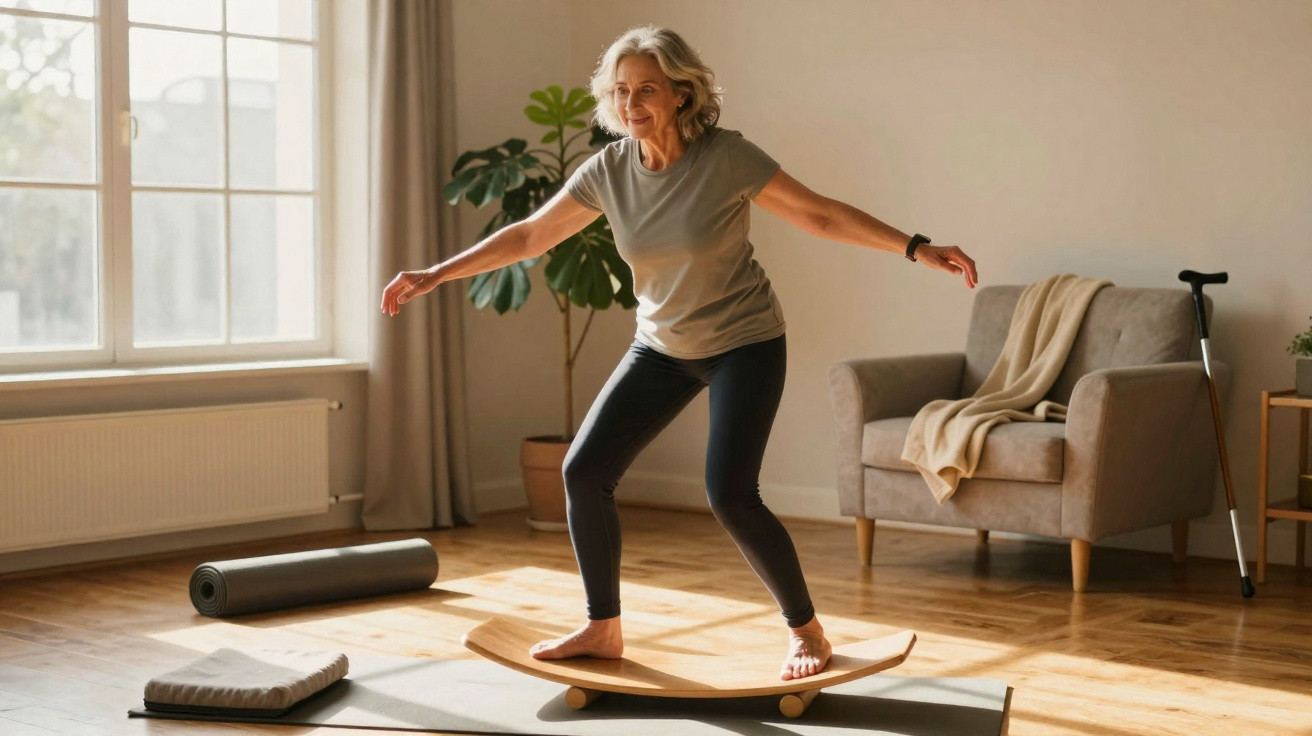
The habit that can make a difference is almost comically modest: deliberately practise balancing every day. Not solely at the gym or in an organised class, but in the small gaps of your usual routine.
Balance on one leg as you brush your teeth. Walk heel to toe along the hallway, just as the woman did on the parking-lot line. In the kitchen, pause and gradually transfer your weight from your left foot to your right, close your eyes for two seconds, then open them again.
These brief “balance breaks” make everyday activities into miniature workouts for the brain and body. Two minutes in one moment, a minute in another. Your body does not require drama; it requires repetition.
Carlos, 68, found this out the difficult way. After a minor fall on a wet pavement, his doctor told him plainly: “Your legs reacted too slowly.” Nothing was broken, but his confidence was bruised and he became newly afraid of walking quickly. He started avoiding stairs, escalators and busy crossings. His world contracted by three city blocks.
His granddaughter, once a dancer, suggested an arrangement: whenever he put the kettle on for tea, he would stand on one leg while keeping only two fingers on the worktop. Initially, he managed four seconds. Then eight. After a month, he began adding heel-to-toe walks along the kitchen tiles. Three months later, he was using the Underground again, with one hand on the rail and his head held high.
Beneath the simple acts of boiling a kettle and following lines in a hallway, something very specific is taking place. Balance play activates the small stabilising muscles in the feet, ankles, hips and spine that can spend years operating on autopilot. It also requires the brain to refresh its internal “map” of where your body is in space.
In effect, you are giving your nervous system new opportunities to practise responding to unsteady moments in a safe environment. When a real wobble arrives - an unexpected kerb, a slippery floor or an energetic grandchild - the response is less likely to be panic and freezing. Instead, it becomes a small adjustment, recovery and continuation. The practice may look foolish from the outside, but inside, neural circuits are being rewired.
How to fit balance practice into your day without making it a task
Begin almost ridiculously small. That is the key. Each morning while standing at the sink, raise one foot only a few centimetres from the floor. Keep one hand close to the worktop; there is no need to act like a superhero. Count to five, lower your foot, then repeat on the other side. If five feels impossibly long, stop at three.
Later, while waiting for the microwave, position one foot immediately in front of the other, with your heel touching the toes of the other foot. Keep a slight bend in your knees and look at a fixed point. Exhale slowly. This “tightrope” position activates the ankles and hips without requiring sportswear or a yoga mat.
For many people over 60, the word “exercise” instantly brings to mind sore knees, Lycra and elaborate YouTube routines. That image can destroy motivation before they even begin. Frankly, no one truly keeps up a demanding routine every single day.
The habit that endures is the one that slips into things you already do. Link balance practice to regular cues: coffee brewing, television advert breaks or speakerphone calls. If you miss a day, forgive yourself rather than giving up. Thirty wobbly seconds while watching the news is better than a perfectly planned workout that never takes place.
“Balance is like a savings account,” says physical therapist Laura Kim, who works with patients in their 60s to 90s. “Every tiny practice deposit protects you from one future fall you’ll never even remember almost happened.”
- Turn waiting time into training: brushing your teeth, waiting for the kettle or riding in a lift.
- Always keep a “safety anchor” nearby: a worktop, chair back or wall within reach.
- Vary the movements: a one-leg stance, heel-to-toe walking and slow sideways steps along a hallway.
- Make it playful: count tiles, follow a line on the floor or balance while humming a song.
- Stop before you become tired: consistency, not heroic effort, is the aim.
Keeping your body’s “software” youthful, one wobble at a time
There is something quietly affecting about watching somebody in their 70s or 80s practise balance alone in their kitchen. There is no audience and no perfect leggings, only someone making a modest investment in their future self. A few seconds on one leg, a narrow stance along the tiles, a slow turn while looking over one shoulder.
Coordination at 65 is not about becoming an acrobat. It is about being able to bend down and tie your shoes without reaching for the wall. It is about crossing a crowded café without a sudden flash of panic. It is about walking with a grandchild in your arms and knowing that you are more support than danger. Repeated over time, these little decisions create a kind of invisible insurance policy that no insurer offers.
| Key point | Detail | Value for the reader |
|---|---|---|
| Daily “balance breaks” | Brief one-leg stands and heel-to-toe walks linked to everyday activities | Develops coordination without additional time or specialist equipment |
| Use safe anchors | Practise close to worktops, walls or sturdy chairs, and progress slowly | Lowers fear of falling and helps practice feel safe |
| Think long-term protection | Improved balance reduces fall risk and helps sustain independence over decades | Supports more confident movement and a broader, freer life after 60 |
FAQ:
- How many minutes a day do I need to practice balance? Start with a total of 3–5 minutes spread across the day. A few 30–60 second bouts during daily tasks already nudge your coordination in the right direction.
- Is it safe to do balance exercises if I’ve already fallen? Yes, but begin with strong support nearby and talk with your doctor or a physical therapist. They can adapt the exercises to your level and any medical conditions.
- Do I need special shoes or equipment? No. Comfortable, flat, closed shoes and a stable surface are enough. Some people like to practice barefoot at home to wake up the feet, but always prioritize safety and stability.
- How long before I notice a difference? Many people feel a change in 3–4 weeks: less hesitation on stairs, better posture, more confidence walking. The deeper benefits, like fall prevention, build quietly over months and years.
- Can I replace walking or strength training with balance work? Balance isn’t a replacement, it’s a partner. Walking, strength training, and balance practice together give your body the best chance to stay steady, coordinated, and independent after 60.


Comments
No comments yet. Be the first to comment!
Leave a Comment