
The onion moved first. A moment later, the chopping board slid a few centimetres across the worktop with that dreadful scraping noise, just as the knife started to fall. The home cook stopped dead: blade suspended, hand poised above the board as though the moment had slowed down. This was not a television kitchen fitted with non-slip professional equipment and flawless lighting. It was an ordinary flat, with a cheap glossy worktop and a plastic board that shifted whenever even slight pressure was applied. One wrong movement could have left a fingertip on the floor rather than an onion slice.
Many kitchen mishaps start in precisely this quiet way.
Why a sliding cutting board is more dangerous than it appears
When your cutting board moves, even slightly, while you are chopping, your brain is compensating constantly without you realising. Each shift makes your hand readjust, your wrist stiffen and your body brace itself. You are not merely chopping a carrot any more. You are also trying to control an unstable surface while holding a sharp knife. That is how minor slips turn into genuine injuries.
Oddly, many people just put up with it. We press down harder, pin the board in place with an elbow or stand at an awkward angle to stop it moving. It seems to work, to a point. Until it does not.
Imagine coming home from work and hurrying to put dinner on the table. Children are milling around the kitchen, somebody wants to know where their sports bag is, and a notification flashes up on your phone. You pick up a tomato and begin slicing fast, only for the board to creep forwards as the knife comes down. It is not a dramatic movement, only a couple of millimetres. Yet that is enough to turn a clean slice into a ragged cut heading towards your thumb.
Accident and emergency departments encounter versions of this situation every day. Not as cinematic disasters, but in the form of those “I just slipped” explanations that can feel almost embarrassing to repeat.
Safety-conscious chefs have good reason to be so focused on steady work surfaces. A knife can only follow a predictable path when the surface underneath remains still. Even the tiniest sideways movement alters the angle of both your knife and hand without warning. You may then overcorrect, turn your wrist or grip harder with your fingers close to the blade. At that stage, the issue is no longer knife technique. It is physics, friction and a board that failed to stay in place.
The damp paper towel trick that quietly saves fingers
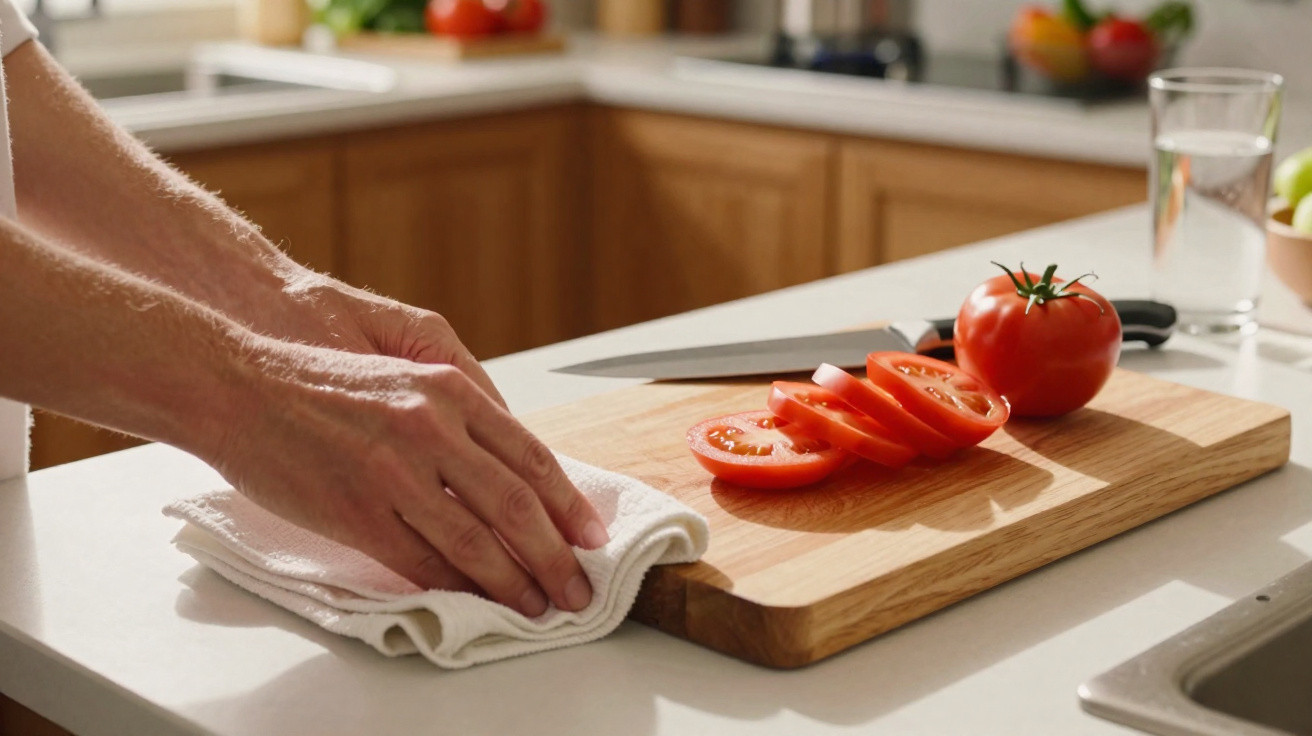
This is the straightforward action that distinguishes professional kitchens from many home arrangements. Before taking out even one vegetable, get a sheet of paper towel. Fold it in half and then fold it again to make a small rectangle. Briefly run it under the tap, then squeeze it until it is damp rather than dripping. Put the damp pad flat on the worktop and set your cutting board directly on it.
Within seconds, you have made a discreet non-slip layer between the board and the counter. There is no specialist equipment and no expense involved. It is simply improved friction.
If you have not used this method before, the change can feel almost startling the first time. A board that previously glided about like an air-hockey puck suddenly stays firmly in position. Chop an onion and it remains still. Slice crusty bread and the board stays exactly where you placed it. The result feels surprisingly reassuring.
There is another useful benefit: because you are no longer battling the board’s movement, you can use less pressure with the knife. That can mean less strain on your wrist, less tightness in your shoulders and fewer “whoa” moments when the blade lands slightly too near your fingertips.
The trick works because a damp paper towel grips on both surfaces. Against the worktop, moisture fills tiny pores and bumps, holding gently without acting like glue. Beneath the board, its lightly cushioned texture increases the contact area. Greater contact creates more friction, and more friction reduces sliding.
Realistically, hardly anyone does this every day, particularly when they are only slicing an apple quickly. Yet quick tasks, rather than major Sunday roasts, are often when accidents occur. A damp paper towel is a routine requiring little effort but offering a significant return. Once it becomes habitual, cutting on an uncovered board that slides around can feel distinctly odd.
How to secure your cutting board before chopping
The method is simplest when reduced to a routine. Before beginning any knife preparation, stop for three seconds. Take a paper towel or clean tea towel, fold it, wet it slightly and wring it out thoroughly. Lay it over the part of the worktop where you normally use your board, smoothing out folds with your hand. Then press the cutting board onto it with a little downward pressure, as though you are “locking” it in place.
Next, give the board a gentle push from the side. If it stays still, you can start cutting. If it moves, the towel may be too dry, too wet, or the board may have grease underneath it and need a quick wash.
The most frequent error is choosing a towel that is soaking wet. This leaves a small pool beneath the board and can make it less steady, particularly on very smooth or laminated worktops. Aim for damp, not sodden. Another problem is positioning the towel unevenly, leaving a corner unsupported and allowing the board to wobble.
Naturally, some people miss out the step for “just this one quick chop”. That is often exactly when fingers get cut. This is not about being perfect or feeling guilty; it is about sparing your future self a silly little accident that spoils the evening. Repeating one small habit can quietly transform how safe you feel in the kitchen.
Sometimes the biggest difference between a relaxed cook and a panicked one is simply whether their cutting board moves under their knife, a chef in a busy bistro kitchen told me. “If my board slides even once during service, I reset everything. I don’t negotiate with a sharp blade.”
- Use a damp, not wet, towel: Wring it out thoroughly so no water pools underneath.
- Cover the board’s entire base: Do not leave any corners suspended in the air.
- Clean the underside of the board: Grease immediately reduces grip.
- Test it before slicing:
- Change the towel if it dries during a lengthy cooking session.
A small cutting board safety ritual that changes how you cook
Once you begin putting a damp paper towel beneath your cutting board, you may notice an unexpected effect. You slow down slightly, but beneficially. Your work area becomes more intentional, and your hands feel less tense. Instead of being partly distracted by little jolts and skids beneath the knife, you can concentrate on the rhythm of chopping, the scent of garlic on the board and the tap of the blade.
It is a modest adjustment that is almost invisible to anyone watching you cook. Still, it quietly communicates that your fingers, your time and your peace of mind are worth three seconds of preparation.
| Key point | Detail | Value for the reader |
|---|---|---|
| Stabilising the board | A damp towel creates friction between the board and worktop | Reduces slipping and knife-related injuries |
| Simple routine | Fold, dampen, place and test with a quick push | Makes kitchen preparation calmer and more controlled |
| Low-cost safety | Uses items already found in most homes, such as paper towel or a cloth | No special equipment is needed to cook more safely |
FAQ:
- Question 1 Can I use a tea towel instead of a paper towel under my cutting board? Yes. A clean, thin tea towel works very effectively provided it is damp and thoroughly wrung out. Fold it flat so that it does not make bumps beneath the board.
- Question 2 Does this trick work on every kind of worktop? It works on most surfaces, including laminate, stone and wood. With particularly textured or wet worktops, you may need to alter the amount of moisture to achieve the best grip.
- Question 3 What if my cutting board is already “non-slip”? Many boards with rubber feet still shift slightly, particularly if the worktop is oily or wet. A damp towel often improves stability even on supposedly non-slip boards.
- Question 4 Would it not be easier simply to buy a non-slip mat? Such mats can be useful, but the towel method is quicker, cheaper and always on hand. It is also easier to wash and replace, helping to keep things more hygienic.
- Question 5 Can I use this approach with wooden cutting boards? Yes, provided the towel is not soaking wet. You should not leave standing water beneath wood for extended periods, but a damp layer while preparing food is both safe and highly effective.






Comments
No comments yet. Be the first to comment!
Leave a Comment