
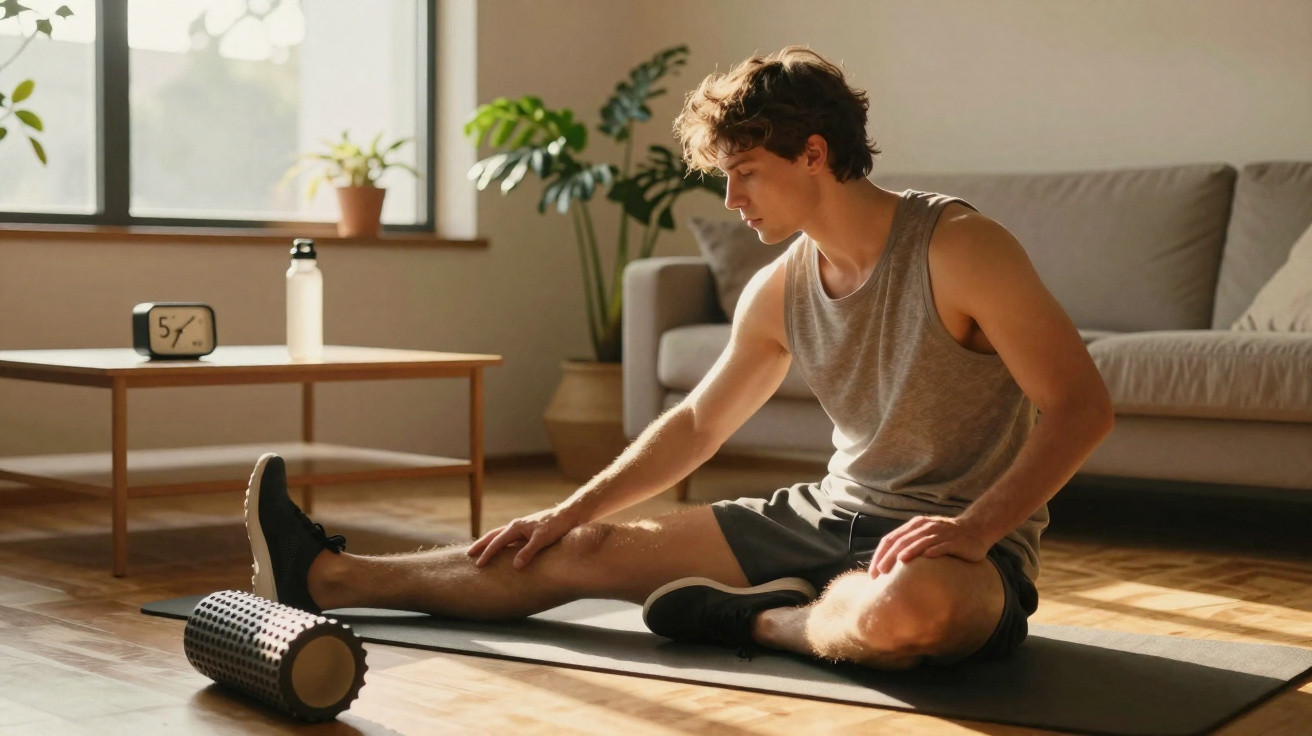
The gym was about to shut, yet he remained on the mat for a few more minutes. Wearing a faded marathon T-shirt, he grimaced as he forced his hamstring into a stretch that was nearly painful. All week, he had been talking about how tight his legs felt. “I’ll just stretch it out hard before bed,” he said, as though it were a magic spell.
By the following morning, he had returned with a limp. It was the same leg, but the pain was sharper, and he had one baffled question: “I thought stretching was supposed to help.”
For a moment, the room fell silent. The trainer glanced at the time, then at the swollen muscle.
Perhaps the issue was not that he stretched, but when he did it.
Why the timing of your stretching matters
Stretching seems so straightforward that many of us treat it like brushing our teeth: something to do anywhere, at any time, whether it is for five seconds between emails or late at night in front of a TV series.
But muscles do not operate according to our diaries. They work in rhythms, with body temperature increasing and falling, the nervous system ramping up and settling down, and hormones moving through cycles.
If those rhythms do not match what you are demanding from your muscles, tension may become irritation. A stretch that feels brilliant at 5 p.m. might feel abrasive at 11 p.m.
That is how an attempt to look after your body can gradually become micro-trauma.
Picture two people performing the same quadriceps stretch. One does it after a warm evening walk, when their muscles are warm and relaxed. The other gets out of bed at 6 a.m., still groggy, and pulls hard on a cold thigh while looking through notifications.
The movement may look identical on paper, but the physical response is not. In the early morning, core body temperature is lower, muscles are less elastic, and the nervous system is transitioning from sleep to wakefulness.
Research into circadian rhythms indicates that strength and flexibility commonly reach their highest point later in the day. Pushing hard into a stretch while tissues are “cold” can increase the chance of tiny tears and soreness that lasts.
The pose and floor may be the same, but the effect can be completely different.
The principle becomes clear once you consider it. Muscles are a little like chewing gum: take it straight from the freezer and it breaks; warm it slightly and it bends.
Stretching when you are cold, stressed or exhausted puts pressure on fibres that already have limited oxygen and blood flow. Rather than relaxing, they push back.
Your nervous system also retains pain. If you pull aggressively on a muscle late at night, after stress hormones have risen during a long day, your brain may “tag” that area as unsafe.
The next time you move, the muscle tightens earlier. You assume you are even stiffer and stretch more forcefully. The cycle then continues.
When stretching is most likely to backfire
One of the least suitable times for deep static stretching is immediately after getting out of bed. Your discs are more hydrated, the spine is slightly more vulnerable, and your muscles are still affected by the night.
Gentle mobility is fine. Long holds at the end of your range are less advisable, particularly for the hamstrings and lower back.
Another difficult period is very late at night, when your mind feels foggy after hours of sitting. Your posture may be poor, your movement quality can be untidy, and your pain threshold is both lower and harder to interpret.
That determined “10-minute stretch before sleep” can quickly become an unnoticed strain.
Consider a familiar scenario: after an intense leg workout or a long run, you hurry home, shower, eat and collapse on the sofa. Two hours later, guilt sets in. You get up, take hold of your ankle and pull your quadriceps into a deep stretch in the living room.
Your muscles are already managing the micro-tears created by training, then they suddenly face additional tension at the worst possible angle. There has been no warm-up or gradual progression.
People may wake with apparently “mysterious” knee or hip pain and blame the exercise session. Often, the actual trigger was an aggressive late stretch on fatigued fibres.
A scan simply shows irritated tissue. In practice, it was a combination of timing and ego.
From a physiological perspective, tissues respond well to predictability. They benefit from warming up, blood flow and movement before being lengthened.
Deep stretching when you are cold, hungry or stressed signals to your system that it is not safe. The muscles tense defensively, which is the opposite of the response you want.
Pain sensitivity matters too: discomfort often feels more intense when you are tired or emotionally depleted. As a result, an ordinary stretch at 10 a.m. may feel severe at 11 p.m. simply because your brain is overloaded.
This is how “stretching to feel better” can gradually become “stretching that keeps hurting you.”
How to stretch so muscle pain genuinely improves
The most useful change is simple: move before you stretch, rather than stretching first.
Walk for five minutes, go up some stairs, perform slow squats or swing your arms - anything that makes you slightly warmer without creating strain. Then move into gentle holds.
If a muscle is painful, consider doing deeper stretching in the late afternoon or early evening, when body temperature is naturally higher.
Hold each position for 20–30 seconds. You should notice a distinct pull, but ease off before reaching the point where it feels like “this is too much”.
The aim is to negotiate with the muscle, not overpower it.
People often target the painful area directly and forcefully, as if they need to punish it. Does your back hurt? You bend forwards and pull harder. Is your calf screaming? You drop into the deepest possible wall stretch.
A gentler method tends to work better. Stretch the area around the pain: work on the hips and glutes when the lower back is irritated, or the quadriceps and hamstrings when the knee is sore.
Account for days when you are tired. If you have slept badly or feel mentally drained, choose shorter, easier stretches and focus more on breathing.
Let us be honest: nobody really follows a perfect protocol every day. The goal is not perfection, but reducing the moments when you undermine yourself.
One physiotherapist I spoke with put it this way:
“The wrong stretch at the wrong time is like pulling on a frayed rope. It doesn’t make it longer. It just makes it weaker and angry.”
When you are in pain, your emotional state also has an effect. On a stressful day, a small pinch during a stretch can feel threatening, causing you to tense up further.
Simple anchors can help your brain feel safer:
- Breathe out slowly as you move into every stretch.
- Use a pain scale: 0 = no pain, 10 = unbearable. Remain around 3–4.
- On the days you stretch, try to do it at approximately the same time so your body begins to anticipate it.
Rethinking “good pain” and everyday routines
A subtle change occurs when you stop asking, “Did I stretch?” and instead ask, “When did I stretch, and what state was my body in?”
Those odd flare-ups after a “gentle evening stretch” then seem less mysterious. They start to make sense when viewed alongside fatigue, cold muscles and impatience.
You may find that the best option for a sore hamstring at 11 p.m. is not a deep static hold, but a hot shower and a mindful five-minute walk the following day.
Your routine becomes less about discipline and more about timing and paying attention.
| Key point | Detail | Why it matters to the reader |
|---|---|---|
| Avoid deep stretching on waking | Cold muscles, more sensitive discs and reduced range of movement | Reduces the risk of stiffness and sudden lower-back pain in the morning |
| Favour late afternoon or early evening | Higher body temperature and more supple muscles | Makes stretching more comfortable and reduces pain afterwards |
| Warm up before stretching | 5–10 minutes of walking or light movement | Improves the benefits without worsening existing tension |
FAQ
- Is it bad to stretch first thing in the morning? Not necessarily, but keep it very gentle and dynamic. Avoid deep forward bends or long static holds with cold muscles, especially if you already have lower-back or hamstring problems.
- Can stretching at night make muscle pain worse? Yes, if you do intense stretches when you are tired, stiff after sitting, or soon after a demanding workout. Choose mild, brief holds and concentrate on breathing rather than forcing your range.
- What time of day is best for flexibility gains? Many people feel more flexible and safer when stretching in the late afternoon or early evening, when body temperature and blood flow are greater. This is often the best window for progress.
- Should I stretch a muscle that’s already very sore? Begin by working around it: mobilise nearby joints and connected muscles, use warmth or take a short walk, then test a very gentle stretch. Reduce the intensity if pain increases or persists.
- How do I know if a stretch is “good pain” or harmful? Helpful discomfort remains mild, settles when you ease off and leaves you feeling looser after a minute. Sharp, stabbing or persistent pain that worsens over several hours suggests you have pushed too far, or stretched at the wrong time of day.






Comments
No comments yet. Be the first to comment!
Leave a Comment