
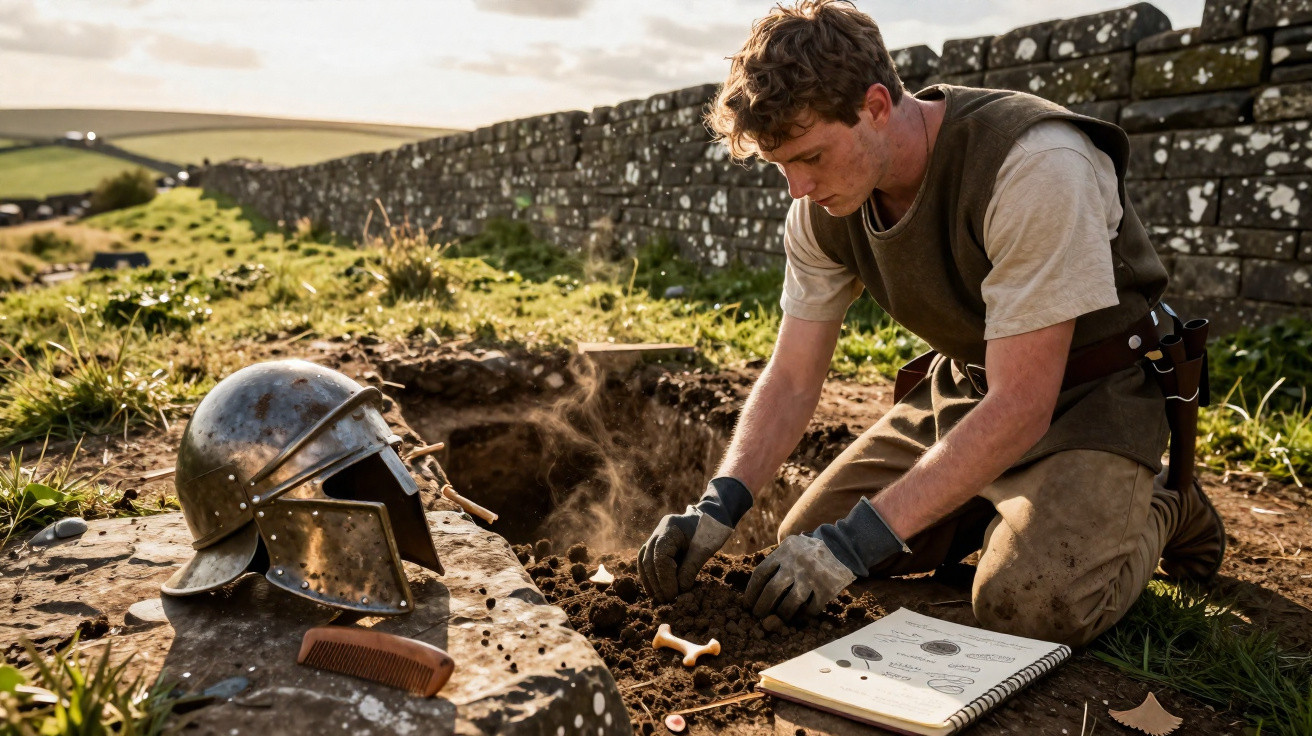
The wind lashes the ridge above Housesteads, while the stones of Hadrian’s Wall sit in a weary shade of grey beneath a pale English sun. A guide wearing a red cloak tells a school party about “brave legionaries standing firm against the barbarians”, delivering it with all the drama of Hollywood. The children scan the view and picture powerful Romans in gleaming armour: flawless, orderly, spotless and heroic.
What goes unmentioned is the odour that surrounded those troops. The lice in their hair. The whipworms in their intestines. The latrines contaminating the water they also consumed.
This omission, however, was not accidental.
Hadrian’s Wall wasn’t glorious – it was crawling
Beside one of the excavated barrack blocks on Hadrian’s Wall, the narrow stone chambers make the conditions easy to imagine. At night, eight men occupied a room scarcely larger than a modern bedroom, surrounded by woollen cloaks, leather equipment and wet boots. A brazier gave off smoke at its centre. There were no windows and no showers.
Archaeologists now believe these very rooms were alive with parasites. Soil samples from latrines near the Wall have yielded microscopic eggs from roundworm and whipworm. Fleas and lice flourished in coarse clothing and communal bedding. For many soldiers, everyday existence involved itching, discomfort and fevers… followed by another spell on guard in freezing rain.
An excavation at Vindolanda, immediately south of Hadrian’s Wall, altered how the story was understood. Researchers investigated deposits of old latrine waste beneath the fort. Viewed through a microscope, the results were horrifying: parasite eggs were everywhere, pointing to persistent infection.
Other teams studied the remains from bathhouses where soldiers attempted to wash “clean”. They found fine-toothed lice combs worn down until they snapped, as well as traces of human skin cells and faecal bacteria in the drains. The army constructed baths to support discipline and morale, but these facilities probably circulated contaminated water repeatedly. On postcards, Hadrian’s Wall appears to be a sharply defined frontier. In reality, it was a grimly physical place.
How, then, did the image of immaculate Roman heroism take hold? Victorian historians provide part of the explanation: they admired the vision of hardened, civilising legions confronting untamed northern tribes. Parasites had no place in that patriotic picture.
School textbooks continued to promote the same vision: neat formations, straight walls and upright posture. No diarrhoea, vermin or stench. We edited out the gross parts to keep the legend tidy. Yet findings from soil laboratories, bioarchaeology teams and museum archives repeatedly make the same point: Roman frontiers were as physical and disorderly as any present-day army camp, merely with less soap and no antibiotics.
How experts are dismantling the clean Roman soldier myth
The change began with a straightforward process: collecting minute soil samples from ancient toilets, drains and rubbish pits, then dissolving them in water. Parasite eggs become visible under a microscope. Exceptionally durable, they can remain intact for millennia. Once researchers recognise them, they appear throughout Rome’s former frontier zones.
Specialists compare this evidence with skeletal remains. Numerous skeletons from frontier forts display indications of lasting inflammation, restricted growth and strain on the spine. Taken together, these clues form a clear picture: living on Hadrian’s Wall was less “epic war movie” and more “long-term low-grade illness mixed with exhausting routine”.
This interpretation is no longer limited to specialist journals. Museum labels at some Wall locations are gradually being revised. A display in one northern museum now refers to intestinal parasites directly beneath a gleaming legionary helmet. Elsewhere, an exhibition places the delicate Vindolanda writing tablets – in which soldiers complain about cold and shortages – alongside information panels on lice and fleas.
Visitors are frequently taken aback, and some give an uneasy laugh. It is a familiar response when a polished version of the past suddenly meets the physical realities that school lessons avoided. That uncomfortable laughter marks a myth beginning to fracture.
According to experts, the traditional telling of Hadrian’s Wall followed a familiar formula: emphasise bricks, battles and emperors, while overlooking bodies, grime and illness. Immaculate, linear walls suited equally immaculate, linear narratives. Consequently, generations pictured Roman soldiers as near-superhuman figures who scarcely perspired beneath their armour.
Bodies, though, are indifferent to legend. They itch, bleed, swell, acquire worms and develop infections. Legionaries were no exception. Historians argue that restoring parasites, lice and latrines to the centre of the account produces a more truthful history: less postcard imagery, more ordinary people enduring one punishing day after another on an empire’s cold frontier.
What this changes in the way we read “heroic” history
The next time you encounter an uplifting phrase about “the brave men of the Wall”, try a small exercise. Stop and imagine that same soldier bent over with whipworm-induced stomach pain. Picture him rubbing his scalp raw beneath his helmet during a lengthy watch. Then return that picture to the heroic narrative.
This does not erase courage; it changes its meaning. Facing raiding parties is difficult enough. Facing them while deprived of sleep, underfed and infested is something else altogether. The gloss disappears, yet a more human reality emerges.
A frequent error, particularly in educational material, is to overcorrect when the myth falls apart: replacing “glorious Romans” with “disgusting Romans” in an instant. That swing of the pendulum is no more helpful. Life on Hadrian’s Wall lay somewhere between these extremes. Men made jokes, gambled, sent letters home, traded with local people, became ill, recovered and fell ill again.
To be honest, no one truly does this every day – by “this”, historians mean wandering about picturing lice beneath every ancient helmet and worms under every stone. Most people simply want an account that seems vivid and broadly truthful: one in which the labour and its cost can be felt, rather than only the presence of marble statues.
“Once you realise how riddled these soldiers were with parasites, the word ‘heroic’ actually means something different,” says one Roman frontier specialist. “You stop seeing them as bronze statues and start seeing them as exhausted conscripts doing their best with bad boots and worse plumbing.”
- Ask what’s missing – If a history book contains only gleaming armour and straight walls, remember that there is likely an unseen chapter about bodies and dirt.
- Look for the lab work – Soil analysis, parasite research and isotope testing quietly reshape major narratives. The most vivid evidence is often found in those technical footnotes.
- Value the discomfort – If a fresh detail makes the past seem slightly disgusting or awkward, it is usually a sign that you are getting closer to the way people actually lived.
A wall of stone, a past of flesh and blood
Hadrian’s Wall continues to draw thousands of visitors wishing to touch Rome’s frontier. They stand on its stones, take photographs, feel the wind and imagine themselves connected to something resilient and timeless. The desire for a clean, heroic past is powerful. Yet evidence of parasites quietly suggests a different account.
The Wall becomes less a monument to perfect discipline than a long, damp workplace for ordinary conscripts, many of them far from home, coping with poor food, unfamiliar weather and aching bodies. That perspective does not destroy the magic; it makes it gentler. It creates space for empathy as well as admiration.
Perhaps this is the real worth of the scientific “debunking”: after imagining a legionary shivering, scratching and swearing in darkness, it becomes harder to accept any polished narrative – ancient or modern – without asking what, and who, has been edited out.
| Key point | Detail | Value for the reader |
|---|---|---|
| Hadrian’s Wall soldiers were heavily parasitised | Soil and latrine analysis reveal widespread worms, lice and fleas in frontier forts | Challenges the clean “super-soldier” image and makes the past feel closer to real life |
| History books long hid the bodily reality | Victorian and later authors favoured orderly stories of discipline and empire | Encourages readers to challenge heroic accounts that omit mess, illness and exhaustion |
| New science is rewriting the frontier story | Bioarchaeology connects parasites, diet and everyday hardship at the Wall | Provides a fuller, more human way to imagine ancient lives and modern “heroes” |
FAQ:
- Were all Roman soldiers along Hadrian’s Wall infected with parasites? Not every individual soldier, but evidence from several forts has found parasite eggs in most latrine layers examined, indicating widespread and long-term infections throughout the garrison.
- Does this mean Roman hygiene was completely useless? No. Baths, latrines and washing practices reduced certain risks, although shared sponges, reused water and overcrowded barracks also enabled parasites to spread.
- Did the Romans know what parasites were? They observed worms in stools and connected some illnesses with foul water or dirt, but they did not understand microscopic eggs or complete life cycles as modern medicine does.
- Were local Britons in a better state than the legionaries? Not necessarily. Rural communities also experienced parasites, although food, housing and workloads differed, meaning some local people were probably healthier than frontier soldiers while others were worse off.
- Does this new research change how we should teach Hadrian’s Wall? Yes – not by removing bravery and engineering, but by including bodies, illness and daily hardship, allowing students to see Roman soldiers as complex people rather than spotless action figures.






Comments
No comments yet. Be the first to comment!
Leave a Comment