
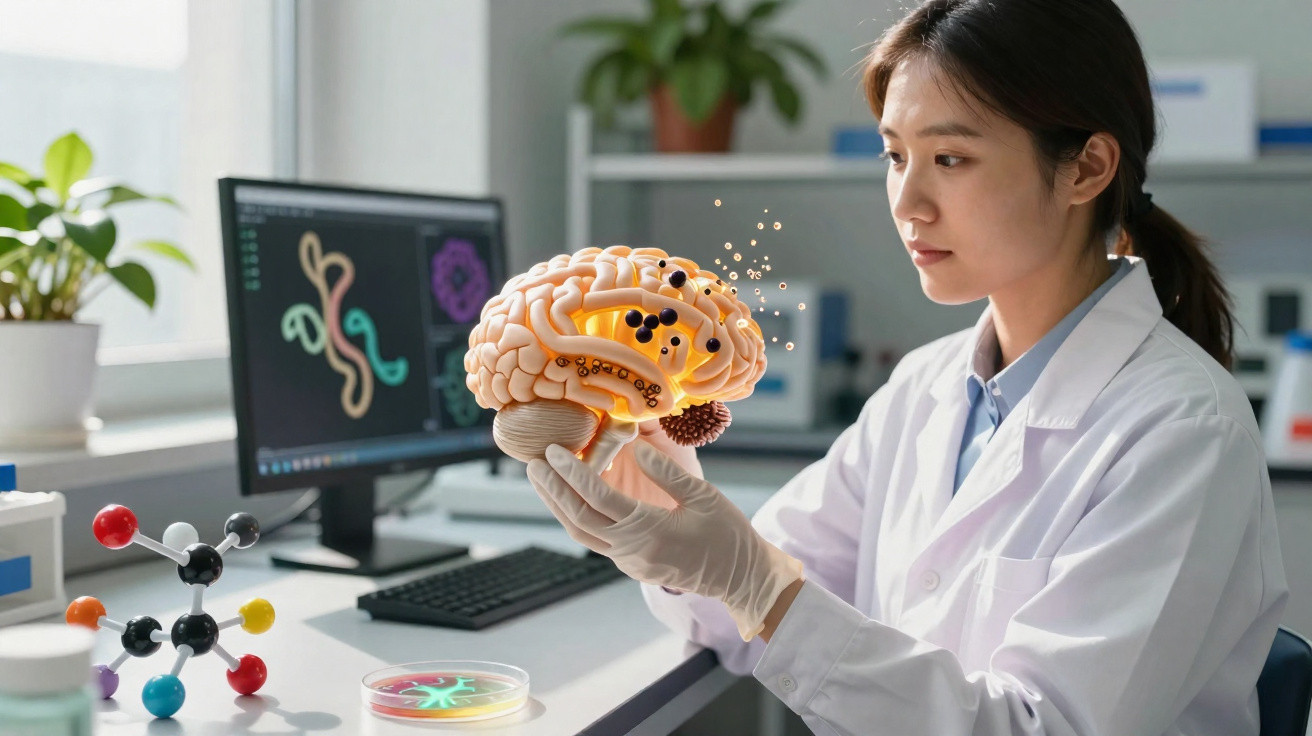
Researchers have discovered that the small molecule spermine may prevent the harmful accumulation of brain proteins associated with conditions such as Alzheimer's and Parkinson's – in a process likened to melting cheese over spaghetti.
Spermine has been known for more than 150 years. Under normal circumstances, it has a role in metabolism: the set of processes that turn food into energy and keep essential biological functions operating.
Spermine and Alzheimer's and Parkinson's protein build-up
A research team led by scientists at the Paul Scherrer Institute (PSI) in Switzerland gave additional spermine to worms displaying symptoms similar to Alzheimer's and Parkinson's. In old age, these worms were healthier, and their cells were less prone to losing energy and deteriorating.
Detailed studies of cells in test tubes revealed the mechanism involved. Spermine prompts tau and alpha-synuclein proteins – which commonly behave abnormally in Alzheimer's and Parkinson's – to gather into liquid-like droplets.
This makes the toxic proteins more readily removed by the body's waste-recycling process, called autophagy, helping cells retain their usual function. The researchers even use a culinary comparison to explain the process.
"The spermine is like cheese that connects the long, thin pasta without gluing them together, making them easier to digest," says biophysicist Jinghui Luo, from PSI.
How spermine supports autophagy
Tau and alpha-synuclein are amyloid proteins. When they malfunction, they may create hard, sticky aggregates that subsequently damage brain cells in neurodegenerative diseases.
Scientists do not yet fully understand whether these deposits cause Alzheimer's and Parkinson's or arise as a consequence of them, although they are clearly involved.
Spermine also forms clusters, but these are softer and more mobile. As a result, the body's clean-up system can eliminate them more easily, while spermine also stops the proteins developing into solid plaques. Such plaques resemble burnt food stuck to the base of a pan, making them far more difficult to remove.
"Autophagy is more effective at handling larger protein clumps," says Luo. "And spermine is, so to speak, the binding agent that brings the strands together."
"There are only weakly attractive electrical forces between the molecules, and these organize them but do not firmly bind them together."
The researchers also found that spermine only affects tau and alpha-synuclein when their concentration becomes excessively high and they are more likely to misfold under stress, producing toxic aggregates.
Potential wider uses for spermine
Although moving from experiments in test tubes and worms to treating a human brain affected by Alzheimer's or Parkinson's remains a considerable step, these initial findings are encouraging. Additional spermine could enable the brain to remove troublesome proteins more efficiently.
The researchers selected spermine because earlier work had shown that it can protect the brain from harmful processes.
Following these findings, the team hopes that spermine and similar molecules might be used against several diseases, including cancer – rather like combining special sauces to eliminate toxic processes.
"If we better understand the underlying processes, we can cook tastier and more digestible dishes, so to speak, because then we'll know exactly which spices, in which amounts, make the sauce especially tasty," says Luo.
The study was published in Nature Communications.






Comments
No comments yet. Be the first to comment!
Leave a Comment