
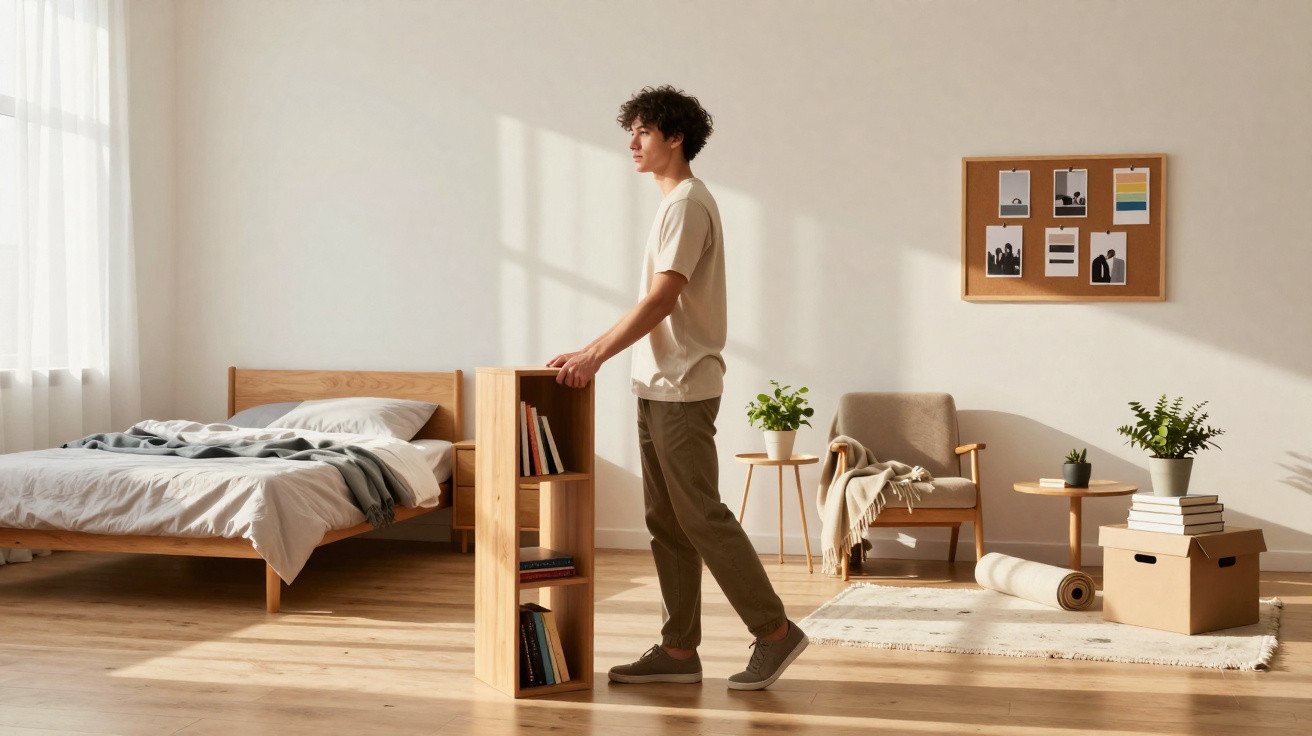
Her grey sofa was still there. So was the coffee table covered in old magazines, along with the pile of laundry that seemed to stare at her in silent judgement. In two years, so much had shifted - a new job, a break-up, therapy - yet her home appeared stuck in a snapshot of “before”.
She noticed that she was reliving the same arguments, the same late-night scrolling and the same Sunday gloom in precisely the same spot on precisely the same sofa. The room had turned into a set for emotions she no longer wished to carry, right down to the dip in the cushion.
Then, one Saturday, she pulled the sofa across to the other wall. She repositioned the lamp and got rid of half the belongings that reminded her of earlier versions of herself. The room felt brighter, but the real surprise was what happened in her mind. It was as though someone had silently opened a window in her head.
That was when she realised that perhaps some of her feelings were, in part… in the furniture.
Why your room keeps replaying the same emotions
Step into the kitchen from your childhood and pay attention to your body. Your shoulders may ease slightly. You catch the scent of phantom toast or imagined coffee. Your nervous system already knows its role. Your present-day home operates in much the same way, only less obviously.
Every area contains its own memory cycle: the chair where you cried during lockdown, the side of the bed where you doomscrolled in darkness, the desk where you invariably feel behind. Without fanfare, your brain labels these places with messages such as “this is where we feel anxious” or “this is where we feel small”.
You may think you are simply walking into a room. Your body believes you are returning to a feeling. When the room remains unchanged, so does the familiar script. This is how emotional patterns can start to seem like personality traits, even though they are often habits surrounded by walls.
Consider what happened in a small London flat. A 32-year-old software engineer told his therapist that he felt “instantly exhausted” whenever he sat at his compact dining table. He assumed he was experiencing burnout. Together, they traced the feeling to months of late-night pandemic work, bent over that very table beneath the same unforgiving ceiling light.
On impulse, he relocated his workspace to another wall, introduced a warm-lit lamp and reserved the table for meals and visitors. Two weeks later, he reported something unexpectedly straightforward: “I don’t dread that corner anymore.” His workload was unchanged. His environment was not.
It is easy to dismiss this effect. A 2023 survey by the American Psychological Association found a strong connection between cluttered or chaotic homes and increased stress and helplessness. Yet statistics cannot fully capture the quiet instant when a person sits in an old chair and unconsciously becomes an older version of themselves.
There is a reason reorganising a room can feel like pressing a gentle reset button in your chest. The brain is a prediction machine, holding an immense catalogue of “when I am in this place, I usually feel X”. Place, lighting, scents and sightlines can all become signals.
If your sofa is where you routinely binge-eat and spiral, your brain does not wait for the food or difficult thoughts to arrive. The emotional sequence begins as soon as you sit down. Altering the physical arrangement can therefore loosen something: you are disrupting the cue rather than merely battling the emotion.
Therapists increasingly discuss “behavioural architecture”: arranging spaces so that new emotional habits are easier to practise. There is no need to knock down walls. Simply rotating a desk, replacing a chair or clearing one surface can be enough to unsettle the old routine. In that short period of uncertainty, something different can take root.
How to rearrange your surroundings to reset your inner script
Begin with something small and oddly precise. Choose one emotional pattern you have had enough of - scrolling in bed late at night, absent-minded snacking at the kitchen worktop or tense Sunday evenings at your desk. Then ask yourself directly: where does this normally happen?
That specific place is your experimental area. Give it a new script. Shift furniture by at least 30–40 cm, so that your body cannot automatically settle into the same position. Change the lighting. Put a plant where your phone usually sits, or a notebook where the remote control used to be. This is not merely decorating; it is a way of rewriting cues.
One simple rule: no emotionally heavy activity should share a corner with rest or joy. Keep work away from the bed. Move arguments away from the place where you eat. Separating these zones teaches your nervous system: “Here, we do calm. Here, we do hard things. They’re not the same.”
Many people hear this and conclude that they need a complete Pinterest transformation: new furniture, fresh paint and a huge budget. Nothing then changes, because the task feels too demanding when life is tiring enough already. Let us be honest: nobody really does that every day.
Instead, focus on small moves. If you often feel unsafe or on edge, position your chair with your back to a wall rather than a doorway. Clear one bedside table so that it contains only a book and a glass of water, rather than work emails. Place a soft throw or cushion on the chair where you usually steel yourself for difficult conversations, and use it solely for calls with people who make you feel secure.
The most frequent error is viewing a home as a storage unit rather than as part of the nervous system. Another is copying the aesthetic fashions of strangers when they do not suit your own life. Your sitting room need not resemble a magazine spread; it needs to feel like relief. While rearranging, pay less attention to “would this look good online?” and more to “can I breathe here?”
“Spaces are not neutral,” says a trauma-informed designer I spoke with. “Every object either feeds your stress or feeds your capacity to come back to yourself.”
How can you make this manageable on an ordinary Tuesday, when your energy is low and your mind is exhausted? Try a simple experimental format: 20 minutes, one corner, no perfection. Set a timer and leave your phone in another room. Then ask yourself quietly: what in this space makes me sink, and what makes me soften?
- Choose one emotional pattern and one area, rather than tackling your entire home.
- Move at least one large item and alter one light source.
- Take away one object linked to a difficult memory, then add one that represents the person you are becoming.
- Live with the new arrangement for 7 days before assessing it.
- If it feels worse, you have not failed - your body has simply given you more useful information.
The change is seldom dramatic at first. It appears in small choices made again and again: using a new chair rather than the old sofa when you are overwhelmed, or taking difficult calls beside a window instead of pacing the same corridor. Patiently, you show your body that the story unfolds differently here.
Living differently inside the same four walls
It takes a quiet sort of courage to look at your home and acknowledge that its layout belongs to a previous version of you. There is the desk that supported survival mode, the crammed wardrobe containing five separate identities and the sofa where you remained in a relationship long after your heart had gone.
Rearranging does not mean acting as though those chapters never existed. It means choosing not to keep rehearsing them physically every day. On a Tuesday morning, you move the bed so that light, rather than your laptop, is the first thing you see. On a Thursday evening, you shift the “fight corner” away from the sofa and preserve that space for silly films instead.
During a peaceful weekend, you might sit in the middle of the room and ask: if this space reflected how I want to feel next year, what could change by only 10%? The angle of a lamp. The direction of a chair. One shelf made less crowded. Small adjustments can create large ripples.
The stories we repeat about ourselves often sound permanent: “I’m just an anxious person.” “I’m bad at resting.” “I can’t focus at home.” Yet these statements were written in particular rooms, at particular tables and under particular lighting.
Once you move the table, the sentence may no longer fit quite so easily. Your brain must reconsider the terms: perhaps in this place, I read rather than scroll. Perhaps by this window, I breathe more slowly. The same life, rearranged, can begin to seem slightly less confining and more like something you can help edit.
Some people begin with a drawer. Others start with their bed, or with the first thing they see upon opening the front door. Wherever you begin, the message remains: your surroundings are not merely a backdrop. They are a quiet partner in your emotional life.
Changing them is not magic. Some pain runs deeper than any shift in furniture can reach. Still, people repeatedly describe the same surprise after a modest alteration: an argument that did not escalate this time, a craving that passed more quickly, a Sunday evening that felt like a pause rather than a storm.
We all recognise the feeling of entering a hotel room or rented cottage and, for no obvious reason, feeling lighter and more free to be different. The walls do not know you yet. There is no established script. Reorganising your own home lets you borrow some of that feeling without going anywhere.
Perhaps you will not repaint a thing. Perhaps this week you will only move one chair, clear one surface or retire one object that hurts to look at. That may be enough to tell your nervous system: the story is not finished. The set is changing. You are allowed a new scene.
| Key point | Detail | Benefit for the reader |
|---|---|---|
| Places trigger emotions | Each area of a room is connected with memories and repeated internal states | Understand why certain spaces feel draining or anxiety-inducing before anything even happens |
| Small changes, major effects | Moving a piece of furniture, changing a light source and creating dedicated zones | Access improved emotional wellbeing without a large budget or major building work |
| Experiment rather than decorate | Try a new arrangement for a few days, then make adjustments | Create an environment that genuinely supports the version of yourself you want to become |
FAQ:
- How do I start if my place is tiny and cluttered? Choose one square metre and one emotional pattern. You do not need additional space; you need clearer functions: this corner is for rest, not work or scrolling. Clear only that zone, then reposition one chair or light source.
- Can rearranging a room really impact anxiety or low mood? It cannot replace therapy or medication, but it may reduce everyday triggers. Altering visual and physical cues can help your nervous system avoid falling so quickly into old stress cycles.
- What if the people I live with don’t want to change anything? Take ownership of small areas: your bedside, desk surface or one shelf. Explain that you are experimenting for your mental health, rather than criticising their habits. Sometimes, clear benefits make others curious instead of resistant.
- Do I need to buy new furniture or decor? No. Begin by changing what you already own. Remove, rotate and repurpose. Often, taking items away has greater emotional impact than bringing in more objects.
- How long until I feel a difference after rearranging? Some people notice a change on the first evening, while for others it is more subtle. Give every new arrangement at least a week. Look for small signals: less dread in one corner, falling asleep more easily or arguments that feel gentler.






Comments
No comments yet. Be the first to comment!
Leave a Comment