
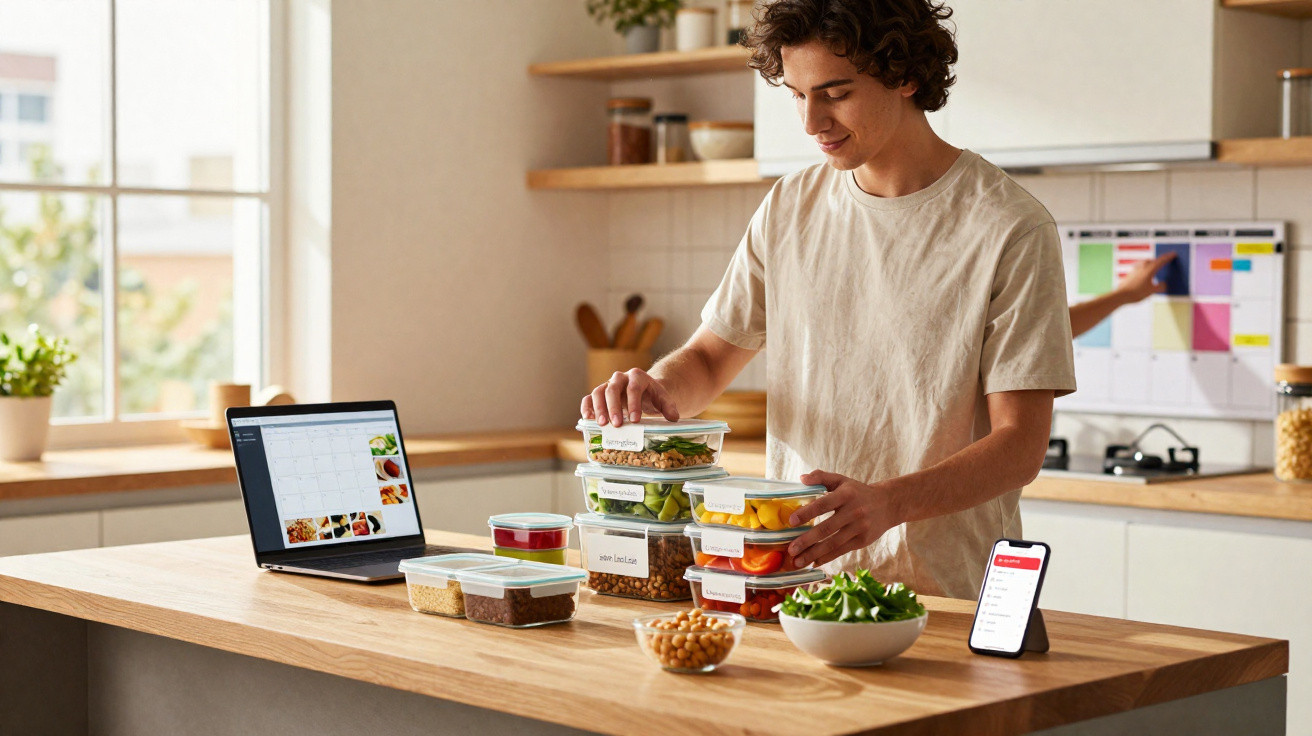
The fridge door swings open to reveal leftovers wrapped in plastic - and guilt.
There is a forgotten salad, half a box of eggs and three sauces that nobody can recall purchasing. It is Monday evening; you are worn out and hungry, managing a gluten intolerance after a meeting that overran. The hob remains untouched while the delivery app glows on your phone.
With dietary restrictions, children’s activities and that loose intention to “eat healthier this week”, meal prep can seem like another full-time role. Recipes call themselves “simple”, yet somehow presume you have 45 minutes and a fresh haul from the farmers’ market. In reality, you have 12 minutes, a microwave and an already overloaded mind.
Yet some people have found a way through. Their food is prepared, labelled and, crucially, eaten. There is no graveyard of sad Tupperware. Perhaps the answer is not greater willpower, but more intelligent personal rules built around real life - rules that flex with your allergies and diary, and that you can genuinely maintain.
Rethinking Meal Prep When Your Life Doesn’t Fit the Template
The traditional Sunday mega-prep - four hours, ten containers and relentless chopping - suits almost nobody with a realistic schedule. Add coeliac disease, lactose intolerance or a low-FODMAP diet, and much of the generic “meal prep inspo” on social media becomes meaningless background content. You scroll through it, save it and never make it.
The change usually happens when people stop aiming for photogenic batch-cooked meals and begin seeing meal prep as an adaptable system. Instead of complete recipes, they prepare components. Rather than “eat this exact bowl from Monday to Friday”, the approach becomes “keep five safe ingredients that I can combine while half-asleep”. It is a modest adjustment with an enormous effect.
A London nutritionist told me that many of her most time-pressed clients prepare only two items: a protein base and a flexible sauce compatible with their restrictions. That is all. The rest comes from the freezer and cupboard in a plug-and-play format. It may sound almost overly simple, but simplicity is precisely what an overwhelmed brain can repeat every week.
In a survey of office workers with dietary restrictions, those who maintained their food plans were not the people with the harshest rules. They had the most forgiving systems. One teacher with a nut allergy and IBS said she makes only three “anchors” weekly: a safe grain, a protein and a tray of roasted vegetables. She uses them in entirely different ways - bowls, wraps, omelettes and even blended soups.
One week, her “grain” may be quinoa; the following week, it may be rice. Her protein could be tofu, chicken or lentils, depending on her budget and what is on offer. The framework remains constant while the ingredients shift. It is like using the same template but colouring it differently every few days. That small routine lets her feel organised without feeling trapped, while her gut symptoms flare less because she always knows exactly what is in her meals.
Whether logical or not, our minds dislike friction at 8 p.m. If you must decide every detail from scratch - what to eat, what fits your diet and what you have time to prepare - you are bargaining with yourself when you are already exhausted. A personalised meal prep plan succeeds because it automates those choices. You are preparing not only food, but fewer decisions. Once the framework is in place, dietary restrictions become barely noticeable guardrails rather than a daily problem to solve.
Practical Meal Prep Systems for Allergies, Intolerances and a Wild Calendar
One of the most useful steps is creating a “safe swaps library” before you even switch on the hob. Rather than searching separately for gluten-free, dairy-free and low-sugar recipes, make a concise list of your reliable substitutions: oat milk in place of cream, tamari instead of soy sauce and chickpea pasta rather than wheat pasta. Write it once, stick it inside a cupboard and leave it there.
When you find a recipe that appeals, the question changes from “Can I eat this?” to “Which three items do I replace using my list?” A cheesy pasta bake can then become a gluten-free, dairy-free traybake that still feels familiar. This is particularly effective during busy weeks. You no longer waste time mentally converting every recipe from “normal” into “safe for me”; you make the swaps and carry on.
Let’s be honest: nobody genuinely does this every day. Nobody batch-cooks flawless, macro-balanced lunches and homemade snacks five evenings in a row. The people who appear to manage it are usually repeating small, unexciting habits that endure even during their worst weeks. A ten-minute cupboard check on Sunday. Washing vegetables as soon as they are bought. Labelling frozen food with “Tuesday-me will be tired: heat this.” None of this is glamorous, but it keeps meal prep functioning when the week falls apart.
On a hectic cardiology ward in Paris, a nurse with a dairy allergy told me that she prepares only what she calls “emergency meals”. She keeps two or three microwave-ready portions in the freezer, clearly marked “Night shift safe”, “Post-call safe” and “Too tired to chop”. They are not attractive meals: rice, frozen vegetables and a protein prepared in bulk during a calmer afternoon, with a jar of dairy-free pesto to make it taste like a proper dish.
When colleagues order cheese-laden pizza at night, she has nothing to weigh up. She opens the freezer, takes the box marked in her own handwriting and eats without anxiety. It is not aspirational; it is practical. That is exactly why it works from one week to the next.
The figures point in the same direction. In a small internal study run through a corporate wellness programme, employees with food allergies who made only two emergency meals weekly reported 32% fewer last-minute takeaways and significantly less anxiety about “what if there’s nothing I can eat at this event?”. That is the understated value of a personal back-up plan, frozen and waiting for your future self.
Logically, the benefit comes from dividing meal prep into small, repeatable tasks. With dietary restrictions, you are not simply cooking; you are managing risk. This does not require an elaborate system, only predictable routines. A weekly “prep window” need not be Sunday. It might be two 20-minute sessions: Wednesday for grains and proteins, and Saturday for chopping and washing produce.
This divided method works around children’s bedtimes, shift patterns and unpredictable meetings. It also turns the psychological mountain of “Sunday prep day” into two smaller hills that you may actually manage to climb. Your restrictions become parameters rather than barriers. Once you have safe ingredient bases ready, weekday cooking becomes assembly - something manageable even on the bleakest days.
Psychologists describe this as “choice architecture”: arranging your surroundings so that the easiest option also supports your health needs. Meal prep is simply choice architecture with Tupperware and spices.
Tools, Tricks and Tiny Rituals That Change Everything
For busy people with dietary restrictions, the “two-pan rule” is a particularly effective shortcut. Rather than constructing complicated menus, commit to using precisely two cooking surfaces once or twice each week: one baking tray in the oven and one saucepan or frying pan on the hob. Both must be completely safe for your diet. That is the sole requirement.
On the tray, add a selection of vegetables that work for your digestion - perhaps carrots, peppers and courgettes if you follow a low-FODMAP approach. On the hob, make a large amount of one protein: lentils, marinated tofu, chicken thighs or turkey mince. Once they have cooled, portion everything into separate containers. Later, they can become wraps, bowls, stir-fries or salads in fewer than ten minutes.
That straightforward limit prevents you from making the week unnecessarily complicated while providing dependable ingredients to work with. It is rather like having a discreet sous-chef who completed half the work several days earlier.
Standard advice tells people to “plan all your meals on Sunday”, but for many people with restrictions this becomes a perfectionist trap. You attempt to schedule every breakfast, snack and dinner; then a meeting overruns, your child is ill or you are simply too tired, and suddenly the entire plan seems “broken”. At that point, many people give it up altogether.
A gentler approach is to prepare for the problems you already know will occur. There will be one late arrival home, one lunch break swallowed by a meeting and one day when your stomach is more sensitive than normal. Include those realities in your preparation: one extra mild meal, one portable safe snack and one adaptable dinner that can take either 10 or 25 minutes, depending on how much energy remains.
Practically, this means beginning on a smaller scale. This month, your whole “plan” might simply be making breakfast foolproof: overnight oats with lactose-free yoghurt, boiled eggs, chia pudding with soy milk or savoury rice porridge reheated throughout the week. Once that is effortless, move on to lunches. You do not need a Pinterest-perfect board; you need one or two actions you can still repeat when the day goes wrong.
“The best meal prep plan isn’t the one that looks perfect on paper. It’s the one you still follow on the days you’re exhausted, annoyed, and tempted to skip it all,” shared a dietitian who works with burned-out junior doctors.
To make difficult days more manageable, some people keep a small “comfort box” in the cupboard containing three or four shelf-stable foods that are both safe and comforting. This could include gluten-free instant miso soup, tinned lentils, rice cakes and a jar of dairy-free chocolate spread. When life feels overwhelming, supper might be nothing more than hot soup, lentils with olive oil and salt, followed by a sweet rice cake. It is not glamorous, but it is soothing, quick and entirely compatible with your needs.
- Reserve one shelf or drawer exclusively for “me-safe” foods to prevent cross-contamination and avoid last-minute panic.
- Put coloured stickers on containers: green for “stomach-friendly”, red for “eat on high-energy days only”.
- Batch-prepare sauces and dressings that suit your restrictions; they can turn plain rice and vegetables into proper meals.
- Freeze leftovers in individual portions, labelling each with the date and a mood: “Spicy night”, “Gentle on gut”, “Post-gym”.
Food That Fits Your Life, Not the Other Way Around
There is a quiet sense of relief when your food finally fits your actual life rather than an idealised social-media routine. You stop battling your schedule quite so much. You no longer have to renegotiate your restrictions at every meal. You open the fridge and find choices made by an earlier version of yourself who understood what today might feel like.
On a difficult Wednesday, this may be a labelled container of rice and roasted carrots, a jar of nut-free pesto and some cooked tofu waiting at the back of the fridge. Five minutes later, you are eating a hot meal that does not upset your stomach or damage your budget. No drama and no elaborate recipe - simply a plan quietly doing what it was meant to do.
We have all experienced the moment when the takeaway app wins, not because we do not care, but because we are tired and facing the decision alone. A customised meal prep system - made up of your own safe swaps, your own “emergency meals” and your own two-pan ritual - is there at that moment, gently shifting the balance in another direction. It does not have to look impressive. It has to function when you are least able to manage.
The genuine innovation is not a new superfood or a complicated smart kitchen device. It is choosing to design food around your real body and your real days. Once you do that, the plastic containers in the fridge stop feeling like obligations and begin to feel like small, quiet acts of care. That is the sort of plan people discuss, copy and share.
| Key point | Details | Why it matters to readers |
|---|---|---|
| Build a personal “safe swaps” list | Make a short list of reliable replacements for your restrictions (for example, tamari instead of soy sauce, oat milk instead of cream and rice pasta instead of wheat). Keep it visible in the kitchen so you can adapt any recipe in under a minute. | It reduces decision fatigue and allows you to prepare mainstream recipes without continual anxiety over labels, saving time and lowering stress on busy evenings. |
| Prep “anchors”, not full meals | Concentrate on 2–3 basic items each week: a grain, a protein and a tray of safe vegetables. Combine them in different ways - bowls, wraps and soups - rather than preparing identical lunches. | Your meals feel less repetitive while still offering structure, helping you remain consistent when the week becomes chaotic. |
| Always have 2–3 “emergency meals” frozen | Batch-cook uncomplicated, fully safe meals in individual portions (for example, rice + veg + protein) and label them for your future self: “Late shift”, “Stomach fragile”, “Zero energy”. | This creates a safety net on evenings when a takeaway seems like the only choice, helping you meet your health needs and protect your budget. |
FAQ
- How do I start meal prepping if I have multiple dietary restrictions? Start with one meal and one rule. For instance, make only safe breakfasts for the week using an easy pattern such as “grain + protein + fruit”. When that becomes manageable, introduce lunches. Attempting to transform every meal at once commonly results in burnout.
- What if my schedule changes every week and I can’t predict my evenings? Avoid strict day-by-day schedules and instead prepare “meal types”: quick microwave dinners, lunches suitable for eating at a desk and options that are gentle on the stomach. Make 2–3 of each, then choose according to your energy and timings that day.
- How can I avoid cross-contamination when I share a kitchen? Keep one shelf or drawer solely for your ingredients, use dedicated chopping boards and utensils, and place prepared food in sealed containers on the top shelf of the fridge. Colour-coding your equipment can help other people at home remember what is off-limits.
- Is meal prep still worth it if I can only spare 30 minutes a week? Yes, provided you target the greatest impact. Use those 30 minutes to prepare a large batch of one safe protein and wash and chop a few vegetables. Those two jobs alone can reduce weekday cooking to 5–10 minutes per meal.
- What can I do if I get bored eating the same foods all the time? Alter the “accessories”, not the entire meal. Change the sauces, herbs and textures: make rice and chicken into a salad one day, soup the next and a wrap on Friday. Small changes maintain interest without adding hours of kitchen work.






Comments
No comments yet. Be the first to comment!
Leave a Comment