
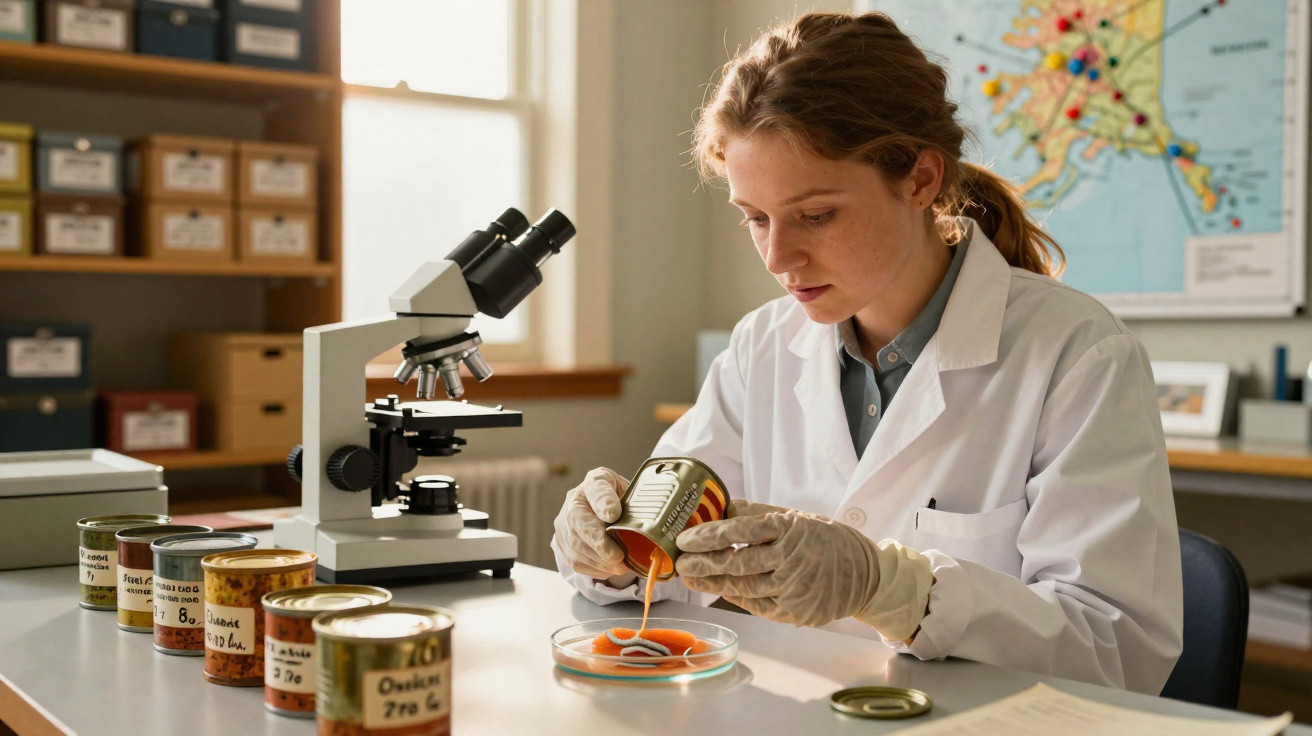
Scientists have uncovered some fascinating findings about parasites in an accidental natural history museum tucked away at the back of a pantry. Salmon tins long past their expiry date have retained decades of Alaskan marine ecology in brine and metal.
Because parasites interact with numerous species, they can offer valuable insight into an ecosystem. Yet, unless they create a serious problem for people, they have largely been overlooked historically.
This has posed a challenge for parasite ecologists such as Natalie Mastick and Chelsea Wood of the University of Washington, who were seeking a retrospective way to monitor the effects of parasites on marine mammals in the Pacific Northwest.
Canned salmon becomes an ecological archive
When Wood received a call from Seattle's Seafood Products Association asking whether she would take boxes of dusty, out-of-date salmon tins off its hands - some dating from the 1970s - she gave an unequivocal yes.
The association had retained the tins for decades as part of its quality-control procedures. For the ecologists, however, they became an archive of exceptionally preserved specimens - not salmon, but worms.
Watch the video below for a summary of the research:
Although the thought of worms in canned fish may be rather stomach-churning, these marine parasites - anisakids, which are about 1 centimetre long - are harmless to humans once the canning process has killed them.
"Everyone assumes that worms in your salmon is a sign that things have gone awry," said Wood when the research was published in 2024.
"But the anisakid life cycle integrates many components of the food web. I see their presence as a signal that the fish on your plate came from a healthy ecosystem."
How anisakid parasites move through the food web
Anisakids enter the food web after being consumed by krill, which are then eaten by larger animals.
That is how anisakids reach salmon and, eventually, the intestines of marine mammals. There, the worms reproduce and complete their life cycle. The mammals excrete their eggs into the ocean, where the cycle starts again.
"If a host is not present – marine mammals, for example – anisakids can't complete their life cycle and their numbers will drop," said Wood, the paper's senior author.
Salmon tins reveal changing worm numbers
The 178 tins in the archive held four salmon species caught in the Gulf of Alaska and Bristol Bay over a 42-year period (1979–2021): 42 tins of chum (Oncorhynchus keta), 22 coho (Oncorhynchus kisutch), 62 pink (Oncorhynchus gorbuscha), and 52 sockeye (Oncorhynchus nerka).
While the methods used to preserve the salmon did not, fortunately, leave the worms in perfect condition, the researchers could dissect the fillets and work out the number of worms per gram of salmon.
They discovered that worm numbers rose over time in chum and pink salmon, but not in sockeye or coho.
"Seeing their numbers rise over time, as we did with pink and chum salmon, indicates that these parasites were able to find all the right hosts and reproduce," said Mastick, the paper's lead author.
"That could indicate a stable or recovering ecosystem, with enough of the right hosts for anisakids."
Explaining the unchanged worm levels in coho and sockeye is more difficult, particularly because the canning process prevented the specific anisakid species from being identified.
"Though we are confident in our identification to the family level, we could not identify the [anisakids] we detected at the species level," the authors write.
"So it is possible that parasites of an increasing species tend to infect pink and chum salmon, while parasites of a stable species tend to infect coho and sockeye."
Mastick and her colleagues believe this new method - turning dusty old tins into an ecological archive - could lead to many further scientific discoveries. It appears they have opened quite a can of worms.
This research was published in Ecology and Evolution.
An earlier version of this article was published in April 2024.






Comments
No comments yet. Be the first to comment!
Leave a Comment