
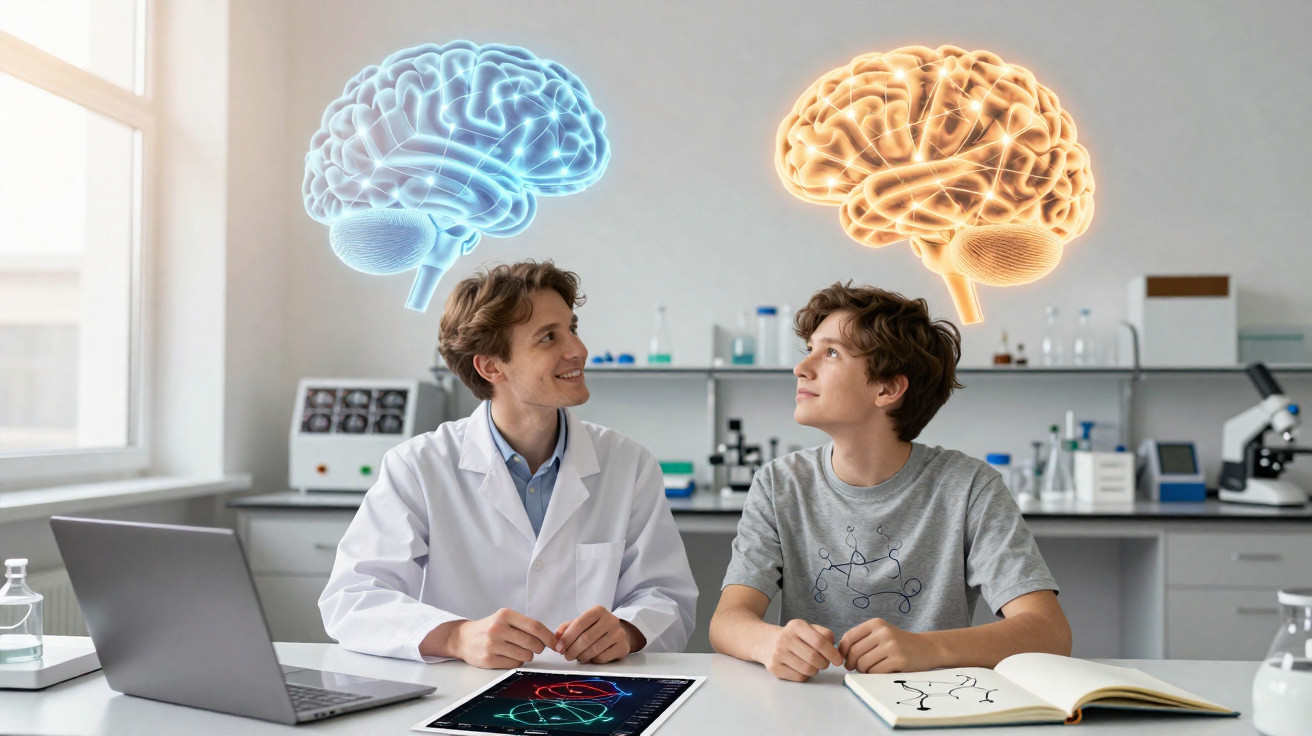
Autism is a complex condition that affects people in markedly different ways.
Although researchers have greatly improved their understanding of the condition over recent decades, defining separate autism subtypes has remained difficult. Such classifications could assist people diagnosing autism, those living with it, and anyone seeking to understand it better.
A new study may have brought that goal closer.
Two autism subtypes identified through brain connectivity
An international research team has identified two autism subtypes using evidence from human and mouse brains. Through cross-species analysis, the scientists verified their results and established the biological differences between the subtypes.
They hope the findings will support the development of more targeted autism therapies and support programmes, replacing the approach to the condition that is often treated as 'one size fits all'.
"For decades, we've observed tremendous variability in how autism manifests, but we lacked direct evidence that these differences reflected distinct underlying biology," says neuroscientist Alessandro Gozzi, from the Italian Institute of Technology.
"Our approach enabled us to isolate specific genetic and immune factors, then translate those signatures to human brain scans, showing that different connectivity patterns encode different mechanistic pathways underlying autism."
The team examined brain scans from mice with 20 different models of autism-like brain features, alongside scans from 940 autistic children and young adults and 1,036 neurotypical people. They searched for differences in patterns of brain connectivity.
Hypoconnectivity and hyperconnectivity patterns
This analysis revealed two clusters of comparable patterns.
The first was the hypoconnectivity group, in which autism was linked with lower brain connectivity. In this group, brain activity was associated with genes involved in the synapse junctions that allow brain cells to communicate.
The second was the hyperconnectivity group, which was connected with greater connectivity throughout the brain. Its brain patterns were associated with immune-system-related genes and measures of slightly more severe autism.
The fact that the results could be reproduced in both mice and humans, as well as across separate human datasets, provides strong evidence that these are real autism subtypes.
There could still be further subtypes to uncover, however. Only around one in four of the analysed human autistic brains belonged to either the hypoconnectivity or hyperconnectivity groups.
"The mouse models gave us a biological 'Rosetta Stone'," says neuroscientist Adriana Di Martino, from the Child Mind Institute in the US.
"We could see which biological pathways drive which connectivity signatures, then search for those same patterns in humans."
Much remains to be done, but if the hypoconnectivity and hyperconnectivity subtypes are confirmed and can be diagnosed, it may be possible to develop therapies specifically for these autism categories, based on the biological traits identified by the study.
Previous efforts to classify autism
This is not the first attempt by researchers to identify shared patterns and divide autism into multiple types.
A study published in 2025 identified four autism types among 5,000 children. However, it defined those categories through more than 230 distinct behavioural traits, rather than the brain-imaging method used in this research.
Other studies have investigated how the expression of autism may vary according to when it develops: in early childhood, late childhood, adolescence, or young adulthood. Together, these lines of research can contribute to the wider aim of identifying and understanding autism more effectively.
Autism may be described as a spectrum, a term intended to capture the broad range of ways autistic people communicate and behave.
Some experts, however, argue that this is not the most useful description of what it means to be neurodiverse in this respect, and advocate for alternative approaches.
The researchers say that bigger datasets and more sophisticated analytical methods should enable the identification of further subtypes in future. For now, they have made their collected data and analytical tools available for other scientists, making it easier to build on the study.
"Our cross-species approach provides an advanced translational framework for a multidimensional, biologically grounded stratification of autism," write the researchers in their published paper.
"Our database is openly available to the research community, supporting future investigations into autism-related connectivity alterations."
The research has been published in Nature Neuroscience.





Comments
No comments yet. Be the first to comment!
Leave a Comment