
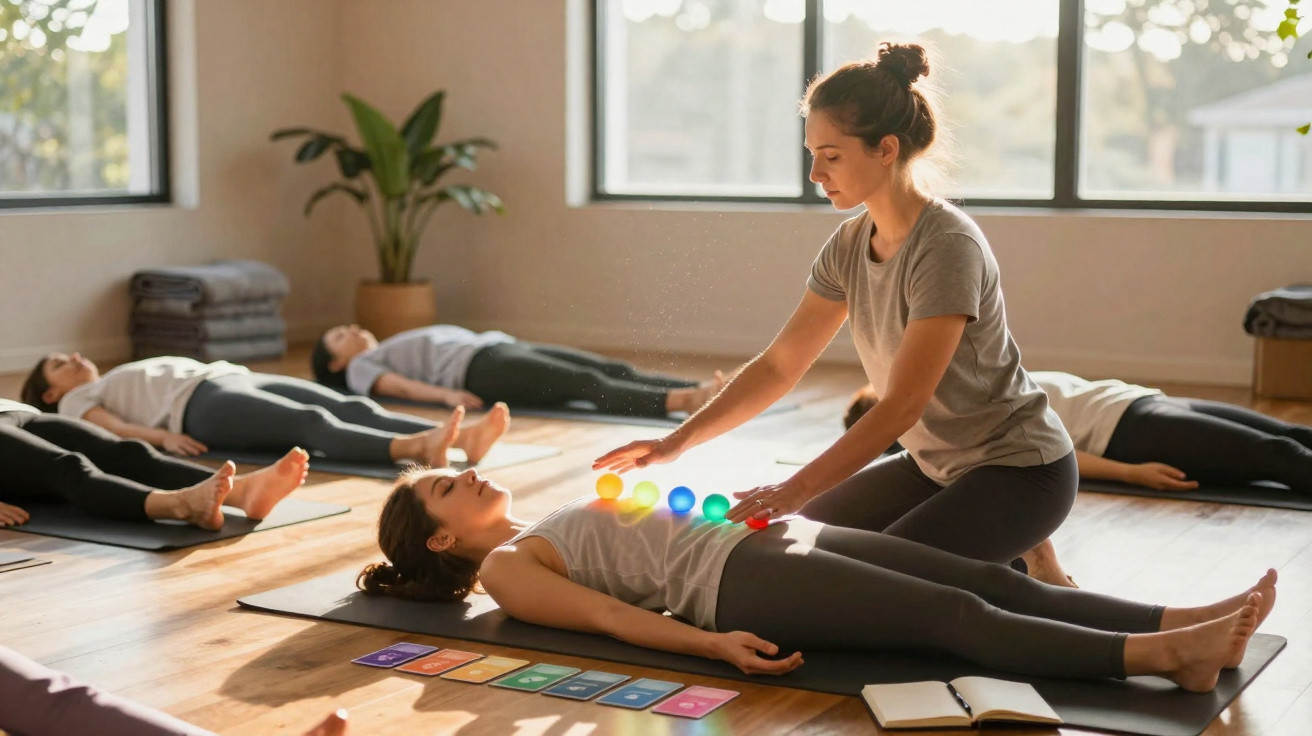
Understanding the Chakra System and incorporating it into your teaching methodologies: insights and suggestions
I was first introduced to the Chakra system while training as a Shiatsu practitioner. Before that point, it had only brought to mind the familiar image of a floating colour wheel placed over a faceless person sitting in lotus position.
At the time, it was not a concept that came naturally to me. I could not retain the names, never mind the colours, locations or emotional associations.
The phrase “third eye” came up regularly in Tai Chi and martial arts classes, and that was at least an idea I could understand. Even so, I did not feel any urge to investigate it further.
During my Yoga London teacher training course, I was also relieved to learn that we would only be assessed on the concept, names and locations of Ida, Pingala and Sushumna.
What changed this time?
After two years of teaching Yoga, these ideas began appearing in classes despite my initial resistance. Students would say things such as: “ I don’t feel grounded, my balance postures are off.” Others would develop a throat irritation, almost without fail, as they settled into Savasana. There were also many conversations about ongoing insomnia, digestive difficulties and students who were reluctant to let their hearts lead them forwards.
I started noticing, too, that certain asanas were becoming less comfortable in my own practice. Over time, I became increasingly aware that my experience of particular postures was changing. I recognised that there was a risk of allowing my own personal bias to filter into my teaching methodologies.
Because there are so many perspectives and methods within the Chakra system, I wanted to use this article as a resource I could return to. It sets out ideas that are both familiar and new to me, with the broad aim of finding fresh ways to weave these concepts into class themes and sequences. It also gives me an opportunity to deepen my own self-practice.
An overview of the Chakra system
The most useful description of the Chakra system that I found came from the Advanced Yoga Practices Ebook.
It describes the system as “functioning under the hood.” When driving a car, for instance, we do not need to focus on the workings of the engine, electronic systems or its many other processes.
Instead, we watch the fuel gauge, remember to release the handbrake and know that braking late is never wise. Meanwhile, the engine continues operating, much like the smooth muscles in the body that activate and function automatically. The same is true of the nervous system: much takes place without our conscious awareness. In a similar way, the energy wheels continue turning alongside our other internal processes.
Chakras as part of the internal energy system
Each Chakra has an anatomical position that corresponds with different aspects of the nervous system. A Chakra may be understood as a rotating energy vortex formed within us by both internal and external influences.
Chakra is derived from the Sanskrit term for “wheel” or “disk.” Tantric traditions refer to seven principal chakras. In this article, I will use the eight major chakras proposed by the Transformational Yoga model.
The Chakras sit vertically along the spine, beginning at its base and extending to the crown of the head. Every chakra is linked with a major nerve ganglion, glands within the endocrine system, and bodily functions including digestion and breathing. It is important to remember, however, that chakras themselves have no physical structure.
Chakras in psychological and philosophical practice
Psychologically - in mental, emotional and spiritual terms - the chakras correspond with key areas of life, including survival, sex, power, love, communication, perception and understanding.
From a philosophical perspective, chakras can be connected to archetypal ideas represented by earth, water, fire, air and ether. Colour, sound, herbs, food groups and particular gemstones may also be used as ways of accessing the chakras.
There are numerous smaller chakras across the body, including in the hands and feet. The eight chakras running along the principal Sushumna nadi are the best known. Nadis, or prana channels carrying vital life force, run throughout the body and connect the chakras. Ida nadi spirals from the left and carries descending life-force energy. Pingala nadi spirals from the right and carries ascending life-force energy. Smaller chakras regulate energy flow back towards the major chakras, although these minor chakras are far subtler.
For a kundalini awakening to occur, dormant energy travels from the base chakra through the nadis. It moves up the body’s centre, awakening each chakra as it rises. When it reaches the highest crown chakra, oneness with God or enlightenment is attained. A combination of Yoga practice, meditation, pranayama and body cleanses can trigger this process.
A basic description of each Chakra
The lower or ‘untransformed’ Chakras
These chakras relate to our general sense of identity and power in the world. They have greater influence over the physical body and its systems.
Mooladhara
The root chakra lies at the perineum in men and at the cervix in women. As the lowest chakra, it is connected with the earth element. It is regarded as the home of primal energy, known as Kundalini shakti. Kundalini is described as a serpent lying coiled in deep sleep and as the source of all prana. Regular Yoga practice aims to awaken this ‘sleeping serpent’ through self-purification and mental concentration, supporting energy as it travels upwards through the chakras towards sahasrara.
Swadhisthana
The sacral chakra is found in the spine, approximately two finger widths above the mooladhara chakra. Its loosest translation is ‘dwelling place’. This chakra relates to the pursuit of pleasure and security. Its focus includes excitement, pleasurable feelings, sexual desire and overcoming fear. When overactive, it can lead to an excess of desires and/or cravings. It corresponds with the water element.
Manipura
The solar plexus chakra sits in the spine behind the navel. Manipura translates as ‘city of jewels’. Considered the fire centre, it should shine with vitality and energy. This chakra is associated with self-assertion, dominance and ego. It is strongly related to digestion and metabolism. It also connects to the adrenal glands, especially our fight-or-flight response when we are under ‘threat.’
Anahata
In Transformational Yoga, the heart chakra is separated into lower and higher aspects. The lower chakra is concerned with emotions including conditional love, attachment and jealousy.
Located in the spine behind the sternum, level with the heart, anahata literally means ‘unstruck’. Physically, Anahata is linked to the heart and lungs, as well as the circulatory and respiratory systems. It is also described as our shock absorber.
The upper or ‘transformed’ Chakras
These four chakras concern higher states of consciousness and may not always be accessible until the lower four chakras have been cleared of blockages and toxins.
Anahata
When this chakra becomes purified, a sense of universal fellowship and tolerance can start to emerge. Conditional love develops into unconditional love, and we are released from attachment and expectation. The heart centre is also where the anahata nada, or unstruck sound, manifests. It is where intuition may be felt most powerfully in connection with the universe’s pulse. For me, this is the most difficult chakra to “feel” or relate to in myself. It is interrelated with the lower Anahata Chakra.
Vishuddhi
The throat Chakra represents purity in expression. It is positioned in the middle of the throat, between C7 and the first thoracic vertebra. This chakra concerns sound communication and the authenticity with which we express ourselves, through both listening and speaking. Vishuddha means purification. It is also connected with sound, vibration and creativity. It is interrelated with the Manipura chakra.
Ajna
The third-eye Chakra is located between the eyebrows at forehead level and is connected to the pituitary gland. Ajna means both to perceive and to command. It supports a state of ‘witnessing’ by directing attention inwards. It can help us cultivate intuition, visualisation and imagination, as well as the ability to distinguish between images we perceive and those we create.
In a Tai Chi class, once a new movement or section of a form has been taught, students may be told to stand still, close their eyes if they wish, and picture themselves moving through the exercises from their third eye. This method can help memorise the movements and internalise the practice further. Ajna is interrelated with the Svadhisthana chakra.
Sahasrara
The crown Chakra is concerned with thought, consciousness and information. It is unquestionably the most abstract of the chakras. It is the final gateway to “higher consciousness” or samadhi. It also represents our belief systems, awareness, and the ways in which we shape, change or reorganise the patterns in our lives. Sahasrara is interrelated with the Mooladhara chakra.
How to incorporate the Chakras into your teaching methodologies
Yoga practice naturally supports the chakras because asanas are intended to release prana. Through bending, twisting and stretching, prana is able to move more freely around the body. Yoga can be particularly helpful for releasing kundalini energy.
As with any Yoga class theme, there are many ways to build Chakras into your teaching methodologies.
Some teachers may create an entire class around one chakra. For instance, they might choose a backbend as the peak asana and use their language to integrate a heart-chakra theme. Others may weave elements of every chakra through the class, perhaps referring to the colour or sound associated with all eight chakras as the session develops. Alternatively, during Savasana at the end of class, a teacher might lead a meditation that invites students to scan the chakras throughout their bodies.
However, not everybody knows about chakras or has much interest in them. What other, more distinctive ways might introduce students to these concepts and to the benefits of becoming aware of these spinning wheels that help move our prana?
There are further questions to consider. Should we focus on the upper four chakras in a large group when we do not know every individual’s current physical and emotional wellbeing? If, in theory, the upper four chakras cannot be activated without first preparing the pathways in the lower four, might classes be better directed primarily towards the lower four?
1. Opening the hand chakras
While researching this assignment, I found a playful method for opening the hand chakras. As mentioned above, there are several chakras beyond the eight discussed in greater depth here. This practice is an effective way to access the sensation of a chakra, and I would certainly use it near the start of a class.
Sit comfortably and extend both arms straight ahead, with one palm turned up and the other turned down. Open and close the fists quickly and repeatedly, squeezing tightly for as long and as many repetitions as possible before reversing the direction of the palms. Continue until the hands feel tired.
Next, lower the arms, relax the fists and gradually bring the hands towards each other before moving them apart again. Can you sense a ball of energy between the hands? That feeling comes from the hand chakras, which are a smaller version of the chakras along the spine.
2. Colour themes
When working with colour themes, I would invite students to contemplate one colour during class, or ask them to observe any colours they notice when their eyes are closed in an asana or in Savasana.
There are also various yantra meditations in which you ‘breathe in’ a colour associated with a particular chakra. On the exhale, the colour is then allowed to clear toxins or blockages from the body.
Mooladhara: Red
Swadhisthana: Orange
Manipura: Yellow
Anahata: Green
Visuddha: Bright Blue
Ajna: Indigo
Sahasrara: Violet
3. Possible overall class themes for each Chakra
When planning a class, it can be helpful to establish a clear overarching theme. Your dialogue can reinforce that intention throughout the warm-up, standing sequence, seated sequence and final Savasana. Depending on students’ interest, you do not always need to name the chakra itself. Alternatively, you could identify your chosen chakra in the opening introduction without giving too much detail, then reinforce the theme using some of the suggestions below.
Mooladhara
Include ideas such as observing gravity and moving slowly between asanas. This may be particularly valuable for students accustomed to more dynamic Vinyasa classes. Encourage a connection to the feet and refer to Mula Bandha. This can work well in balancing postures, or while seated when drawing attention to the base of the tailbone and “grounding” into the mat. Stability, security and belonging are also useful words, as they relate to the earth element associated with this chakra.
Swadhisthana
For the sacral chakra, it can be enjoyable to focus on playfulness and awareness of bodily sensations. I might suggest that students move like water from Downward Dog through Chaturanga, or flow like water from one posture to the next. Include positive encouragement that helps students feel good in their bodies. You could also acknowledge that this chakra concerns desire and cravings, using light and appropriate references to the fact that we can all be guilty of overindulgence at times, and to our needs and wants.
Manipura
A Manipura class theme can centre on moving with purpose and will, while energising the limbs and abdominal area. Twisting asanas work particularly well because they stimulate metabolism and the digestive system. Remind students to remain fully present. In powerful asanas such as Virabhadrasana 2, encourage confidence, strength and discipline. As this chakra is associated with fire, it can make an excellent winter class theme for generating heat in the body.
Ananhata 4th & 5th
This is an especially popular theme among many teachers. I frequently attend classes in which teachers repeatedly invite students to open their hearts or move through the heart centre.
Useful keywords include air, feelings, compassion, love and joy. Encourage movement led by the breath, with an emphasis on deep breathing.
Perhaps because of my own hesitation around this area, I immediately feel uneasy. Not everyone is ready to open their hearts, and I feel that greater attention to the lower three chakras may be a more useful and beneficial place to begin. I regularly hear from clients that their friends attended a Yoga class based around heart openers and did not return to Yoga because they left in such an emotionally unsettled state.
Chest openers should always be taught with modifications that gradually build towards the full posture. Group classes can easily develop a strong competitive atmosphere. As teachers, we need to remain aware of this and discourage students from causing themselves physical or emotional harm. Pushing into Dhanurasana, Ustrasana or Chakrasana too early in practice may result in injury, or worse, put someone off continuing with Yoga.
Deep chest openers and backbends may sometimes release held emotions - frustration, fear, anger and sadness, as well as joy and love - so it is not unusual for students to experience these feelings again as they move through the body. Ensure that students understand this possibility and have enough time at the end of class to reflect on anything that arises.
As with the physical demands of these asanas, where a lack of core strength can place the lower back at serious risk, it is equally important to be gentle when grounding the emotional core.
Vishuddi
As this chakra is linked to sound and vibration, it is a suitable theme for introducing chanting and mantras. Chant at the beginning and again at the end of class, inviting students to notice differences in the sounds and sensations they experience at the start of practice compared with the end. Backbending asanas including Ustrasana, Matsyasana and shoulder stands may support the opening of the throat chakra. Again, be mindful that these postures can heighten a student’s sense of vulnerability. Always provide education and maintain a safe space in which students can explore these feelings and sensations.
Ajna
An Ajna class theme should make use of visualisation and imagination. In Warrior 3, for example, students might be asked to imagine that they are flying with their arms reaching forwards. In a Vrksasana variation, they could picture themselves as a tree moving in the wind. The class could begin and end with a short meditation, perhaps visualising each chakra colour progressing up the spine as outlined above.
Closing the eyes while repeating a sequence may help students learn to move from one asana to another with natural intuition as their guide. Forward folds can also be valuable because they are contemplative and turn attention inwards. Nadi Sodhana is another excellent addition because it governs the overall nervous system and all pranic bodies.
Sahasrara
For this class theme, it is useful to emphasise the relationship between the Mooladhara chakra and the crown chakra. This is particularly important for ensuring students feel grounded in their physical bodies again at the end of class. Meditation is an effective method for developing witness consciousness and cultivating a deeper connection with ourselves. Yoga Nidra and Nadi Sodhana can also complement a crown-chakra class. Even verbal instructions, such as inviting students to extend the crown of the head towards the ceiling, can reinforce the theme.
4. Dancing
I attended a chakra-themed Yoga class in London which began with 10 minutes of dancing around the studio. Initially, it took me by surprise, but I soon began enjoying it. There can sometimes be intense energy in a Yoga studio before class starts, so it is a relief when everybody is moving and dancing.
Dancing is an excellent way to open the root chakra and allow your natural rhythm to lead you. Letting the body move freely and without inhibition can help clear negativity while opening and balancing the first chakra. Awakening the root chakra can act as a catalyst for shifting prana upwards.
Dancing can activate and energise every chakra. Try different styles of music to shift your mood or mental state into a more positive space.
My conclusion
There is an enormous amount of information available on the Chakras. Like all holistic concepts, they can be presented and re-presented through Ayurveda, Traditional Chinese medicine, crystal therapies and even bad tie-dye T-shirts.
For me, the most significant lesson is their relevance, both as a teacher and within my own self-practice. I can see the real value of being more aware of verbal cues and broader information that may enhance the overall experience of a Yoga class.
Developing, little by little, an understanding of the role of the Chakras - from their place in the physical body to a Kundalini awakening - is an essential aspect of Yoga.
Until I understand the ‘bigger picture’ more fully, I think I will continue working with the ‘untransformed’ chakras and include pranayama such as Nadi Sodhana in group classes. In this way, the ‘untransformed’ chakras can prepare and feed back into their corresponding ‘higher chakra’. Over time, Nadi Sodhana can help balance the overall nervous system and the general movement of prana in students’ bodies.
This does not mean that I will avoid teaching backbends, inversions or chest openers. First, though, I will make sure there is adequate core strength and sufficient flexibility through the shoulders and hips. This allows the physical body to support the prana body, then the mental body, and ultimately the psychic and spiritual body.

Comments
No comments yet. Be the first to comment!
Leave a Comment