
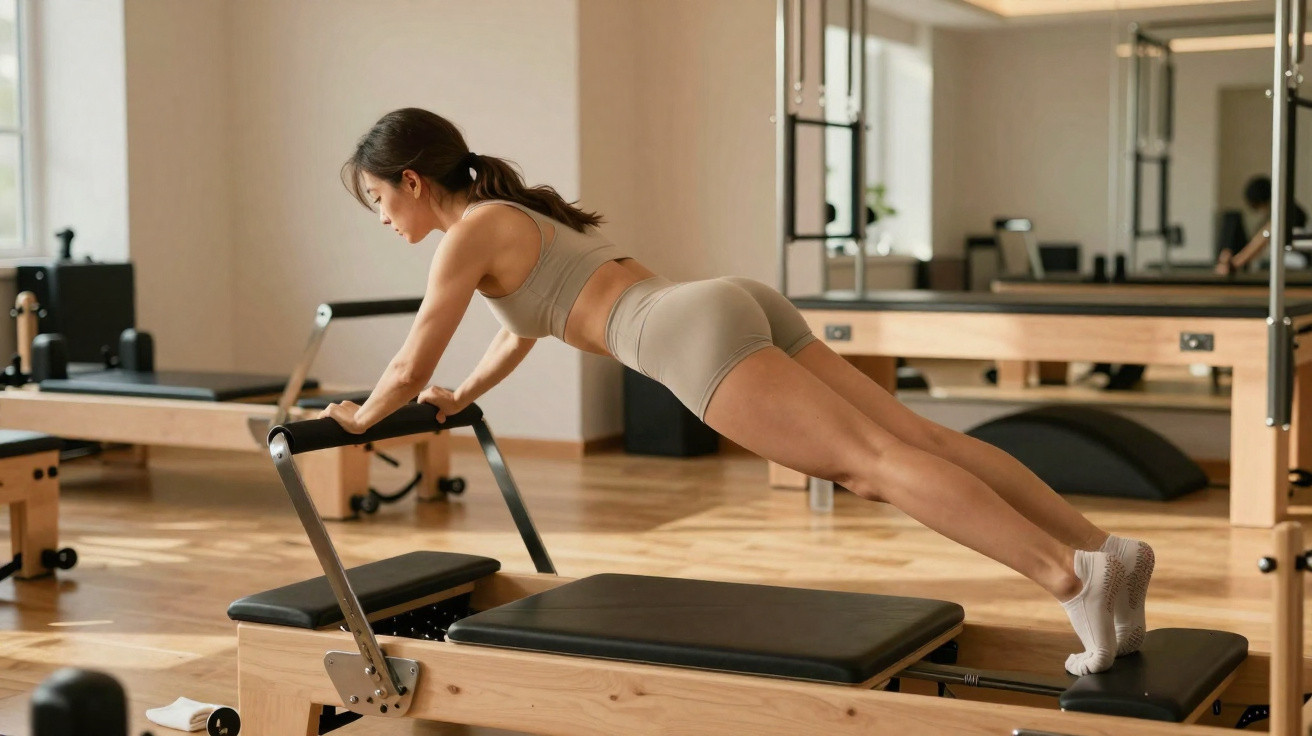
A quiet, slow yet exceptionally intense training method is currently attracting plenty of attention.
Many people who have trained on the mat for years recognise the feeling: their posture has improved and their back feels stronger, yet their body no longer seems to change visibly. This is where a form of training comes in that may look like Pilates on a futuristic torture device, but feels entirely different. It promises a lean, defined physique without the need to sprint, jump or push yourself to total exhaustion.
When Pilates reaches its limits
Pilates remains an excellent tool for improving body awareness, increasing mobility and easing back pain. But after months or years, those wanting to keep progressing often notice that their body has adapted: the movements become easier and the stimulus is no longer enough.
This is not a failure; it is biology. Muscles only build and become firmer when they are regularly exposed to new demands. If the intensity remains unchanged, a plateau develops and the physique stops progressing despite a consistent routine.
Without increasing intensity, your shape stays the same and change comes to a halt.
Many people then switch, frustrated, to demanding programmes such as HIIT or CrossFit. These can raise the pace and heart rate, but knees, backs and the pelvic floor often pay the price. Anyone who has overdone jumping exercises or burpees will know the issue.
Lagree instead of jumping: high intensity with low impact
This is precisely where Lagree Fitness comes in: a system developed in California that is now gaining ground in more and more European studios. At first glance, it can appear to be “Pilates turned brutal”, but it is an independent method with a clear philosophy: maximum intensity with minimal impact.
Its central principle is to deliberately take muscles to their limit without jolting the joints. Training is slow, precise and performed under constant tension. The body works hard while the skeleton remains protected.
The Megaformer is not a traditional Pilates machine
At the centre of the method is the Megaformer. It broadly resembles the familiar Pilates Reformer, yet it is larger, more complex and considerably more versatile. A moving carriage, fixed platforms at the front and back, and several adjustable springs allow for dozens of movement patterns and resistance levels.
While the Reformer is often used for rehabilitation or gentler practice, the Megaformer requires continuous effort from the body. The machine does not make anything easier; it demands everything. Breaks do not happen automatically - you have to actively refuse them.
- More resistance: adjustable springs rather than body weight alone
- More instability: the carriage remains in constant motion
- More angles: exercises performed standing, kneeling, seated and lying down
- More combinations: legs, core and arms active at the same time
Strength, endurance and core work in one session
Lagree is known for complex movements that recruit several muscle groups at once. For example, you may move into a deep lunge on the unstable carriage, use your core to maintain balance and simultaneously pull handles to work your upper body.
Your heart rate rises not because you are jumping, but because a large amount of muscle tissue needs oxygen at the same time. This creates “hidden” endurance training while the muscles burn as they would during strength work.
Lagree feels like strength training, a core workout and cardio in one single, slow movement.
Slow is the new heavy: why tempo changes everything
Perhaps the greatest difference from conventional workouts lies in the pace. Rather than moving abruptly, you work at a snail’s pace: four seconds in one direction and four seconds back, with no momentum and no shortcuts.
Four seconds that feel longer than expected
Anyone doing a squat or lunge variation on the Megaformer with this count for the first time quickly realises that it suddenly feels like eight times the effort. Since momentum is not allowed, the muscles must control every millimetre of movement.
This is what activates the muscle fibres responsible for endurance and a lean, toned appearance. The usual “cheats” that help you get through a fitness session no longer work.
Continuous tension rather than short repetitions
Unlike many gym machines, Lagree training offers almost no moments of relaxation. An exercise block generally lasts one to two minutes, during which the muscle remains under constant pressure.
This produces the familiar burning sensation and triggers signals in the body that support fat burning and muscle building. Every second is used rather than being lost between repetitions.
Your first encounter with the Megaformer: shock and revelation
People who consider themselves fit often experience a small humiliation on the Megaformer - in the best possible way. Even experienced runners, CrossFitters and Pilates enthusiasts suddenly discover muscles they never knew they had.
Instability: the secret weapon for a strong core
The moving carriage means the body must constantly resist instability. The deep abdominal muscles, lower back and small muscles surrounding the spine are continuously engaged.
Rather than completing countless crunches that push the stomach forwards, the focus is on the transverse abdominal muscles. This deep bracing tends to draw the abdomen inwards, stabilises the torso and makes the waist appear slimmer.
Lagree trains the stomach more through holding than through traditional “abdominal crunching”.
Quick changes, slow movements
What is interesting is the combination of slow exercise execution and brisk position changes. The coach may instruct you to move from a leg exercise to an arm exercise in under ten seconds, change your grip, reposition your foot and continue.
This keeps your heart rate in the optimal fat-burning zone. You sweat heavily without feeling rushed by the pace. Many describe the sensation afterwards as “worked out, but not drained” - challenged, yet not completely exhausted.
The famous “shake”: when the muscle is visibly working
One word is often heard in Lagree studios: “shake”. It refers to the uncontrolled muscle tremors that begin when a muscle is genuinely working at its limit. Although it can seem unsettling at first, it is almost regarded as a badge of honour here.
Why trembling is a good sign
When a muscle group remains under tension for long enough, there comes a point when it starts to shake. This shows that its reserves are nearly depleted and that the neuromuscular system is doing everything possible to maintain the movement.
A large part of adaptation happens in these final seconds. The body recognises that this demand is likely to return, so it needs to prepare by becoming more stable, stronger and more efficient.
High intensity without being harsh on the joints
Despite this intensity, hands and feet are almost always in contact with the machine. There are no airborne landings and no hard impacts. The knees, hips and spine are working, but they are not slamming into a hard surface.
This makes Lagree appealing to people who want to change their physique but do not feel ready for sprint intervals or jumping combinations - whether because of concerns about injury or existing discomfort.
How the body changes - and what is realistic
Those who train two to three times per week often report noticeable changes after just a few weeks: firmer arms, more clearly defined shoulders, a stronger midsection and an overall longer, athletic look.
Defined rather than “bulky”
What makes Lagree distinctive is its frequent use of extended positions and long levers. This tends to create long, lean muscle definition rather than bulky upper arms or pronounced volume. People concerned about becoming “too broad” generally find this approach more comfortable than traditional heavy weight training.
A typical goal is a dancer-like body: strong yet mobile, with defined lines rather than maximum size. Posture also improves as a by-product, because the deep muscles running alongside the spine are trained continually.
Why many do not want to return to their old workout
After trying Lagree for a while, many find standard mat workouts or repetitive cardio no longer sufficient. Its blend of variety, tangible intensity and visible results quickly makes the routine highly appealing.
Even so, a sensible combination is worthwhile. Adding easy jogging, walking or relaxed yoga supports recovery, cardiovascular fitness and mobility. The Megaformer provides the clear sculpting stimulus, while complementary activities keep everyday movement light and mobile.
Who Lagree is suited to - and what to consider
Lagree is particularly suited to people who:
- have reached a plateau with Pilates or gym training;
- want to train intensely without jumping;
- wish to protect their back, knees or hips;
- have limited time and want an “all-in-one” session in 45 minutes.
Before starting, it is worth having a brief conversation with the coach, especially if you have existing issues or are returning after pregnancy. Beginners should accept that they will shake intensely and reach their limit quickly at first - this is part of the concept, not a sign of weakness.
Those who remain consistent soon learn to control the machine, regulate their breathing and manage the inner voice urging them to stop. This blend of focus, control and slow, purposeful work is exactly what makes Lagree compelling: the body changes - intensely - without being worn down in the process.

Comments
No comments yet. Be the first to comment!
Leave a Comment