
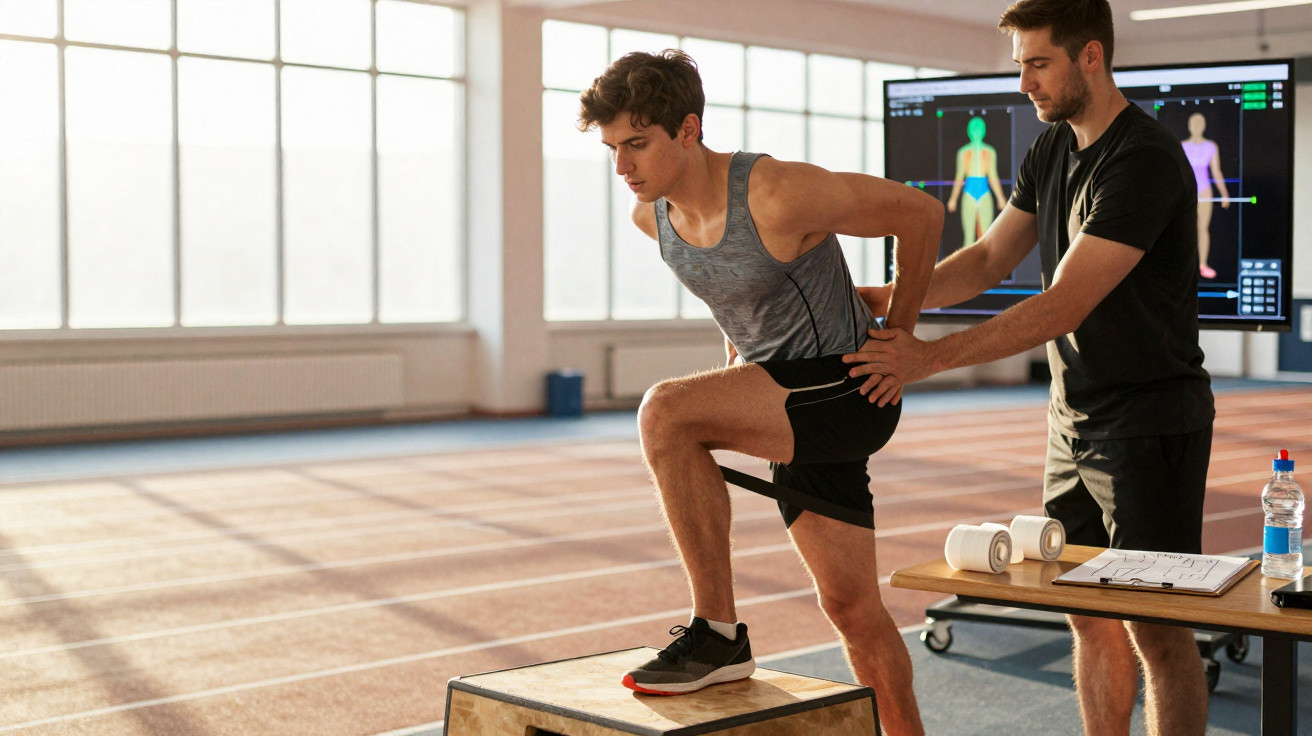
People often associate Olympic athletes with victory. Yet chasing an Olympic medal is uncertain, and for most competitors it ends in disappointment.
Achieving success demands committed work on speed, strength and technical skill. That preparation, however, must be weighed against an athlete’s greatest concern: sports injury.
Olympic sport and injury risk
In terms of musculoskeletal health and injury risk, exercise - physical activity undertaken to maintain health - can be beneficial, while sport - competitive physical activity regulated by rules - may be less so. Sport places greater stress on the body’s supporting structures: muscles, bones and ligaments.
In the javelin, the front leg has been reported to experience forces greater than seven times bodyweight. Gymnasts, meanwhile, complete hundreds of training repetitions involving forces above bodyweight through the wrists and elbows. When these structures are exposed to such loads, even a technical error can readily lead to injury.
A 2007 investigation into sports injuries sustained in training or competition at the 2007 World Athletics Championships found that almost 10% of athletes reported an injury, and 71% of those occurred in competition. Research at the 2008 Olympics similarly found injuries in 11% of athletes, with comparable findings at the London 2012, Rio de Janeiro 2016 and Tokyo 2020 Olympic Games.
Injury rates are far higher in certain sports. At the 2018 Youth Olympics, 43% of rugby players sustained an injury.
Sports injuries fall into two groups: acute, or instantaneous, injuries and overuse injuries. Acute injuries occur at approximately twice the rate of overuse injuries. They are generally caused by a single unusual incident, such as a ruptured ligament on landing or a hamstring tear caused by muscle overload.
Building strength for an Olympic medal
Athletes must dedicate years of their lives to developing the strength base needed for their bodies to withstand the physical requirements of competition, and to generate the forces and movements necessary to excel in their sport.
For instance, trained sprinters generate considerably more force with their quadriceps than people in the general population - almost one and a half times as much. Olympic sprinters have also been found to possess proportionally larger volumes in muscles that support sprinting performance, including the Rectus Femoris, which forms part of the quadriceps.
Olympic gymnasts commonly begin training and competing before reaching their teenage years. Gymnastics rules now stipulate that they cannot compete at the Olympics until the year in which they turn 16.
In many sports, physical preparation depends on the principles of muscular adaptation, which increase muscle size, strength and power. Increasing muscle size, known as hypertrophy, requires the muscle to be overloaded. This overload creates tears in individual muscle fibres; as they heal during the following days, the muscle becomes larger and stronger.
Strength training, in literal terms, takes muscles beyond their breaking point to trigger growth and lasting improvements in strength. In recreational exercise, these tears tend to be minor and the body can repair them easily. Professional athletes seeking to maximise physical strength, however, may take training to extremes, causing muscle injuries that require weeks or even months of recovery.
Overuse injuries result from micro-trauma - minor damage caused by repeated loading of the musculoskeletal system in training or competition. A 2018 study on musculoskeletal injury risk found that those specialising in only one sport are more likely to experience an overuse injury.
When an injury occurs, athletes miss crucial training time, which may lead to atrophy - a reduction in muscle size and strength.
For sports that demand exceptional strength or speed, extensive strength training is the only route to winning an Olympic medal.
Managing sports injury through training
Training need not be entirely a matter of chance, however, and knowledge of injury risk and the most effective ways to reduce it continues to develop.
Athletes can, for example, lower their likelihood of injury with a structured, periodised training programme. This approach accounts for different performance targets, including stabilisation, strength and power, as well as preparatory stages, ensuring that foundational strength is in place before the most demanding work begins.
These stages are divided into short-term periods of days to weeks, medium-term periods of weeks to months, and long-term periods of months to years.
Training must also account for injury risk factors, including genetic factors such as body alignment and asymmetries between limbs.
Scientists are also exploring movement variability as a way to lessen injury risk. This refers to the deliberate and unintended changes in movement that occur when the same task is repeated many times.
Research appears to indicate that purposeful, slight changes in movement may help avoid overuse injuries by distributing high forces across muscle tissues over time. Yet excessive movement variability can be just as problematic as insufficient variability. A sprinter whose step width varies greatly, for example, may be more likely to fall or to compensate adversely while attempting to stay balanced.
Ultimately, it is possible to win an Olympic medal without injury, but the strength needed to become an elite athlete in many sports can only be developed through activities that raise the risk of injury.
Athletes will be less likely to be injured when their support teams are best able to understand and manage these risks, provide sufficient recovery time and avoid excessive training loads.
These training issues are only a small element of what must go to plan. Psychological reactions to injury, environmental and sociological influences, and technique shaped by the rules must all align perfectly for an athlete to secure a place on the podium.
Tim Exell, Senior Lecturer in Biomechanics and Rehabilitation Science, University of Portsmouth
This article is republished from The Conversation under a Creative Commons licence. Read the original article.






Comments
No comments yet. Be the first to comment!
Leave a Comment