
The heavy historical legacy of cycling, along with the high-profile scandals involving certain teams and riders, has drawn the Tour de France into a spiral of doping suspicions. Yet 2026 is a distinctive year. Rising peloton performances, harsh weather and an unprecedented overnight anti-doping test have raised even more questions around the Grande Boucle.
The 2026 Tour de France ended in Paris on Sunday 26 July, following a shortened 80-kilometre circuit through the capital’s streets. It offered one final chance this season to watch the yellow jersey, worn by Tadej Pogačar, continue his bid to make cycling history, attacking at full speed along Rue Lepic towards the summit of Montmartre hill.
This year’s Grande Boucle was especially demanding, yet the riders have never appeared stronger, particularly the leaders of the leading teams. As a result, doping suspicions have grown, even though they have never truly left the sport because of its troubled history and major scandals, including the Festina affair (1998), Lance Armstrong (the 2000s) and the Puerto system.
In the specialist press, Miroir du Cyclisme - relaunched in 2025 by media outlet l’Humanité - has examined the issue in particular through the work of Florent Le Du. A video accompanying the written investigation, published on 22 July, has exceeded 100,000 views.
Tour de France 2026: why are there doping suspicions?
Average speed up by 1.5 km/h
Across the 21 stages of the 2026 Tour de France, riders’ speeds reached new heights. The average speed was 1.5 km/h higher than last year, which had already been a record-breaking edition. One stage stood out in particular: the eleventh, between Bicheur and Nevers, where the average speed reached 51 km/h. To sustain that effort, the power output of each rider is said to have risen by 60 watts compared with the previous generation, Warren Bargil observed in an interview with L’Équipe.
“People do not realise how much the level has risen. My generation has seen that gap widen. Now, young riders can sustain 7 W/kg for 20 minutes. Before, if you did 6 W/kg, you were a good rider. Now, you are just another domestique,” he said during the second rest day of the 2026 Tour de France.
3 stages above 39 degrees
Producing more power is one thing, but doing so in more difficult conditions is another. In 2026, the Tour de France became a furnace. The peloton suffered during a heatwave. Average temperatures across the Grande Boucle reached 33 degrees. On 9 stages, temperatures climbed above 35 degrees, while 3 of them exceeded 39 degrees. To prepare for the Tour, riders naturally worked on their ability to withstand heat, but above all on altitude training, so they could negotiate the various passes above 1,800 metres without excessive difficulty.
An overnight test
Against this apparent contradiction - record speeds achieved in conditions far from ideal for physical exertion - another development proved particularly striking: a genuine overnight anti-doping raid. The test, which triggered substantial controversy and was heavily criticised by some Tour de France riders, warrants attention.
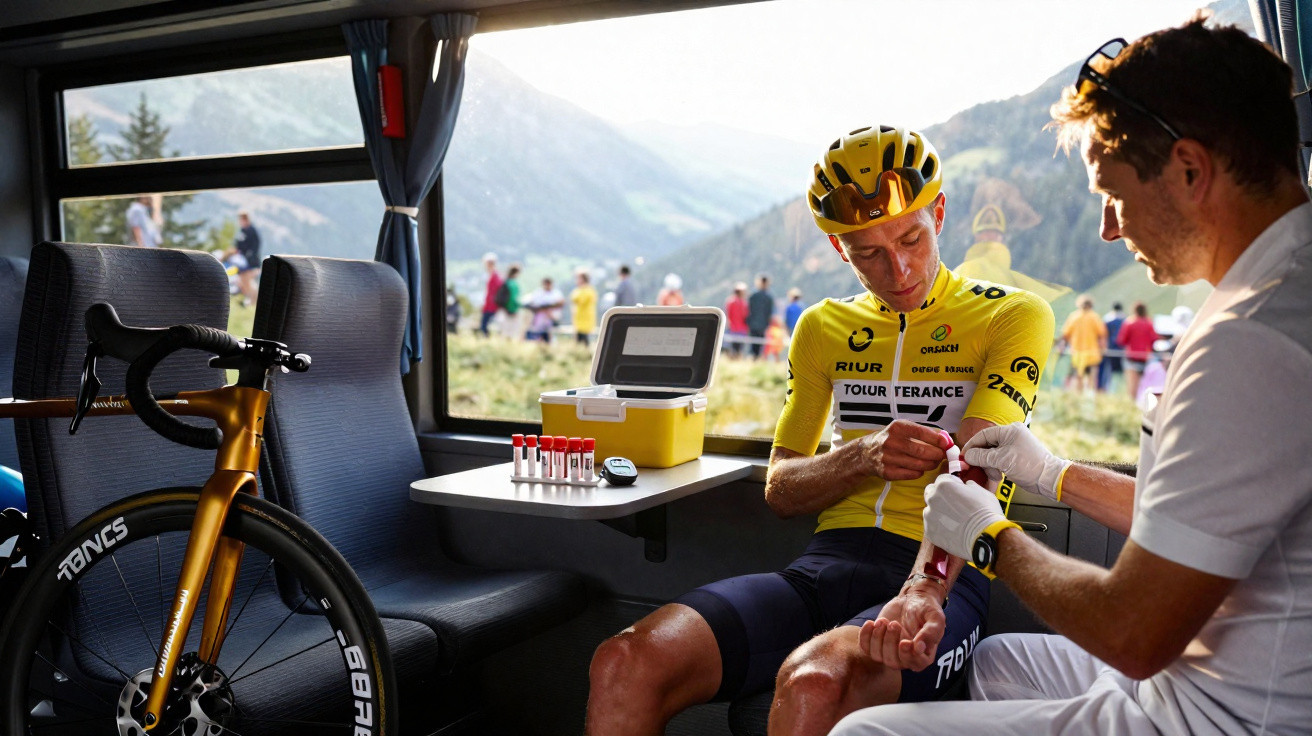
During the night of 18 to 19 July 2026, inspectors from the ITA (the International Testing Agency) knocked on the hotel doors of the top two riders in the general classification, Jonas Vingegaard and Tadej Pogačar. The first was visited at 2 am, the second at 5 am.
Normally, regulations prohibit anti-doping tests overnight, from 11 pm to 6 am. This is an understandable framework intended to protect riders’ recovery, which is vital if they are to perform throughout the 21 stages of the Grande Boucle. However, that window may also be enough time for doping methods or substances to be used before their signs can no longer be detected in the body.
The operation drew criticism. Riders objected first on the grounds of protecting their sleep, while more broadly some saw it as a communications move intended to show that the Tour de France is committing the necessary resources to validate the performances of modern riders. Yet authorising the test also involved a strict exception set out in French law: before obtaining permission, the agency must demonstrate the existence of “serious and consistent suspicions”. There must also be a proven risk that evidence could be concealed. Finally, an application must be made to a liberty and custody judge.
The 3 main doping techniques considered
By crossing, for the first time, the legal overnight boundary for anti-doping tests, inspectors were targeting two main forms of doping. The tests at 2 am and 5 am were not random. The aim was to test riders at times when signs of doping could still be identified for techniques with an extremely short detection window, sometimes just 3 hours.
Autotransfusion
First, one of the leading doping suspicions in cycling - and in many other sports - concerns autotransfusion. The principle is straightforward: reinjecting one’s own previously collected blood. Among other things, this can boost the body’s reoxygenation capacity, for instance if the reinjected blood was drawn after an altitude training camp, when the red blood cell count is higher. The body adapts to altitude by producing more cells capable of carrying oxygen in the blood. This method leaves a “trace” in an individual’s biological passport, but only for a limited period.
Microdosing
Another major avenue of doping suspicion involves microdosing substances, notably EPO and growth hormones. The two do not have the same effect. EPO (erythropoietin) is a glycoprotein hormone naturally produced by the kidneys. It signals to the bone marrow that it should produce more red blood cells when the body acclimatises to altitude. Growth hormones, meanwhile, mainly play a part in muscle production and reducing fat mass.
The use of EPO is not new in cycling. Indeed, it was the shock of the Festina affair in 1998 that brought the practice to light. In the boot of the team doctor’s car, French customs officers found a mobile pharmacy containing 200 ampoules of EPO, growth hormones, testosterone and amphetamines. In 2026, EPO could once again become an issue, as ultra-modern means enable greater discretion, including biosimilar EPO and derivatives from marine organisms.
mRNA vaccine
There are also suspicions surrounding mRNA “gene therapies”, the same technique that made it possible to “vaccinate” populations during the Covid-19 epidemic. In sport, the objective would not be to treat an illness, but to temporarily or permanently alter an athlete’s gene expression in order to maximise physical abilities. This could involve, once again, the EPO gene, avoiding the use of synthetic EPO.
“The coronavirus vaccine, for example, is a form of gene therapy. mRNA is introduced, which encourages the body to produce certain proteins itself,” Belgian researcher Peter Van Eenoo, director of the Ghent anti-doping control laboratory DoCoLab, explained on the programme De Avondetappe. He then added that the same process “could encourage the body to produce more EPO or growth hormone”.
To build endurance and power, other avenues involve stimulating genes that can increase muscle mass by blocking myostatin, a protein that acts as a brake or negative regulator on muscle growth.
Number one on Alpe d’Huez against 4 doped champions
Among the defining moments of the 2026 Tour de France, Tadej Pogačar’s historic climb of Alpe d’Huez will be remembered. Over the 21 bends of the hors catégorie ascent, the rider caught the 3 breakaway riders, who were no longer working together, during stage 19. Sepp Kuss, Richard Carapaz and Frenchman Lenny Martinez watched the Slovenian climb alone, without help from his team, to cross the finish line 35 minutes and 27 seconds after beginning his ascent.
In the historical rankings, Tadej Pogačar moves into first place among the fastest riders on this climb, breaking a 29-year-old record by a sizeable margin of 1 minute and 13 seconds. It was a historic performance in front of more than 500,000 spectators gathered on the slopes of the Grandes Rousses massif. But the ranking also shows, and above all, that four of these riders admitted to doping: Marco Pantani, Lance Armstrong, Jan Ullrich and Richard Virenque.
View this post on Instagram
A post shared by The Domestiques Podcast (@thedomestiques)


Comments
No comments yet. Be the first to comment!
Leave a Comment