
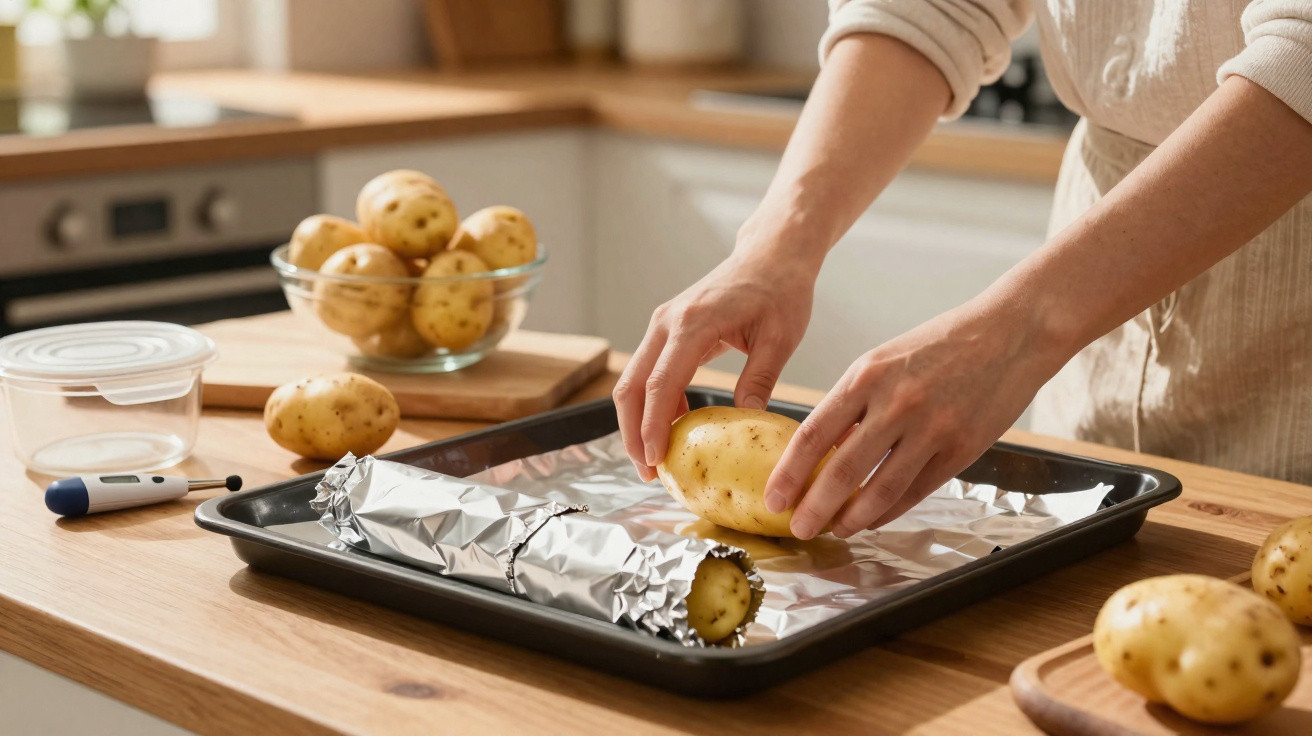
For countless home cooks, wrapping potatoes before baking is an automatic step. It appears convenient and even somewhat “chef-like”. However, food safety experts warn that, if handled incorrectly, this seemingly harmless practice can pose a serious health risk.
Why this everyday potato habit is causing concern
Roasted, mashed, fried, sautéed, served as wedges or turned into chips, potatoes feature on plates in countless forms. Their flexibility has made them a staple for everything from a Sunday roast to a topped jacket potato on a hectic weekday evening. They are widely regarded as an affordable, nutritious carbohydrate suited to almost any eating pattern.
That view is broadly justified. Potatoes provide fibre, vitamin C, potassium and resistant starch, particularly when they are cooked and cooled correctly. They can certainly form part of a balanced diet.
However, one popular shortcut changes the equation. Baking potatoes in aluminium foil and then allowing them to cool while still wrapped creates two health concerns: potential chemical transfer from the foil and a microbiological danger which, in uncommon cases, may result in paralysis or death.
Wrapping potatoes in aluminium foil and letting them cool at room temperature creates near-perfect conditions for botulism bacteria to multiply.
Aluminium foil and the hidden health concern
Aluminium foil is found in most kitchens. It is used to line oven trays, shield dishes during cooking and cover leftovers. Because it is inexpensive and light, many people use it routinely without thinking twice. Health bodies do not advise abandoning it completely, but they do caution against particular applications.
Heat, salt and acidic ingredients can increase the amount of aluminium that moves from foil into food. As a result, a tightly wrapped, salted baked potato may take in more aluminium than a briefly covered, cold and unseasoned food.
Such exposure is unlikely to produce immediate symptoms. The concern is repeated contact over time. Research indicates that long-term aluminium build-up could affect bones and the brain. Some studies have explored potential associations with neurodegenerative conditions, though the evidence is still disputed.
Many food specialists now urge people to limit direct, hot contact between aluminium and food, especially when the dish is salty, acidic or cooked for a long time.
For potatoes, the guidance is straightforward: if foil is used during cooking, eat the potatoes immediately rather than leaving them wrapped for several hours. The most severe threat, however, is not the metal.
How foil-wrapped potatoes can lead to botulism
The greater danger arises when foil-wrapped potatoes are left at room temperature. After baking, the moist centre of the potato and the sealed foil combine to create a low-oxygen environment. These conditions are particularly favourable for one bacterium: Clostridium botulinum.
This organism occurs naturally in soil and dust. Its spores may be present on potato skins without being visible. Normal baking temperatures do not necessarily destroy those spores. If they have moisture, warmth and little or no oxygen, they can grow and produce botulinum toxin, among the most powerful toxins known.
How a baked potato can become a source of toxin
- Uncooked potatoes can carry harmless C. botulinum spores on their skins.
- Baking in foil heats the potato, but the spores may survive that heat.
- After removal from the oven, the potato cools slowly within the foil, where there is very little oxygen.
- Spores can germinate and form toxin if the potato remains at room temperature for several hours.
- Reheating, particularly in a microwave, may not completely destroy the toxin.
Food safety authorities identify baked potatoes held at ambient temperature in foil as a recognised source of foodborne botulism. Although the illness is rare, it is extremely serious. It can begin with digestive upset, followed by vision disturbances, swallowing difficulties and worsening muscle weakness. Without prompt treatment, the muscles used for breathing may fail.
Botulism does not need large amounts of contaminated food. A single foil-wrapped potato left out too long can be enough to cause illness.
Why microwaving is not a reliable solution
Many people believe that a brief spell in the microwave “kills everything”. When leftovers are involved, this assumption can create a misleading sense of safety. Botulinum toxin presents a more complicated situation.
The toxin is sensitive to heat, but microwave ovens do not always heat food uniformly. Cooler areas may remain in the middle of a potato, particularly if it is large or partly wrapped. Consequently, some toxin could remain while the outer surface feels steaming hot.
There is another problem: where a potato has sat in foil at room temperature for several hours, the risk developed before reheating even began. By then, toxin may already have formed. This is why public health advice focuses on correct storage as well as cooking and reheating.
Safe methods for baking and storing potatoes
The positive news is that the risk is simple to manage. A handful of routine measures can keep baked potatoes safe without taking them off the menu.
| Practice | Risk level | Safer alternative |
|---|---|---|
| Baking potatoes tightly wrapped in aluminium foil, then leaving them on the counter for hours | High botulism risk | Bake without foil on a tray, or unwrap immediately and keep hot above 60°C / 140°F |
| Storing foil-wrapped baked potatoes at room temperature overnight | Very high botulism risk | Unwrap, refrigerate within two hours in an open container |
| Reheating old foil-wrapped potatoes in the microwave | Risk of surviving toxin | Discard potatoes left out too long; reheat only properly chilled leftovers |
| Cooking acidic or salty foods directly on aluminium foil at high temperature | Increased aluminium migration | Use baking paper or a glass/steel dish as a barrier |
Practical advice for safer potato dishes
Use alternative cooking methods
Aluminium foil is not needed to make a fluffy jacket potato or crisp potato wedges. Various cooking methods deliver excellent results while reducing both chemical and bacterial hazards.
- Put whole potatoes straight on the oven shelf or onto a baking tray.
- Choose baking paper rather than foil for paper-parcel-style cooking.
- Roast diced potatoes in a glass or stainless-steel dish with a little oil.
- Steam or boil potatoes for mash, then finish them in a frying pan for extra flavour.
For anyone who enjoys the soft, steamed texture associated with foil, a lidded casserole dish or Dutch oven can achieve a similar effect without direct aluminium contact.
Treat leftovers with proper care
Most food safety agencies emphasise one basic rule: hot food should not remain in the “danger zone” - between 5°C and 60°C, or 41°F–140°F - for longer than two hours. This applies especially to potatoes that have been wrapped.
If a foil-wrapped baked potato has been left on the counter all afternoon, the safest option is to throw it away.
To store leftovers safely:
- Take off the foil as soon as cooking has finished.
- Cool potatoes rapidly on a clean plate or tray.
- Place them in the fridge within two hours, using a shallow container.
- Reheat thoroughly until steam reaches the centre, preferably in an oven or frying pan.
Why potatoes present this particular risk
Potatoes grow below ground and are in direct contact with soil, where C. botulinum spores naturally occur. Washing gets rid of visible soil but may not remove every microscopic spore. Cooking eliminates ordinary bacteria, but these spores act differently: they need either very high temperatures or storage conditions that prevent them from growing.
Most common potato preparations, including boiled potatoes, chips and gratins, do not form a low-oxygen space after cooking. Air can circulate and the food cools comparatively fast. In contrast, foil-wrapped potatoes hold in steam and restrict air movement. If stored incorrectly, this can turn an otherwise harmless vegetable into a possible setting for toxin production.
Similar concerns with foods beyond potatoes
The conditions behind potato-related botulism also apply to other dishes. Under suitable circumstances, any starchy or vegetable-based food that is tightly wrapped and left at room temperature can support spore germination. Garlic in oil, home-canned vegetables and vacuum-packed foods share similar characteristics and require careful handling.
For home cooks who batch cook, this highlights a broader issue. Air-removing methods, including vacuum sealing and close wrapping, can offer clear benefits for preservation and flavour, but they require strict control of both time and temperature. Without it, convenience can become a problem.
Replacing a risky habit with a safer one
Moving away from foil-wrapped baked potatoes does not require anyone to give up comfort food. It simply means adapting kitchen routines to advice food microbiologists and toxicologists have given for years: reduce direct aluminium contact at high temperatures, minimise time in the bacterial “danger zone”, and refrigerate food more quickly.
For many households, awareness is the essential first step. Few people associate a fluffy jacket potato with a rare neuroparalytic illness or ongoing metal exposure. Once that connection is understood, using a baking tray or baking paper instead of foil is far less inconvenient than an emergency hospital visit or months of rehabilitation following botulism.





Comments
No comments yet. Be the first to comment!
Leave a Comment