
The trolley had barely left the hospital room when Emily, a nurse on the night shift, quietly remained behind.
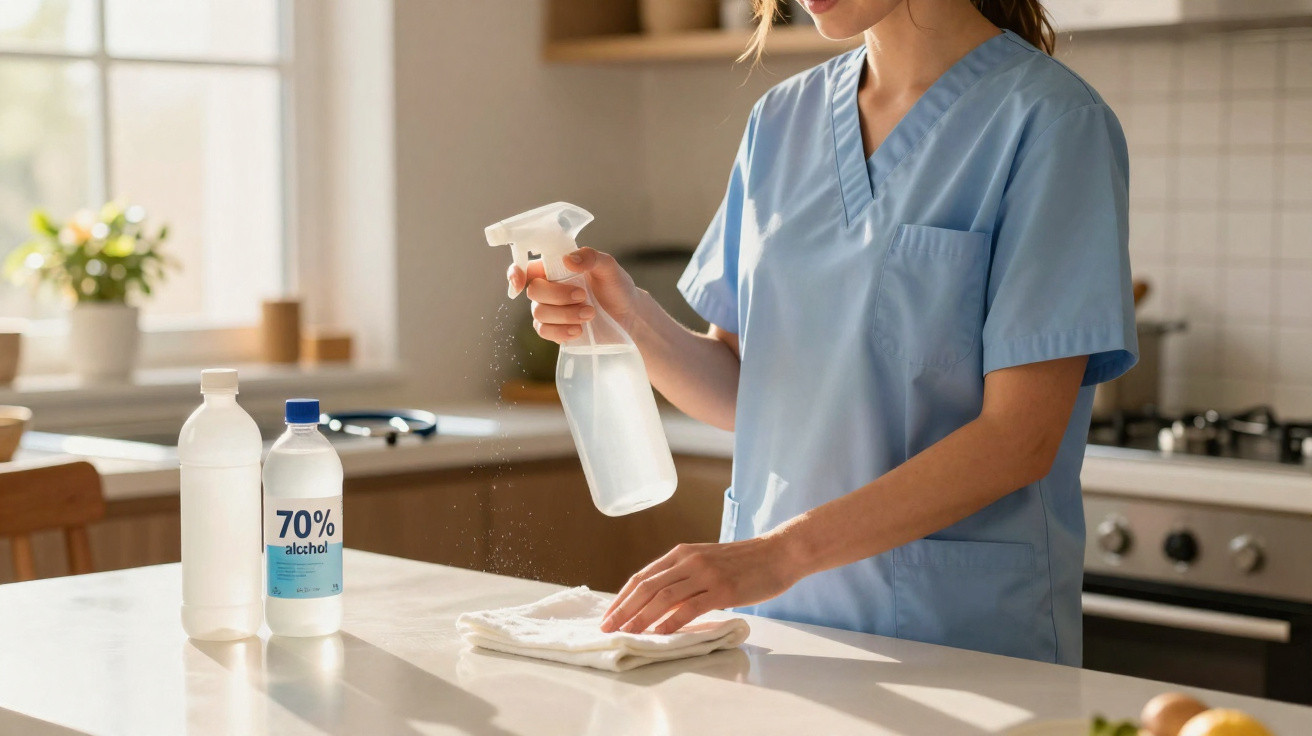
Monitors continued to beep in the low light, while the sharp scent of disinfectant lingered in the air. She took a small spray bottle from her pocket rather than the large branded bottle on the trolley, then lightly misted the bedside table with a solution carrying a subtle citrus-and-herb fragrance.
“This is my backup,” she said, smiling. “When the strong stuff gives everyone a headache, this does the job.”
Using slow, assured circles, she worked the cloth across the surface. Under her hands, fingerprints, coffee marks and germs seemed to disappear.
She was not referring to bleach or a laboratory-strength chemical mixture. It was simply an unassuming, almost traditional blend that many nurses discreetly use in their own homes.
It did not look remarkable.
It was remarkable.
Nurses notice what most people miss
Ask a nurse what makes a work surface “clean”, and the response may be a small, weary smile. They understand the difference between a surface that merely appears wiped down and one that has genuinely been disinfected. In a hospital, that distinction can separate a settled shift from a long and pressured night.
On the ward, nurses see how casually people touch everything: bed rails, keyboards, meal trays, mobile phones and pens. A single cough, sneeze or rushed reach for a patient chart can turn an orderly desk into a small festival of germs. It changes the way they view every table, counter and kitchen worktop once they are home.
Nurses spend years moving through rooms where the dangers cannot be seen. A surface can gleam beneath fluorescent lighting while still carrying a small army of microbes. Their training teaches them to consider several layers: visible grime, unseen bacteria and persistent viruses that survive longer than anyone would prefer. That way of thinking does not disappear when their shift ends.
So, when a nurse mentions a work-surface disinfecting “trick”, they do not mean a magical wipe. They mean habits created through repetition, exhaustion and the quiet awareness of what a missed patch can lead to.
At home, many nurses experience that same pressure in a gentler form. There is the kitchen worktop after hurriedly making packed lunches for school, the dining table that becomes both laptop desk and snack area, and the bathroom basin where cosmetics, hand soap and toothbrushes compete for limited room. During a difficult flu season, these areas can start to resemble risk zones rather than ordinary furniture.
Yet nurses are human too. They tire of powerful odours, dry and cracked hands, and the persistent sting of chemical sprays-particularly when children, pets or allergy sufferers live in the house. That is often where hospital habits meet homemade alternatives. Some of the most interesting nurse hacks emerge in the space between science and straightforward kitchen ingredients.
They want to reduce genuine risk, avoid performative cleaning rituals and still breathe comfortably in their own homes. This is where one particular natural method frequently appears in stories exchanged quietly during breaks and between shifts.
The natural vinegar and alcohol blend many nurses swear by
The method is remarkably straightforward: a homemade disinfecting spray centred on ordinary white vinegar and household-strength alcohol, with a little citrus added. There is no miracle branding and no hidden product. It is simply a carefully measured combination of ingredients that nurses already know how to handle safely.
This is broadly how Emily prepares it at home:
In a clean spray bottle, she combines equal quantities of white vinegar and 70% rubbing alcohol. She then pours in a small amount of water and adds several drops of lemon or orange essential oil, chiefly for its fresh, clean scent. The bottle stays by the sink rather than stored on a high shelf. It has a handwritten label fixed on with tape-plain, but clearly marked.
When she wants to disinfect a work surface naturally, she applies a light, even mist. It is not saturated; it is closer to a fine haze. She leaves the solution in place for at least 60 seconds before touching it. Only after that does she wipe slowly with a clean cloth, working in one direction from the “less dirty” area towards the “more dirty” area. That wait before wiping is the key part.
A fellow nurse uses a comparable mixture in her home office. During the pandemic, her desk became a meeting point for parcels, laptops, snacks, masks and miscellaneous paperwork. Each day, she would remove the clutter before spraying her vinegar-alcohol blend over the desktop, mouse and plastic chair arms. She says she has not needed to buy a commercial surface spray for years.
Research supports some of this reasoning. Household-strength alcohol, at around 70%, is widely recognised for killing many common bacteria and viruses when it is given sufficient contact time. Used alone, vinegar is more of a sanitiser than a complete disinfectant, but when combined with alcohol and applied to surfaces that are already clean, it helps remove grease and makes the mixture easier to distribute.
One small hospital audit found that the greatest difference in surface cleanliness came not from the product brand, but from how long the product remained on the surface. Put simply, people wipe too soon. They spray, swipe and carry on, feeling they have done the right thing. On a laboratory plate, that quick swipe may leave behind more than anybody wants to consider.
At home, nurses apply those lessons in a practical way. They know crumbs and dirt must be removed first, with disinfection following afterwards. They do not treat vinegar as a miracle solution for every situation, but use it within a simple process they can repeat. The aim is not to create a sterile laboratory. It is to make a living space where invisible risk is reduced to a level the immune system can manage without fuss.
That is also why they pay close attention to the materials they are treating. Alcohol and vinegar do not suit every surface. Certain plastics, waxed wood and stone worktops can react badly to acid. Nurses therefore test a small patch, look out for dull marks or streaks, and adjust accordingly. Their “trick” is less a fixed recipe than a way of thinking: understand your products, understand your surfaces and allow enough time.
How to adopt the nurse habit without losing your mind
The practical approach most nurses describe begins before any spray reaches the work surface. First, they clear the space: papers are stacked, crumbs are brushed or wiped into a cloth, and coffee mugs are moved away. They do not disinfect clutter; they disinfect the surface beneath it. That modest distinction makes a substantial difference.
Next comes a two-stage routine: clean, then disinfect. They use warm soapy water or a multipurpose cleaner for a quick wipe to remove visible dirt, followed by the natural spray for unseen threats. Holding the bottle roughly an arm’s length from the area, they mist it evenly. The intended result is a thin, glistening film rather than pools of liquid.
Then they wait. The 60–90 second pause is often the point at which non-nurses become impatient. Nurses, accustomed to timing medication and infusions, simply turn to another small task: rinse a mug, read a message or light a candle. When they return, they wipe the surface steadily with a clean cloth or paper towel, which is then thoroughly rinsed or put in the bin. The surface remains slightly damp before air-drying.
At home, the greatest obstacle is not germs but tiredness. You arrive late, put down your bag and find the counter covered in post, keys and half-opened parcels. On a good day, you may clear it, give it a quick wipe and move on. On a bad day, it remains there until tomorrow. That is normal. Let’s be honest: nobody really does this every day.
Nurses who sustain the routine usually make the goal smaller. They choose one or two “priority zones”: the kitchen food-preparation area, the dining table and the home-office desk. These are the places where hands, food and faces regularly come together. If those surfaces receive the vinegar-alcohol treatment a few times per week, the entire home can feel more settled. Everything else can be “good enough”.
One frequent error is adding too much essential oil. It can be tempting to tip in half the bottle for a stronger fragrance, but this may irritate the skin or airways, especially for children and people with asthma. Another mistake is applying the blend to delicate stone, including marble or granite, where acid can gradually etch the finish. Nurses learn quickly: if a test patch turns dull, that surface is unsuitable.
There is also the myth of one all-purpose magic cloth: the same cloth used for the chopping board, bathroom basin and high-chair tray. That is how germs get a first-class journey around the home. Even in compact flats, many nurses quietly keep colour-coded cloths: one for the kitchen, one for the bathroom and one for “everything else”. They wash them on a hot cycle and dry them completely.
“We’re not trying to live in a bubble,” Emily told me. “We just try not to give germs a free ride.”
To keep this nurse trick easy to recall, it can help to use a short checklist-almost like a mental Post-it note:
- Clear first: disinfection cannot work effectively over crumbs and clutter.
- Clean, then spray: use soap or cleaner for dirt, then the natural mixture for germs.
- Wait time: leave the spray for at least 60 seconds before wiping.
- Use only on suitable surfaces: avoid sensitive stone, waxed wood and screens.
- Make a fresh mix: prepare the solution regularly so that the alcohol does not evaporate.
Some nurses even carry a small labelled bottle at work for personal items such as their phone case, badge reel and pen. At home, the same process can become almost meditative: a few sprays, one slow wipe and a quiet reset at the end of the day. In a hectic week, that small sense of control can be unexpectedly comforting.
More than a cleaning trick: a way to feel safer
There is a quiet sense of relief in seeing a surface change from sticky and uncertain to freshly wiped. It is not about pursuing perfection; it is about reducing the mental noise. When nurses bring natural disinfecting habits into their homes, they often speak not only about fewer colds, but about fewer worries.
On a winter evening, children may drop school bags on the kitchen table while someone coughs in the next room. In that moment, the spray bottle by the sink can feel like a small ally. Clear the area, mist it and wipe it down, and the table is ready for homework or dinner. There is no harsh cloud of chemicals or stinging sensation in the nose-only a mild citrus scent and the reassurance that you have done something meaningful.
On a Sunday morning, the same routine may take place on a desk before a laptop is opened. Perhaps the person working there has endured a difficult flu season or looks after an elderly parent. Perhaps they simply want to stop feeling vaguely uneasy each time they notice fingerprints on the light switch. People do not often discuss it, but many now carry this low-level tension.
Nurses understand better than most that zero risk is impossible. They see infections emerge unexpectedly, and they also see people recover against the odds. That is why their natural disinfecting “tricks” are so modest. They make no miracle promises. They rely on sensible repetition: clean, spray, wait, wipe. Again and again.
What they get in return is a space that feels less unfriendly and more lived-in. It is a kitchen where children can help prepare food without someone anxiously reaching for a chemical wipe every two minutes. It is a shared table that can serve as a craft area at 3 p.m. and a dinner table at 7. It is an office corner where you can eat a sandwich by the keyboard without dwelling on the last delivery box placed there.
Most of us know the experience of entering a room that smells slightly too “chemical”, like a hotel immediately after housekeeping has finished. It may look clean, but your nose remains alert. The nurse trick suggests another approach: quietly safer surfaces, with scents drawn from the pantry rather than a factory.
The real issue is not whether vinegar and alcohol can replace every disinfectant available. They cannot, and nurses are often the first to say so. The question is where this kind of uncomplicated, natural habit could fit quietly into your routine: one counter, one desk or one shared table where hands repeatedly meet.
Perhaps the more meaningful change will not be in the germs you cannot see, but in the calm you can feel.
| Key point | Detail | Benefit for the reader |
|---|---|---|
| Clean before disinfecting | First remove crumbs, marks and grease so the natural mixture can truly reach the surface. | Improves effectiveness without extra effort or complicated products. |
| Vinegar + alcohol mixture | Equal parts white vinegar and 70% alcohol, with a little water and a few drops of citrus. | Provides a gentler alternative to aggressive sprays while remaining genuinely useful. |
| Contact time | Allow the spray to work for 60–90 seconds before wiping with a clean cloth. | Turns a gesture done “to make yourself feel better” into genuinely effective disinfection. |
FAQ:
- Does vinegar really disinfect a work surface on its own? Vinegar mainly sanitises and helps reduce some microbes, but by itself it does not match hospital-grade disinfectants. This is why many nurses combine it with 70% alcohol on surfaces that have already been cleaned.
- Can I use this natural spray on any countertop? No. Avoid marble, natural stone, waxed wood and any material that reacts badly to acids or alcohol. Always test a small, hidden area first, and stop if you notice dulling or damage.
- How often should I disinfect my kitchen worktop like this? In most homes, once a day during periods of heavy use-or after raw meat, illness in the household or food spills-is sufficient. The aim is consistency in important areas, not constant scrubbing everywhere.
- Is this nurse trick safe around children and pets? When used correctly, in small quantities and left to dry, it is usually gentler than many fragranced commercial sprays. Keep the bottle out of reach, provide light ventilation and avoid using excessive amounts of essential oil.
- Can this replace all my cleaning products? No. You still need soap or an ordinary cleaner for visible dirt, and in certain circumstances, such as serious illness, a certified disinfectant is a better option. The nurse trick is a sensible everyday backup, not a universal cure-all.


Comments
No comments yet. Be the first to comment!
Leave a Comment