
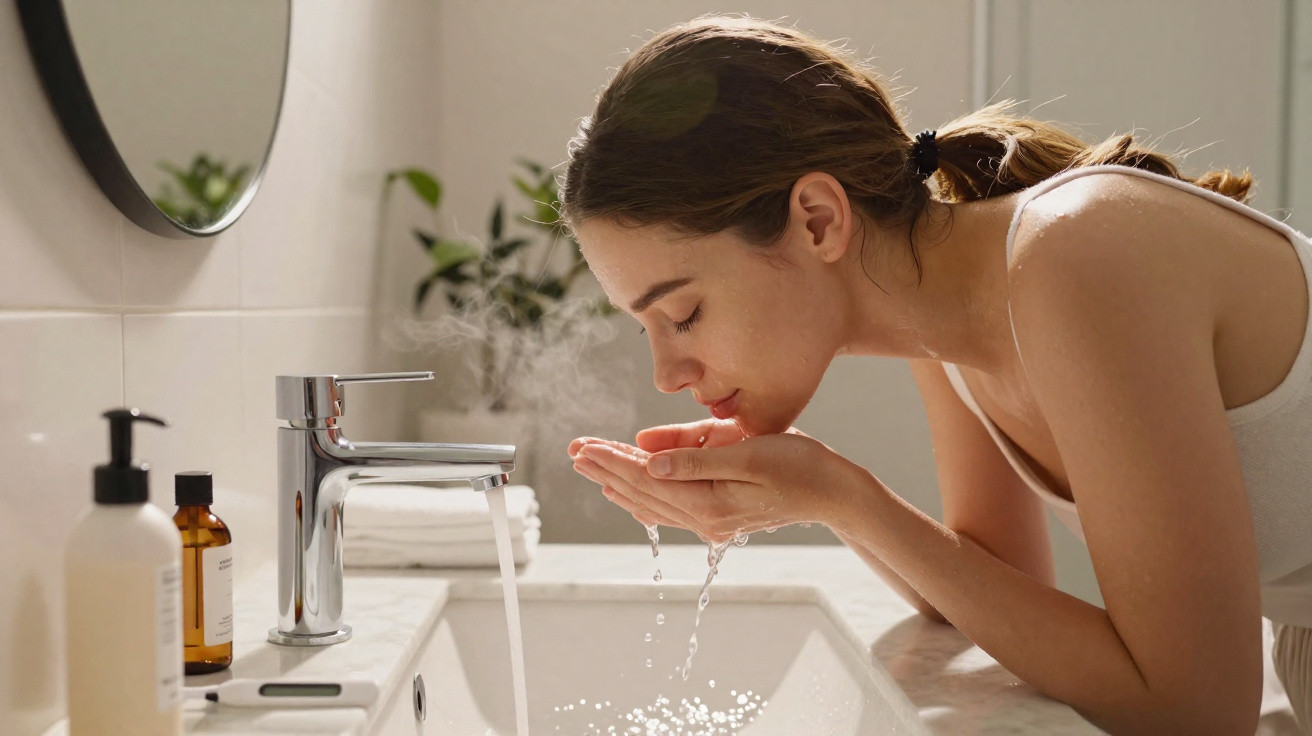
You are standing at the sink, barely awake, flicking through your phone with one thumb as the tap runs. The water turns hot, then cool, then hot once more while you instinctively search for the “just right” setting. You splash your face, give it a quick rub, dry off and carry on. Shampoo, serum, SPF, meeting, Tube, children, notifications. Your skin? Provided the right products are waiting on the shelf, you assume you will sort it out eventually.
But the mirror continues to show the same subtle warnings: skin that feels tight after cleansing, red areas that disappear then return, pores that seem more obvious in the evening than they do in the morning. You put it down to stress, sugar, hormones or blue light.
But what if the main offender is simply the water from your tap?
The invisible skincare step before your products
Most of us fixate on the bottle rather than the tap. We compare retinol strengths, trending acids and “clean” labels, yet wash with water that is either scalding or nearly icy. Your skin registers that shift in temperature as a shock - and responds accordingly.
Dermatologists will quietly make the same point: the way you wash your face sets the tone for everything that comes after. Even a mild cleanser used with near-boiling water may leave skin drier and tighter than an ordinary soap used at the correct temperature. Water seems so commonplace that we no longer give it much thought.
Look more carefully at your own habits. Plenty of people make the shower so hot that the mirror steams up within moments, then cleanse their face beneath the same flow. It feels soothing, almost like a spa treatment. Afterwards, that person may complain that their costly moisturiser “does nothing” and that their cheeks remain red all the time.
A 2022 consumer survey by a European skincare laboratory revealed something notable: over 70% of participants used water deemed too hot for daily facial cleansing. In that group, reports of dryness and tightness were almost twice as common. The surprising part? Most believed they had “sensitive skin”, rather than “overheated skin”. We may have been placing the blame in the wrong place.
Biologically, facial skin is not designed for extreme temperatures. Hot water breaks down the natural lipids in the skin barrier, much as washing-up liquid cuts through grease in a frying pan. Cold water, meanwhile, can temporarily constrict blood vessels and may leave debris behind if your cleanser does not emulsify effectively.
Your skin barrier is essentially a fine wall of fats and cells that holds beneficial elements in and keeps harmful ones out. Removing that wall with hot water can make active ingredients sting more, prolong redness and make breakouts appear more inflamed. Rinsing with icy water each morning can also stop the barrier from functioning efficiently, particularly if you are already prone to redness or rosacea. Rather than the product label, the temperature dial becomes the real point of decision.
Finding the “just right” water temperature for your skin
Dermatologists repeat one straightforward rule: cleanse your face with lukewarm water. Not hot, not cold - simply comfortably warm, almost unremarkable.
The test requires no equipment. Let the tap run and place the inside of your wrist beneath it. If the water feels almost neutral - neither distinctly warm nor cool - it is in the right range. This temperature cleanses without stripping and rinses without causing shock. Your face should never feel as though it is in a sauna or an ice bath. If you like very hot showers, move your face away from the stream or cleanse separately at the sink before stepping in.
Then there is the aspect hardly anyone mentions: how inconsistent we are in everyday life. We have all had that late-night moment when we arrive home with makeup still on and turn the tap up to full heat because it seems quicker. Your skin recognises that shortcut already.
In reality, nobody does this perfectly every day. Nobody stores a thermometer in the bathroom to check that the water is precisely 32°C. Instead, aim for a “baby bath” temperature rather than “pasta water”. Do not let the running water become hotter by the second. That gradual increase in heat is where dryness and redness start. Cool splashes at the end can be useful for waking up, but they should not replace a proper, gentle cleanse.
Here is how many experts describe it when they are asked off-camera:
“People come to me with a 10-step routine and hundreds of dollars in products,” says a Paris-based dermatologist I interviewed. “Half the time, I ask them to do one thing first: lower the water temperature. Two weeks later, their skin is calmer and they think I changed their cream. I didn’t. I changed their faucet.”
A few understated habits can also make a considerable difference:
- Lower the heat: Choose lukewarm water that you could comfortably keep your hands under for a full minute.
- Reduce contact time: For most faces, 30–60 seconds of actual cleansing is sufficient.
- Pat rather than rub: Use a soft towel and press it against the skin instead of pulling it across the face.
- Moisturise while skin is damp: Put on your cream or serum within one minute of washing.
- Keep face cleansing separate from showering: If you enjoy extremely hot showers, wash your face at the sink.
The quiet reset your skin has been asking for
Altering the temperature of the water you put on your face can seem too basic to make any difference. There is no attractive packaging, no unboxing clip and no “actives”. It is simply you, the tap and a slightly altered choice. Yet this is often where the most noticeable changes start.
Try two weeks of reliably lukewarm cleansing. Notice whether your cheeks sting less after serum, whether the edges of your nose flake less, or whether your forehead no longer feels like parchment by 3 p.m. Your regular products may suddenly appear to work better - not because they have changed, but because your barrier is no longer struggling to survive.
This modest reset also gives you the opportunity to reconsider your entire bathroom routine. Do you work at mascara as though you are scrubbing a frying pan? Do you leave your face beneath the shower stream for minutes because it feels comforting? Do you switch between boiling water on cold days and icy water on warm days, making your skin swing back and forth with your habits?
There is no judgement in the mirror, just one quiet question: if something as fundamental as water temperature can alter how your skin behaves, what other “invisible” steps are subtly influencing the way you look and feel each day?
| Key point | Detail | Value for the reader |
|---|---|---|
| Water temperature matters more than product choice | Lukewarm water protects the skin barrier more effectively than hot or very cold water | Can help limit dryness, redness and sensitivity without purchasing new products |
| Minor routine changes count | Less cleansing time, gentle towel-drying and washing the face separately from hot showers | Improves comfort and radiance with little effort or expense |
| Consistent habits show results | Two weeks of steady, lukewarm cleansing often visibly soothes the skin | Helps existing skincare perform more effectively and prevents unnecessary product switching |
FAQ:
- Is hot water really that bad for my face? When used every day, yes. Hot water breaks down the natural oils in your skin barrier, potentially causing tightness, flaking, redness and greater sensitivity to products.
- Does washing with cold water close pores? Pores do not open and shut like doors. Cold water may briefly reduce swelling and make pores appear smaller, but it cannot alter their actual size or cleanse them deeply.
- What’s the ideal water temperature for facial cleansing? Lukewarm - comfortable and almost neutral against the inside of your wrist. You should notice neither heat nor cold, only mild warmth.
- Can water temperature cause breakouts? Indirectly, yes. Very hot water can impair the barrier and prompt inflammation, which may aggravate acne and make existing breakouts more irritated.
- Should I change water temperature morning vs night? Both routines can remain lukewarm. Some people like a brief cool splash in the morning to feel awake, followed by a slightly warmer - but still not hot - cleanse at night to break down sunscreen and makeup.





Comments
No comments yet. Be the first to comment!
Leave a Comment