
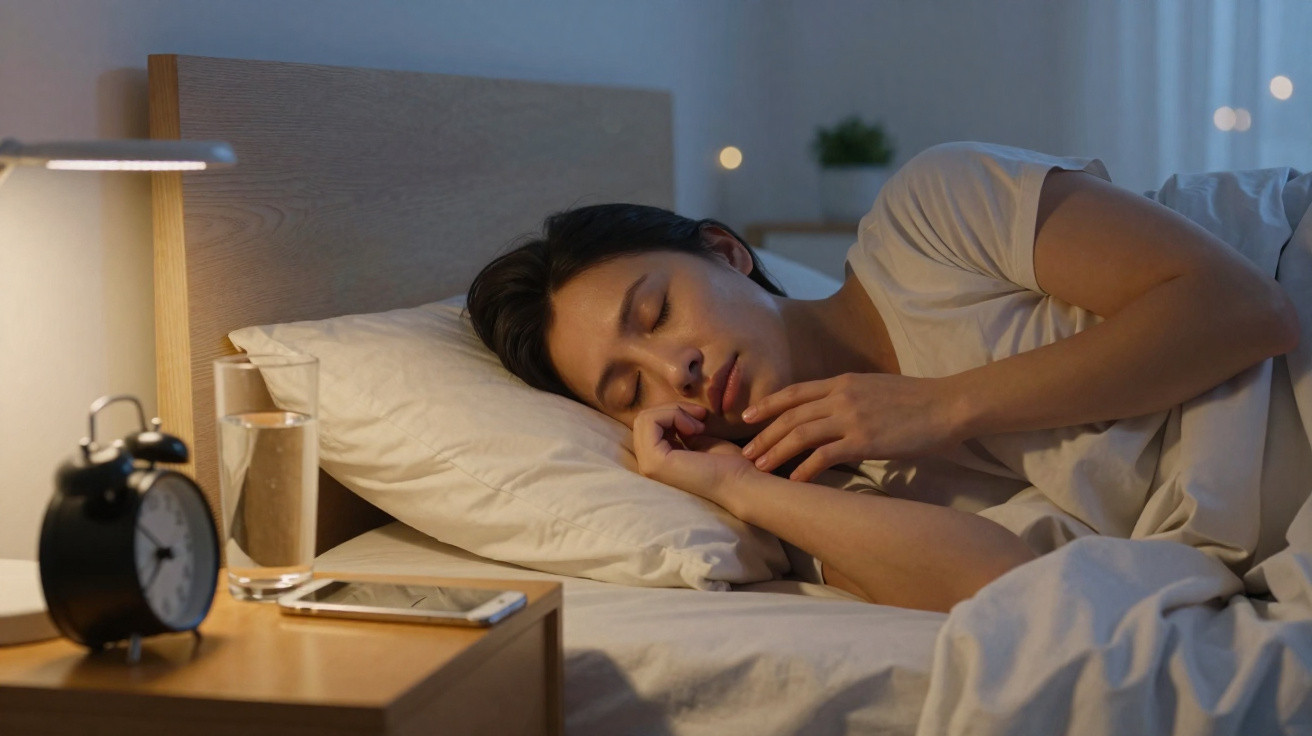
The room is still. Streetlamps cast a faint orange wash through the curtains. You are completely worn out, yet your thoughts are tumbling over themselves. You flip the pillow, swap sides and adjust the duvet for what must be the tenth time. Nothing helps. Your heartbeat seems just a touch too quick. Your jaw is slightly clenched. You are exhausted, but somehow alert.
Naturally, you do what everyone quietly does: pick up your phone, peer at the display and search “why can’t I sleep” as though nobody has faced this before. The results become a blur of advice: cut caffeine, avoid screens, do yoga, drink herbal tea, take magnesium, run a candlelit bath. Lovely in theory. Also rather like taking on another job. Amid all that guidance, one peculiar suggestion keeps returning: inhale for 4, hold for 7, exhale for 8. It seems almost absurdly easy, perhaps exactly why it catches your attention.
The night I eventually tried the strange counting method
When I first came across the “4-7-8” breathing technique, I rolled my eyes. Naturally, it appeared on TikTok, where somebody was whispering into a microphone about “nervous system regulation” while moving crystals around. It came across as another practice we save, send to friends and promise to do daily… before forgetting all about it by Tuesday. Honestly, hardly anyone creates a flawless bedtime routine; most of us simply fall into bed and cross our fingers.
Then, one night, I had no distractions left. I had looked through old photographs, read the news – a dreadful choice – and checked the following day’s forecast twice. Lying on my back, I could hear the muted drone of a fridge somewhere in the flat, when the numbers came back to me: 4, 7, 8. Fine, I thought. I’ll try the stupid breathing thing. At the very least, it would give me something to count besides my regrets.
I shut my eyes and placed one hand on my chest, the other on my stomach, as every meditation app instructs you to do. I breathed quietly through my nose for 4 unhurried counts, held the breath for 7 – surprisingly long – then released it through my mouth for 8, as though gently deflating a balloon. There was no dramatic revelation or immediate serenity. I was simply, rather awkwardly, aware of breathing. Even so, my shoulders loosened a little. It was only a small change, but it happened.
What 4-7-8 does in your body
Put aside the vaguely mystical way it is often presented online and 4-7-8 comes down to fairly straightforward biology. Concentrating on a set breathing rhythm encourages your body to move out of “fight or flight” and towards “rest and digest.” It resembles changing down a gear. Rather than making yourself relax, you offer your nervous system a new instruction.
Much of its effect lies in the extended exhale. Breathing out slowly and completely activates the vagus nerve – an important part of the parasympathetic nervous system. Your pulse begins to ease, blood pressure settles, and your body quietly notes, “We’re not being chased, we can calm down.” The signal may be gentle, but it matters when you are awake in bed with stress humming beneath your skin.
Cortisol, the stress hormone everyone enjoys blaming, plays a role too. If you are anxious or caught in a spiral of thoughts at 1am, your cortisol is often higher than your body requires. Lengthening the exhale and pausing in the middle sends repeated signals of safety, helping to soften that hormone surge. This is not sedation; it is rebalancing.
Why the numbers have a purpose
The 4-7-8 pattern is not a mystical code passed down by monks on a mountain, yet it has been deliberately arranged. Inhaling for four counts is mild enough to prevent you from gulping air. Holding for seven gives the lungs time to take in oxygen and the blood time to circulate it. Exhaling for eight ensures that you empty your lungs properly, instead of relying on the brief, shallow anxious breaths we often fail to notice.
The sequence also has a subtle extra benefit: it makes your brain pay attention. It is difficult to count 4, then 7, then 8 while also replaying an argument over an email from last week. Your mental focus contracts to “one-two-three-four, one-two-three-four-five-six-seven, one-two-three-four-five-six-seven-eight.” It may sound simple, but it is a small way of taking the controls back from racing thoughts.
How to use 4-7-8 when you are restless in bed
Perhaps you are lying awake, looking at the ceiling, with the duvet suddenly too heavy and the prospect of another poor night tightening your chest. This is where 4-7-8 proves useful: it gives both mind and body something to do besides doom-scrolling. There is no need for an app, music or lavender spray shaped like a crescent moon. All you need is your breath and a little patience.
Close your mouth and inhale softly through your nose to a slow count of 4. Without straining, hold the breath for 7 counts. Next, breathe out through your mouth for 8 counts, as though quietly steaming up a window. That is one cycle. Start with four cycles. You can continue for longer, although those initial four can sometimes be enough to shift how you feel.
It is unlikely to feel cinematic at first. You may forget where you are in the count, or your breathing may seem awkward and a little forced. That is entirely fine. You are not appearing in a meditation advert; you are simply practising. The point isn’t perfection; it’s giving your nervous system a gentle, consistent nudge toward calm.
A small routine that does not demand a new life
There is a quiet comfort in a habit that takes only a minute. Consider making 4-7-8 the transition between scrolling and sleeping. Place your phone face down, switch off the lamp and make a deal with yourself: complete four rounds before choosing whether to pick up the phone again. That is likely to feel more achievable than promising to “never take screens into the bedroom again.”
Some people pair each exhale with a short phrase, such as “let go” or “not now.” On the page it may seem a little woo-woo, but in the darkness, when your mind is working through the same worries for the twentieth time, it can be unexpectedly reassuring. The words are not magic; they simply remind you that rest is allowed, even when your life is not perfectly in order. You can still be a work in progress and deserve sleep.
When your thoughts resist
Naturally, some nights make all of this difficult. You inhale for 4, hold for 7, and at around 6 your mind interrupts: “Did you reply to that WhatsApp?” During the 8-count exhale, you remember something you said at a party three years ago that still follows you into the shower. It can seem as if your brain is deliberately wrecking your attempt to relax.
This is often when we give up and conclude that it “doesn’t work.” Yet distractions and missed counts are part of the practice, not evidence that you have failed. Whenever you notice your mind has drifted and kindly return to the numbers, you have completed a tiny repetition in the mental gym. You are strengthening the part of your brain that decides where to place attention, rather than being pulled along by every anxious thought.
On especially difficult nights, reduce the pressure further. Tell yourself that sleep is not the goal; you are only practising calm breathing for a few minutes. That slight reframing can soften the desperation. Sleep often comes more readily once it no longer feels like an exam you are failing.
The reassuring science: it is not all in your head
For those who want evidence, the 4-7-8 technique comes from pranayama, an ancient yogic breath-control practice. It has also been popularised in the West by doctors working with stress, not solely spirituality. Research into slow, controlled breathing repeatedly points to similar effects: improved heart rate variability, fewer signs of physical stress and stronger self-reported feelings of calm. In other words, when breathing becomes slower and longer, the body really does quieten its alarm signals.
Think of the last time something startled you and you told yourself to “just breathe.” That reaction is your body’s built-in reset mechanism. The 4-7-8 technique simply gives you a structured way to use it. You cannot always solve the reason sleep is elusive – pressure at work, money worries or a baby convinced that 4am is party time – but you can lower your body’s response to it. That will not fix your life, but it can make it a little easier to live with.
Some sleep clinicians recommend slow breathing exercises alongside cognitive behavioural therapy for insomnia. They are not presented as a miraculous cure, but as a low-risk method for creating physical conditions more conducive to sleep. Picture it as lowering the lights in your nervous system. You are not hitting an immediate “off” button; you are gradually bringing the volume down.
When it becomes more than a bedtime technique
After becoming familiar with 4-7-8 at night, you may find it quietly making its way into the rest of your day. Stuck in an overly bright supermarket queue while your heart races? Four in, seven hold, eight out. On a train that has unexpectedly stopped in a tunnel? Four in, seven hold, eight out. Supposedly listening in a Zoom meeting while your thoughts start spiralling? You understand the principle.
At that point, it becomes more than a sleep trick; it is a portable cue of safety. Each time you practise it while stressed and nothing awful occurs, your body learns: oh, this is the pattern we do when we’re safe. When you then use it in bed, that connection is already there. You are not beginning from nothing in the darkness; you are reinforcing a language your body already recognises.
This does not mean you will return to sleeping like a teenager, mouth open, phone resting on your chest and no clue what time it is. Sleep in adulthood is more complicated. There will still be disrupted nights and difficult mornings. Yet having one manageable action to take, rather than lying there at the mercy of your own thoughts, can offer a kind of relief in itself.
Those small, private victories
There is something pleasantly unremarkable about 4-7-8. No equipment to purchase, no subscription to pay for and no progress tracker sending motivational messages. It is simply you in the dark, counting breaths quietly like a child learning to float on their back. Nobody else witnesses it. Nobody applauds. Still, these are often the small, private decisions that gradually alter how your nights feel.
The difference may not be obvious straight away. One night, halfway through the third 4-7-8 round, you may notice that your jaw is no longer tight. On another, you may wake up with a vague memory of breathing slowly at some stage, followed by nothing. That is generally how it appears: not as a miracle, but as less drama.
Perhaps that’s the quiet power here: it doesn’t promise perfection, just a little more softness around the edges of your worst nights. When the next restless night arrives – and it will – you need not reinvent your whole life or create a candlelit ritual. You can lie there, count 4, then 7, then 8, and allow your body to recall what ease feels like. Sometimes, that modest act of defiance against racing thoughts is precisely what finally allows you to drift off.






Comments
No comments yet. Be the first to comment!
Leave a Comment