
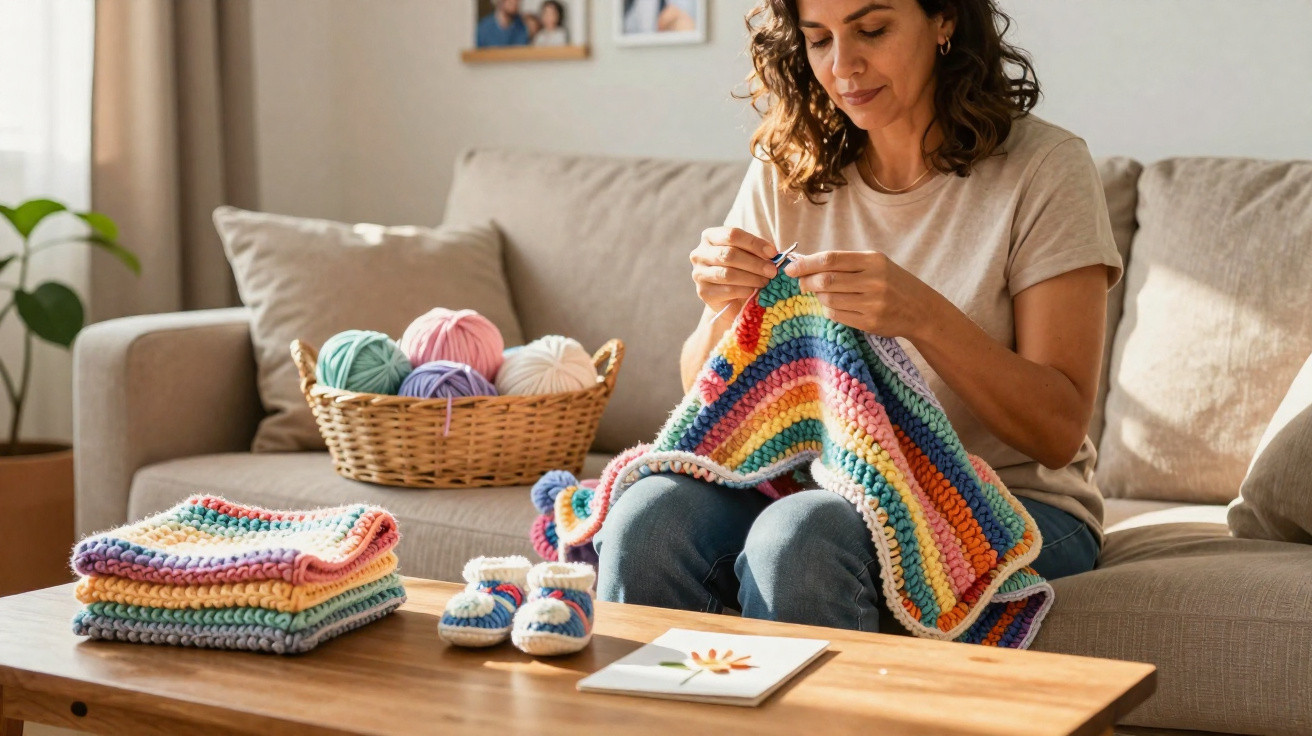
They arrive at the front door in cardboard boxes sealed with tape, as unremarkable as a receipt. In a peaceful seaside town, a retired grandmother takes a different approach: she transforms yarn and offcuts into birthday blankets, baby mobiles and “movie night” mittens, before seeing her family wear them until they are threadbare. That is precisely the idea. Gifts woven into everyday routines do more than look good; they are properly lived with.
The sitting room carries the scent of eucalyptus and black tea. Sixty-eight-year-old Margo holds a yielding ball of heather-grey wool in one hand as her hook makes its gentle, metronomic click, while the dog exhales beside her slippers. Her coffee table holds a button tin, a cut-out photograph of her grandson’s favourite hoodie, three name labels and a well-worn tape measure from a dress shop that shut in 1998. She crochets the scarf at the unhurried pace of writing a letter, finding silence in the gaps between stitches. Then she makes an unexpected choice.
The quiet power of handmade family gifts
Like bakers hiding wishes inside pies, she works stories into the yarn, which is why her presents endure. Each item holds a memory of how it came together: the blue picked to match a cousin’s eyes, the worn label cut from a second-hand shirt, the evening when the pattern failed and had to be carefully unravelled back into shape. When her gift box reaches the family, no one asks for a receipt or a label; instead, they hand the pieces round and search for the stitch concealing her initials.
Last winter, she made a shawl for her granddaughter’s registry office wedding. It was light as a feather, scattered with little seed beads that gleamed beneath the streetlights like icing sugar. The bride wore it over a second-hand satin slip that was still moist from steaming, then later left it over a kitchen-chair back, where it absorbed cinnamon and champagne. In the following months, the same shawl accompanied her to medical appointments, brunches and a job interview, acting like a soft bodyguard carrying a past. A shop-bought scarf could have served the same function. This one held the memories.
Handmade presents have a value that money cannot easily express, because the time spent on them is plain to see. A crocheted blanket is not simply warmer; it says, I made room for you in my hours, I learnt your colours, and I gave up a television episode to finish your edging. They offer useful flexibility as well: sizing and comfort can be adjusted while working, colours can come from an old photograph, and textures can be selected for sensitive necks or clammy hands. People don’t cherish price tags; they cherish proof of attention.
How Margo creates handmade family gifts, stitch by stitch
Margo follows a calm method that resembles a craft shop emptied into a diary. For every relative, she keeps an index card listing favourite colours, disliked textures and an approximate size pencilled in, then plans “gift windows” two months ahead for substantial items and two weeks ahead for smaller makes. She assembles a small palette tray with three yarns, one accent ribbon and one unusual detail, such as a shirt cuff. Before she fully commits, she makes a swatch the size of her palm, because how something feels in the hand matters more than any promise.
The likeliest error is choosing a demanding pattern that seems gorgeous at midnight but punishing by breakfast. Begin with smaller, repeatable projects instead: ribbed wrist warmers, basketweave scarves or granny-square lap blankets that can expand when time permits. We have all experienced the point when the diary falls apart and a present becomes a source of guilt. It need not become homework. Choose forgiving stitches, gentle fibres and a colour palette you can bear to look at in dim light. Let’s be honest: nobody really does that every day.
She speaks softly when describing why certain presents work so well.
“The best present starts with a question: what do they reach for when they don’t think about it? That’s the texture and shape I make.”
By the sofa, she piles up what she calls “ready-to-gift kits”, ensuring that she never loses momentum.
- One completed swatch, annotated with hook size and yarn length
- Three wound skeins, plus a coordinating ribbon or rescued shirt label
- A card telling the story: why she chose the colour, what to wash it with and where the hidden initials are placed
Stories that last longer than the wrapping
Her gifts move through the family much like recipes, and therein lies their understated pleasure: physical objects become reminders of occasions that nobody ever recorded. The baby mobile of tiny crocheted moons recalls the difficult night when the electricity failed; the picnic blanket carries grass marks and summer storms; the kitchen hand towels retain the sound of two sisters laughing over a ruined lemon tart. Craft has a way of bottling the ordinary until it tastes special.
There is a more private reward for the maker, too. Following decades governed by timetables and alarms, deliberate handwork lends her days a form that feels selected rather than imposed. Every present leaves a trail of small choices that keep her mind alert. She insists she sleeps more soundly when a repetitive stitch is on the hook, and the house becomes gentler as a result: less glazed by screens, more animated by projects still taking shape. The real gift might be the room it creates in a day.
At birthdays, she never asks whether someone enjoyed the gift. She wants to know whether the thumb hole was right, whether the cuff caught on a coat sleeve, or whether the blanket corner slipped up over the knees during a late-night film. That is intimacy rather than perfectionism. Each reply informs the following gift, the next winter and the shared thread that means she arrives neither empty-handed nor empty-hearted. Naturally, some pieces disappear, some shrink and others come undone after a difficult week. The story still carries on.
This was the small gesture she made earlier, the one that caught me by surprise. Rather than covering the scarf in shiny paper, she stitched on a little button taken from her husband’s old shirt and slipped a handwritten note beneath the seam. Who does that? A retired person, certainly, but also somebody who knows that a gift can guide you back to its giver long after the occasion has passed.
| Key point | Detail | Benefit for the reader |
|---|---|---|
| Create a gift calendar | Index cards, two-month windows for large pieces, two-week sprints for small ones | Cuts down on rushing and unfinished projects |
| Design around daily habits | Choose textures and shapes people already reach for without thinking | Greater use and a stronger emotional impact |
| Make “ready-to-gift kits” | Pre-wound yarn, swatch notes, ribbon and a story card | Maintains momentum and makes giving effortless |
FAQ
- How long does a simple crochet scarf take for a beginner? Allow 6–8 hours over several evenings, using chunky yarn and a repeatable stitch.
- Which yarn works well for babies and sensitive skin? Choose soft cotton blends or machine-washable merino, and avoid scratchy acrylic for pieces worn close to the skin.
- How can I personalise an item without using complicated patterns? Use a contrasting edge, a reclaimed shirt label or tiny stitched initials in one corner.
- What should I do if I have little time before an event? Make something small but practical: ribbed mug cosies, a set of dishcloths or one luxurious potholder with a story card.
- How should recipients look after crocheted gifts? Wash in cold water with gentle soap and dry flat; add a note naming the yarn type and providing straightforward washing instructions.



Comments
No comments yet. Be the first to comment!
Leave a Comment