
One moment, he is walking through dappled shade amid rustling leaves; the next, he faces a barrier of identical trunks lined up with military precision. The birdsong fades away. The air is strangely motionless, as though the landscape has been put on mute.
Behind him lies an untidy patchwork of oaks, shrubs, mosses and dead wood. Ahead, cloned pines stand row upon row: the same height, colour and age. Somewhere on a screen, it is likely described as a “carbon-positive reforestation success story”. Standing here, however, it feels more like a green factory.
He pulls out his phone, opens a “tree-planting progress” app and watches the tally rise. Thousands of trees have been added. Tonnes of CO₂ have theoretically been absorbed.
What the app fails to reveal is what quietly vanishes within those plantations.
From living forest to green machine
A natural forest feels mildly chaotic when you walk through it. Branches snag your route, fungi emerge from the leaf litter, and a brief flicker of feathers darts through the corner of your eye. The ground is soft beneath your feet and has a spring to it. Life can be heard at several levels: insects near the soil, warblers overhead and perhaps a woodpecker tapping at a trunk in the distance.
Enter a monoculture plantation and that richness shifts. Needles or leaves form evenly spread carpets. Plants in the understorey become sparse. Its soundscape is flatter as well. You may still hear the wind moving through the canopy, or a chainsaw further away, but the multi-layered chorus of species becomes little more than background sound.
From satellite imagery, both places appear equally green. In carbon calculations, the plantation may even come out ahead. Fast-growing eucalyptus and pine excel at absorbing CO₂ per hectare. They also excel at pushing out everything that does not suit the business model.
The expansion of eucalyptus plantations in parts of Brazil and Portugal is one example. Local people sometimes refer to them as “green deserts”. This is not because trees are absent, but because almost nothing else remains. Eucalyptus grows quickly, certainly. Yet water tables fall, native vegetation struggles and birds reliant on hollow trunks or stands of mixed ages disappear altogether.
In Indonesia and Malaysia, natural rainforest has been cleared for oil palm and acacia plantations in pursuit of productivity and, more recently, “climate-smart” development. On paper, millions of trees occupy land where satellites once recorded dense jungle. In reality, orangutans, hornbills, orchids, thousands of insects and microorganisms lose their entire world.
Similar patterns can be found even in Europe, in areas of Germany, France and the UK dominated by blocks of spruce or pine. After a storm or beetle infestation, vast plantation areas can collapse at the same time. The land can suddenly resemble a shaved scalp. There is a sharp irony here: systems designed around timber and carbon may be less able to withstand the climate shocks they were intended to soften.
The reasoning behind this change seems straightforward. Plant one rapidly growing species, harvest it on a timetable, then replant. Turn its timber into paper or construction material. Measure carbon storage through neat graphs and dashboards. For governments under pressure to reach climate goals, monocultures offer rapid CO₂ gains that are simple to calculate and trade through carbon markets.
Yet forests are not simply carbon-processing machines: they are networks of relationships. A natural woodland performs overlapping roles. It cools the air, manages water, supports pollinators and provides shelter for predators that control pests. It also preserves genetic diversity that remains poorly understood. Reduce that system to one species of one age, and these unseen benefits collapse.
Researchers are now recording cases where “carbon-only” policies produce the opposite of their intended effect. Monoculture plantations may burn more intensely in wildfires, returning CO₂ to the atmosphere before requiring costly replanting. They are also more vulnerable to storm damage or a single pest. Long-term carbon storage looks precarious when everything depends on such a narrow range of life.
How to plant trees without killing a forest
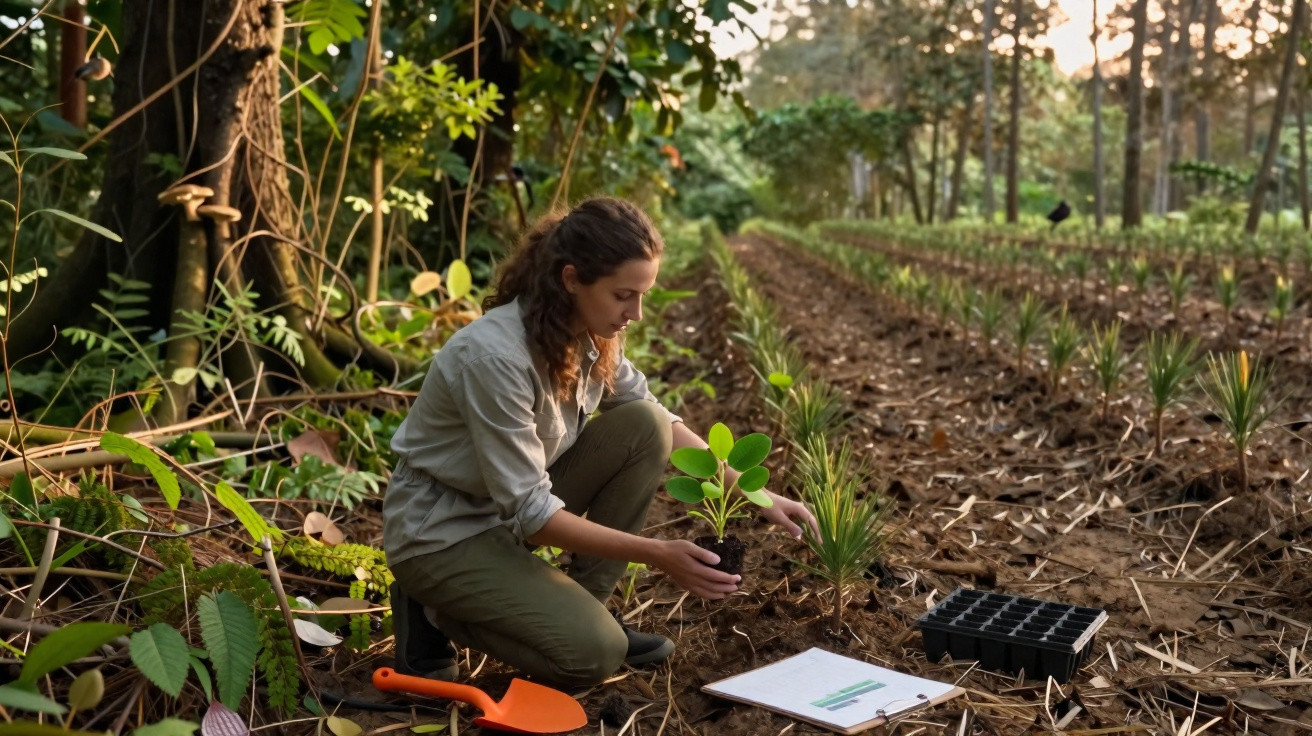
Tree planting can be approached differently: begin with the ecosystem rather than a spreadsheet. Instead of asking, “Which species grows fastest?”, conservationists increasingly ask, “What did this landscape used to be, and what can it become under a warmer climate?” In practice, this involves planting mixed species and different age groups while making room for natural regeneration.
On degraded land, the most sensible approach is often to plant fewer trees and allow birds, wind and soil to do the remaining work. Young native saplings can be protected, while pockets of shrubs, flowering plants and dead wood are added. Put simply: fewer straight rows and more irregular clusters. Less fixation on uniformity, and greater acceptance of “untidy” areas where life can return by itself.
Some schemes now combine fast-growing “nurse” trees with slower native hardwoods planted beneath them. The pioneer species capture carbon rapidly and shade the soil, while the slower trees establish lasting habitat and structure. Where firms seek carbon credits, some are beginning to offer more for projects that specifically monitor biodiversity rather than CO₂ tonnage alone.
Whether you are a policymaker, a landowner or simply donating to “plant a billion trees”, the major mistake is assuming every green scheme is alike. Many reforestation programmes still rely on species that are inexpensive, readily available in large volumes and known to grow quickly. They are often non-native, cloned or genetically very limited. In photographs, the result can look lush and heroic. The reality may be much less romantic.
Typical errors include planting in unsuitable places, such as converting natural grasslands or peatlands into plantations, which may actually intensify climate impacts. Another is excluding local communities, who may receive no benefit and later clear the trees. A further problem is concentrating on initial planting totals instead of long-term survival and ecosystem condition.
At a personal level, many of us click “plant a tree with your purchase” and enjoy a small burst of virtue. On a bad day, we may do so without looking any further. Let’s be honest: nobody really reads the 60-page technical reports behind these programmes. Still, asking only one or two questions can direct money away from greenwashing and towards genuine restoration.
Forestry and ecology projects often express the same principle in different terms:
“A forest is not an orchard. If every tree looks the same, you probably built a plantation, not a home for life.”
For anyone selecting or supporting tree projects, a straightforward mental checklist can help filter out the noise:
- Does the scheme restore native species rather than simply planting fast-growing exotics?
- Does it contain a variety of ages and structures, or only a single crop cycle?
- Have local communities taken part in its design and do they gain lasting benefits?
- Is biodiversity monitored alongside carbon, even through basic indicators?
- Does the scheme safeguard existing natural forests before planting new trees?
We have all seen an email announcing “10,000 trees planted!” and felt inspired for a moment. Then a quieter doubt appears: what sort of forest is it, really? Raising these uncomfortable questions is not about blaming people who plant trees. It is about moving from reassuring figures to living, breathing landscapes.
What we gain – and risk losing – with every planted tree
Imagine two possible futures for the same hillside. In one, drones scatter rows of identical seedlings across a damaged slope. They grow fast, absorb CO₂, supply a pulp mill and create tidy climate certificates. In the other, the slope contains patches of young native trees, surviving old stands, shrubs, open streams and several areas left entirely untouched.
On a map, both futures are “green”. Both could be included in national statistics. But only one vibrates with the untidy, layered life able to adapt, evolve and surprise us. The choice between optimised carbon and flourishing biodiversity is not always absolute, but today’s planting rush often strongly favours the former while barely measuring the latter.
The more important question is not, “How many trees did we plant?” but, “What worlds did we create or destroy as we did it?” Keep that question in mind when a brand, government or app displays a large, gleaming tree counter. It offers no reassuringly simple answer.
| Key point | Detail | Why it matters to the reader |
|---|---|---|
| Monoculture ≠ forest | Single-species plantations store carbon but provide limited habitat and little resilience. | Helps you recognise when “reforestation” may actually mean biodiversity loss. |
| Native diversity matters | Mixed local species and varied ages support more species and make carbon storage more stable over time. | Provides practical criteria for backing stronger climate and tree-planting schemes. |
| Ask better questions | Who benefits, which species are used, how biodiversity is measured and what was there previously? | Turns passive donations into informed decisions that avoid greenwashing. |
FAQ:
- Are tree plantations always bad for biodiversity? Not always. Plantations on land that is already degraded or used for agriculture can increase tree cover and provide some habitat. The issue arises when they replace species-rich natural forests or rely on one non-native species without room for wild regeneration.
- Do monoculture plantations still help with climate change? They may store carbon rapidly in the short term, particularly when fast-growing species are used. The danger is that fire, pests or storms can destroy them, releasing that carbon and requiring expensive replanting while delivering few wider benefits.
- How can I tell if a tree-planting project is genuine? Seek clear details about native species, community participation, long-term management and basic biodiversity monitoring, rather than only “trees planted” claims and glossy photographs.
- Is natural regeneration better than planting trees? Often, yes. Where seed sources and soil remain, allowing woodland to recover naturally can produce more varied, resilient ecosystems than planting one species at scale.
- What can individuals actually do beyond clicking ‘plant a tree’? You can support organisations that protect existing natural forests, encourage your council or employer to adopt biodiversity-friendly policies, and choose products that do not drive deforestation in the first place.





Comments
No comments yet. Be the first to comment!
Leave a Comment