
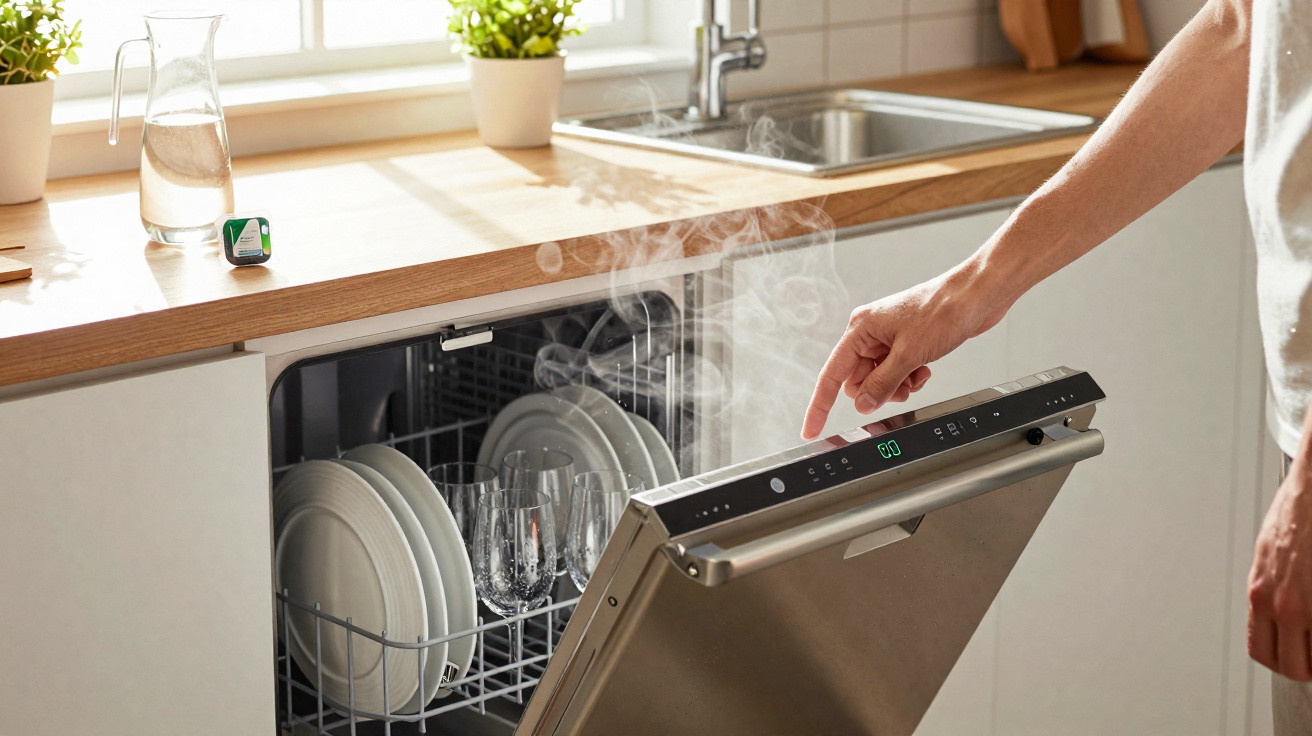
The evening I discovered that my dishwasher had been deceiving me for years, I was barefoot in a silent kitchen, looking at its control panel as though it had revealed something shocking. Plates covered the worktop, a half-finished glass of wine stood beside the sink, and the usual weekday disorder was finally easing. I selected the familiar “Quick” programme, then, for once, paused and pulled the user manual from the drawer where it had been hidden.
Five minutes later, I was on the floor with the manual spread in front of me, learning that the programme I had always ignored was actually the most water- and energy-efficient option.
I also found that the “eco” cycle, which I had dismissed as a marketing gimmick, was quietly outperforming the alternatives in every comparison test.
The oddest thing?
Most people are making exactly the same choice without realising it.
Why the “eco” cycle quietly beats all the others
Watch people choosing a dishwasher setting and the pattern is clear. Nine times out of ten, they immediately press “Quick”, “1h” or “Intensive”. Fast, forceful, finished. We are naturally drawn to the quickest choice, particularly at 10:30 p.m., when you want an empty sink and a place on the sofa.
At the far end of the controls, the eco cycle looks slow and vaguely untrustworthy. Three hours? Four? It seems excessive. So we avoid it, convinced that a longer programme must use more water, more energy and create more guilt.
The facts point in the other direction.
Look at figures from consumer associations and energy agencies, and the same pattern emerges. On its eco cycle, a modern dishwasher uses approximately 8 to 10 litres of water. On an intensive or short programme, that same appliance can readily use 13–15 litres, and occasionally more. Washing a full load by hand can require 40 to 60 litres, especially if hot water is left running.
The principle is straightforward. An eco programme heats water to a lower temperature but circulates it for longer, filtering and reusing it several times. Rather than attacking plates with very hot water in a brief blast, the dishwasher operates gradually and consistently, more like a gentle simmer than a vigorous boil.
Less heat, more time, greater efficiency.
Once you understand how a dishwasher operates, the logic becomes clear. Heating water accounts for most of the electricity it consumes, rather than spraying it. Because the eco cycle uses lower temperatures, energy costs fall. The pump does run for longer, but its motor requires very little electricity compared with the heating element.
Cleaning is not simply a matter of using boiling-hot water to remove stains. Marks need time in contact with detergent, as well as movement. That is precisely what an extended programme provides. Dried pasta, baked-on cheese and coffee marks gradually soften, lift away and rinse off, without high temperatures doing all the work.
The programme that appears “lazy” is actually doing the intelligent work behind the scenes.
The simple dishwasher setting change that saves water and cleans better
The most useful routine change is almost absurdly easy: make the eco programme your default for nearly every wash. That is all. Not once a week, and not only “when you remember”. Before loading even one plate, decide that eco is your standard setting and that every other programme is the exception.
Keep intensive for genuinely extreme situations: casserole dishes with burnt-on sauce, very greasy pans or heavily soiled items after a dinner party. Choose quick only when speed is truly necessary, rather than simply because you are impatient.
For everyday plates, glasses and lunch boxes, eco quietly does the better job.
Naturally, this approach only works if the rest of your habits are not undermining the dishwasher. The usual error is rinsing everything excessively under the tap ‘so it’s cleaner’. You are not the only one. We have all had that moment when we practically wash a plate before placing it in the appliance meant to wash plates.
Manufacturers formulate detergents to attach to food residue. When every trace is removed, sensors in modern dishwashers can sometimes decide that the load is already clean and reduce or shorten the programme. The result can be cloudy glasses and that frustrating film on plastic containers.
Scrape dishes, certainly. Rinsing them excessively, no. Allow the eco cycle to do the task it was created for.
The German engineer who tested my dishwasher for a consumer lab told me this line I can’t forget: “The most ecological setting is not the one you like best, it’s the one you use correctly.”
- Make eco your regular setting
Nearly every mixed everyday load can use eco, including loads with a few dried-on marks. - Scrape rather than pre-wash
Use a fork or spatula to remove larger food remnants, and stop leaving the tap running for ages. - Load with some care
Angle bowls slightly, prevent glasses from touching and mix cutlery in the basket so water can reach every item. - Run full loads without cramming them in
A full load means properly filled racks, with nothing obstructing the spray arms or detergent flap. - Maintain the dishwasher
Once a month, run an empty high-temperature maintenance programme using a cleaning product or vinegar.
Rethinking what “clean” and “efficient” really look like
After switching to eco and sticking with it for several weeks, something unexpected changes: your sense of time in the kitchen. The dishwasher runs quietly for three hours in the background, and you no longer fixate on the precise moment its door will open. Load it after dinner, go to bed and wake up to dry plates.
You start noticing the subtle savings, too. Your water bill falls slightly. You use fewer detergent tablets because you are no longer rewashing partly cleaned dishes. And there is no guilty feeling from running a not-quite-full quick cycle “just this once”.
There is a modest mental adjustment as well. Instead of regarding the dishwasher as a difficult assistant that needs watching and correcting, you begin to view it as a well-designed tool that knows how to do its job. The appliance is designed around eco, which is where engineers focused their efforts on refining sensors, temperature curves and water routes.
The old assumption that fast and hot means better begins to feel outdated, much like leaving lights on “because it doesn’t change much”. One plain-truth moment arrives when you recognise that the most effective action is neither complicated nor heroic: it is simply… pressing another button every day.
Then the idea travels further. You mention to a friend that your longest programme is now your most economical, and they laugh before checking their own manual that evening. Somebody else admits they still rinse every plate “out of habit”. A neighbour discovers that their eco programme automatically changes its running time according to how dirty the water is.
This is where small household choices begin to connect with bigger issues: how we use resources, what we consider efficient and why slower can sometimes be better. There are no grand declarations or guilt trips, only a different default setting quietly working while you sleep, conserving water you will never see and energy you will never have to pay for.
| Key point | Detail | Value for the reader |
|---|---|---|
| Eco cycle uses less water and energy | Lower temperature, longer duration, optimised water circulation | Lower bills and a genuinely smaller environmental footprint |
| Stop over-rinsing dishes | Scrape off solids and let detergent work on ordinary food residue | Better cleaning results, less water wasted at the sink and fewer rewashes |
| Reserve quick/intensive programmes | Use them only for emergencies or heavily soiled cookware | Prolongs appliance life and keeps everyday use cost-efficient |
FAQ:
- Question 1 Does the eco cycle really clean as well as the intensive or quick programmes?
- Answer 1 Yes, provided the load is arranged properly and is not exceptionally dirty. Independent tests show that for normally soiled loads, eco equals or even outperforms many faster cycles. The longer duration makes up for the lower temperature.
- Question 2 Why does my eco programme show 3–4 hours? Is that not too long?
- Answer 2 The extended duration lets the machine filter and reuse water at lower temperatures, dramatically cutting energy consumption. You are not paying for “extra work time”; you are saving the energy needed to heat water. Run it while you are asleep or out.
- Question 3 Should I still pre-rinse heavily soiled plates?
- Answer 3 Remove only large pieces of food and very thick sauces. For everything else, the combination of detergent, hot water and extended contact time on eco is intended to manage it. A light rinse is fine, but scrubbing dishes almost clean wastes both effort and water.
- Question 4 My glasses are cloudy when they come out. Is eco responsible?
- Answer 4 Cloudiness is generally caused by hard water, low-quality detergent or too much pre-rinsing, rather than eco itself. Try adding rinse aid, choosing a better detergent, checking salt levels and ensuring glasses do not touch when loaded.
- Question 5 Can I use eco for half loads, or is that pointless?
- Answer 5 A full load will always provide the best efficiency, but an eco half load remains more economical than short, hot programmes. If your model includes a half-load or “top rack only” setting, combine it with eco to avoid wasting water.






Comments
No comments yet. Be the first to comment!
Leave a Comment