
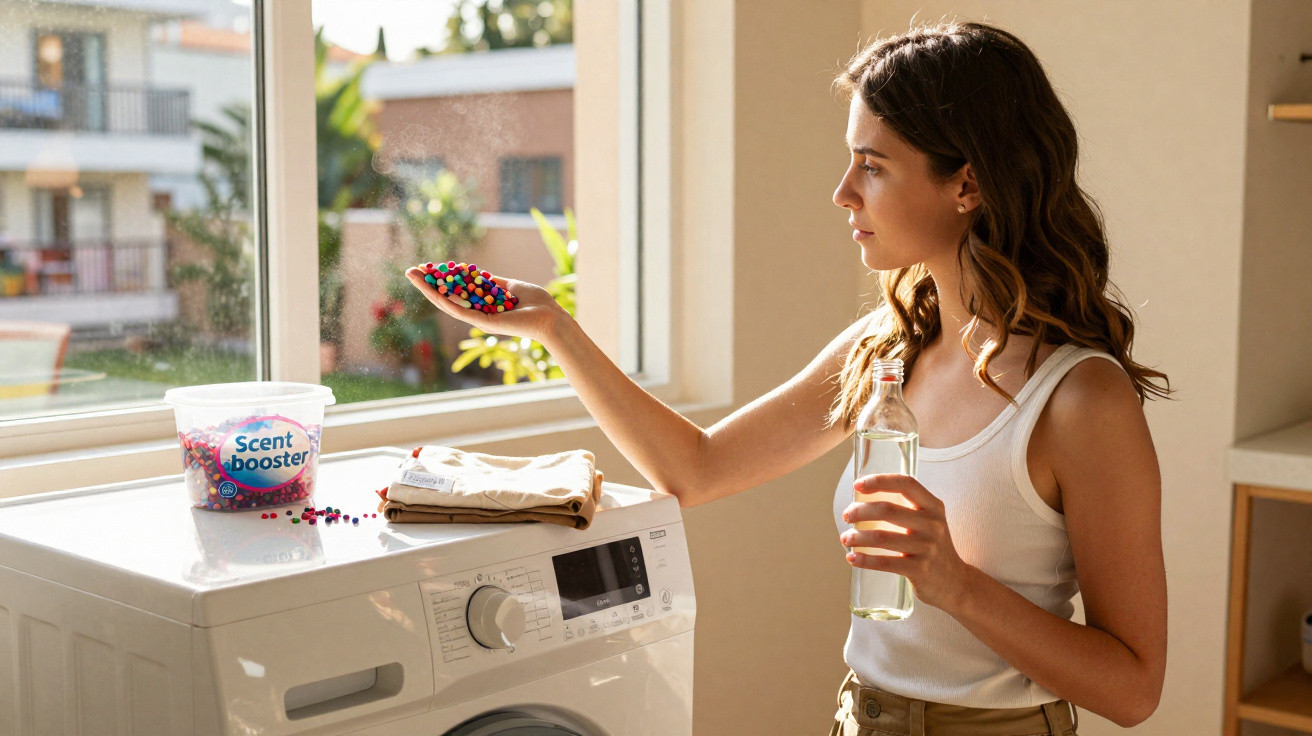
The neighbour’s window is open by a crack-just wide enough to let the smell in. A dense, sugary cloud of “fresh laundry” wafts over the courtyard and settles in your kitchen as you try to enjoy a peaceful coffee. On the drying rack across from yours, T-shirts are so loaded with fragrance boosters that they seem almost able to stand upright.
You see a woman snap out a towel, and a synthetic gust reaches you: tropical flowers, vanilla, ocean breeze… plus something faintly chemical that catches at the back of your throat. Opposite, a man bends over his washing basket and grins as though he has entered a perfume shop.
A single washing machine trick has become an unspoken battle between heavenly-scented clothes and those who simply want to breathe.
Your laundry room is the front line.
The viral “one-cap” trick quietly transforming the air we breathe
The trend began discreetly, as these trends so often do: with an offhand video, a neatly folded towel and an effortless promise. “Just add one cap of this to every wash,” the influencer beams, raising a neon-coloured bottle of scent beads. “Your clothes will smell amazing for weeks.”
People tested it once, then became devoted. Unlike traditional softeners, the scent did not disappear after a day. It remained on hoodies, pyjamas and pillowcases. It followed them onto the bus and into office meeting rooms.
When somebody says “Wow, you smell so clean,” the brain records it as a success.
At the next wash, the cap gets filled a little further.
On social media, this trick has turned into something close to a ritual. Users record themselves tipping full cups of fragrance boosters directly into the drum, scattering them as if they were glitter.
The comments fill up with “My neighbour always asks what detergent I use!” and “The smell fills my whole house!”-as though scenting an entire house were genuinely the aim.
Then a different kind of comment starts appearing. One mother says her child’s asthma worsens whenever the neighbour downstairs does the washing. Another woman says she knows exactly when the man next door washes his clothes because the scent slips beneath her door.
We have moved from a “fresh laundry smell” to an ever-present perfumed haze.
The simple reality is that these products were not made for the volumes that people now proudly tip in on TikTok.
Fragrance boosters and exceptionally powerful softeners are concentrated blends of synthetic fragrances and volatile chemicals. They cling to textiles before gradually being released into the air whenever the fabric moves or rubs, and throughout every night beneath your duvet.
That appealing aroma in your hallway is not merely “clean”. It is a combination of compounds that can also drift into a neighbour’s bedroom when their window is open.
Your heavenly-scented T-shirt could be the reason for their 3 a.m. headache.
The alternative washing trick: fragrance without the chemical storm
Another washing trick is also circulating. It is less eye-catching on video, yet remarkably useful in everyday life, and it begins with something as unglamorous as white vinegar.
A modest amount of vinegar in the fabric softener compartment can help remove detergent residue, neutralise odours held in fibres and give clothing a restrained, light smell of being genuinely clean. It is neither perfumed nor overpowering-just neutral.
You can then add one optional element: a few drops of a gentle essential oil, such as lavender or orange, first blended with water or bicarbonate of soda before adding it to the drawer. The result is a delicate scent that stays near the skin rather than shouting from the balcony.
Your clothes will smell pleasant when you embrace someone, not when you pass their window.
Many people put too much into the machine because they pursue intensity rather than balance. They use twice the detergent, twice the softener and a handful of beads “for good measure”. Afterwards, they wonder why their towels feel oily or why their sportswear still smells sour despite being “clean”.
The fibres have become overloaded. They cannot breathe-and neither can you.
We have all experienced it: rewashing the same T-shirt three times because the underarm odour refuses to shift. The natural reaction is to add more fragrance. What tends to work instead is a warm wash, a little vinegar, sufficient drying time and enough room in the drum.
Clean is a feeling on the skin, not only a smell in the air.
“Since I swapped my huge cap of softener for vinegar and a few drops of lavender oil, my laundry smells like… nothing, then just a whisper of flowers,” says Sarah, 34, who lives in a small building with thin walls. “The best part is my neighbour, who used to complain about smells in the stairwell, hasn’t said a word in months. In a good way.”
- Use the correct amount
Follow the detergent mark on the cap rather than the temptation of the scent. Using too much often leaves clothes looking dull and feeling stiff. - Replace softener with vinegar
Around 100 ml of white vinegar in the softener drawer helps rinse fabrics, soften fibres and remove lingering odours without a heavy fragrance. - Choose a light scent, not a perfume explosion
If you like fragrance, use 3–5 drops of essential oil diluted beforehand in water or bicarbonate of soda, rather than applying it neat to fabrics. - Allow air to do its work
Dry laundry completely and leave room around each item. Much of the “fresh” scent people enjoy is simply air and sunshine. - Consider more than your own nose
If the smell of your washing reaches the corridor or a neighbour’s balcony, you have used too much, however “amazing” it smells.
When heavenly-scented laundry becomes a shared discussion
Laundry has an unusual intimacy. It touches our skin, covers our beds and sits against the backs of our necks. It holds traces of our lives: the kitchen, the gym, the baby’s room and the bar where we stayed too late last Friday.
Fragrance claims to wipe all of that away and replace it with “mountain air” or “sunrise meadow”. Some people find this reassuring; others experience it as an intrusion. The fragrance that comforts you could give your neighbour a migraine or leave their toddler coughing overnight.
Laundry is personal, but its scent is not necessarily private.
There is also a class and cultural aspect that receives little attention. For many families, strongly scented washing has long served as a subtle symbol of respectability: “We are clean, we take care of our things, we do not smell of sweat.”
Reducing the fragrance can therefore feel like relinquishing that signal. However, more people are quietly voicing another experience: “My head hurts when the stairwell smells like a detergent aisle,” or “I had to close my windows because someone’s laundry was drying outside.”
This discreet washing trick-using less product, creating a more neutral base and adding a hint of real scent-offers a way to enjoy pleasant-smelling clothing without making the whole building feel like a testing laboratory.
Perhaps that is where genuine change begins: not with a clever hack, but with a small adjustment in viewpoint. Rather than asking “How strong can I make this smell?” a better question may be “Who else is going to have to breathe this?”
In a time when every habit is displayed online, from organising fridges to folding socks, laundry has become as much a public performance as a private household task. Yet the quiet washes, half-caps of detergent and modest drops of lavender that nobody will ever record are probably what make the biggest difference to daily life.
The next time you pour something into the machine, picture the unseen cloud that will travel with you, ride the bus beside you and slip beneath a door you will never notice.
Between heavenly-scented clothes and angry neighbours lies a middle ground that simply smells of living together.
| Key point | Detail | Value for the reader |
|---|---|---|
| Hidden impact of “scent hacks” | Excessive use of boosters and softeners sends persistent fragrances and chemicals into shared air | Helps readers recognise why their washing habits may annoy neighbours or trigger symptoms |
| Low-chemical washing trick | Use measured detergent, vinegar instead of softener and diluted essential oils for a subtle scent | Provides a practical approach to keeping clothes pleasantly scented without overwhelming others |
| Social dimension of laundry | Laundry smells move through walls, courtyards and corridors, influencing other people’s comfort and health | Promotes more thoughtful routines and lowers tension in shared buildings |
FAQ:
- Question 1 Will vinegar make my clothes smell like salad?
Answer 1
The vinegar odour generally fades during rinsing and drying. Any slight trace that remains disappears quickly in the air. A few drops of essential oil in the drawer will disguise it further.
- Question 2 Are fragrance boosters really that bad for health?
Answer 2
They are not poison after a single wash, but they contain synthetic fragrances and volatile compounds that may irritate sensitive people-particularly children, people with asthma and migraine sufferers-especially when used excessively.
- Question 3 Can I still use softener if I like fluffy towels?
Answer 3
Yes, although you should use less and avoid adding it to every load. Alternate it with vinegar-only washes, and do not use softener on sportswear or microfibre, as it can reduce absorbency.
- Question 4 What’s a simple starting routine for “quieter” laundry?
Answer 4
Use one measured amount of detergent, 100 ml of white vinegar in the softener drawer and an occasional diluted essential-oil mixture. Where possible, wash at 40°C and dry items thoroughly with space around them.
- Question 5 How do I talk to a neighbour whose laundry smell is overwhelming?
Answer 5
Be kind and specific: refer to headaches or breathing discomfort instead of accusing them of being “dirty” or “toxic”. Explain that the products may be particularly strong, then ask whether they would consider using a little less. People sometimes simply do not realise how far the fragrance travels.





Comments
No comments yet. Be the first to comment!
Leave a Comment