
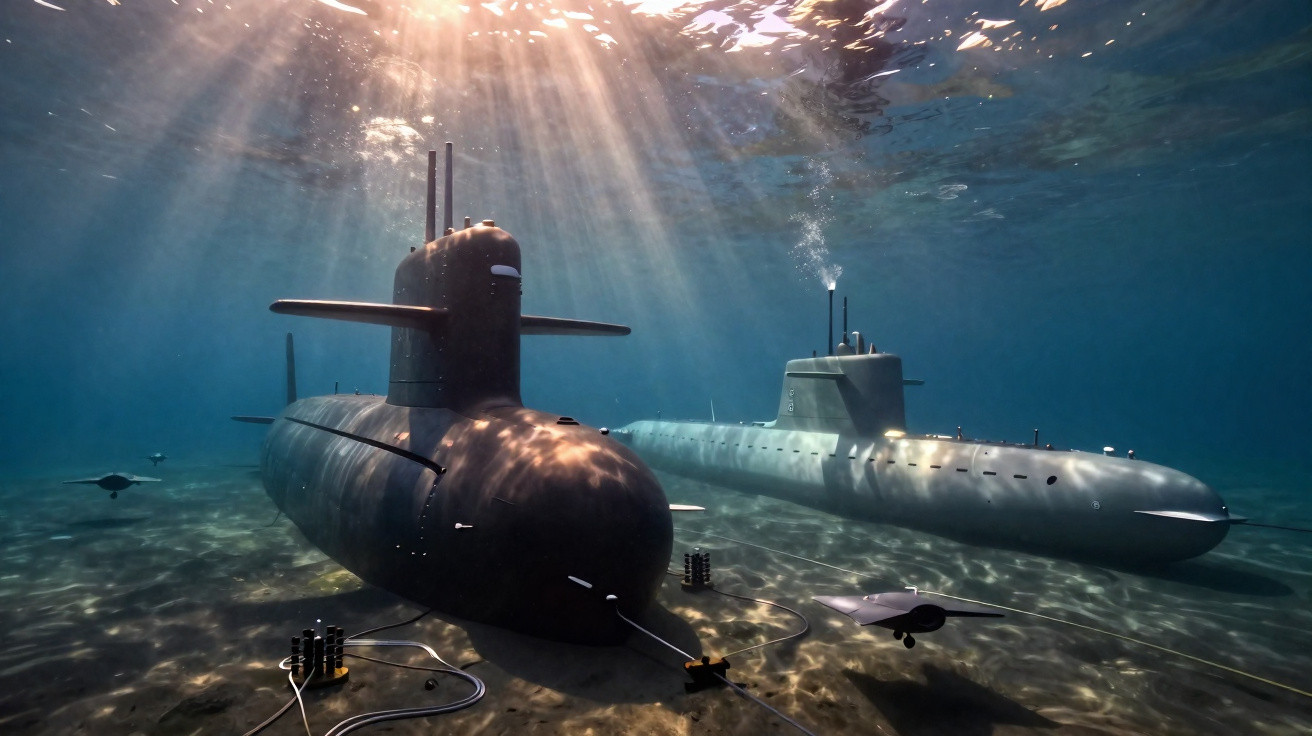
At a hearing titled “Part of Their World: Undersea Competition Between the United States and China,” naval officers and analysts appeared before the U.S. Economic and Security Review Commission. The United States warned that nuclear-powered vessels are expected to account for half of the Chinese Navy’s submarine fleet by 2035.
The assessment was set out early in an extensive briefing by Rear Admiral Michael Brookes, the current Commander of the Office of Naval Intelligence.
Chinese Navy submarine fleet and nuclear transition
Rear Admiral Brookes said China is already among the world’s largest submarine operators, with a fleet of more than 60 boats. Reports indicate that this force includes six nuclear-powered attack submarines (SSNs), two precision-guided missile submarines categorised as SSGNs, and six ballistic missile submarines, or SSBNs.
Most of the fleet nevertheless remains made up of conventional diesel-electric submarines, including boats fitted with the latest AIP systems, namely the Yuan- and Song-class.
The briefing further stated that the Chinese Navy is undergoing a transition intended to sharply expand the number of nuclear submarines at its disposal. A central element is the development of a new Type 041, or Zhou-class, variant. Comparable in size to a conventional submarine, this design would provide greater endurance.
This could give Beijing a more capable platform than those forming the majority of its present submarine force, while keeping expenditure below that needed for a large SSBN or SSGN.
Production capacity, sensors and strike capability
This shift does not suggest that China will dispense with larger, more capable submarines. Estimates indicate that it intends to retain such platforms in service throughout the 2030s and beyond, requiring further progress in sensors and weapons. The presentation also noted Chinese interest in technologies to lower submarines’ acoustic signature, alongside advances in reactor design.
The strategic implications are evident: this path would provide the Chinese Navy with a larger and more capable long-range strike capacity in the event of a conflict.
Rear Admiral Brookes’s report also recognised China’s substantial growth in submarine manufacturing capacity, stating: “China has dramatically increased its domestic submarine production capacity through major infrastructure investments at three primary shipyards, accelerating production from fewer than one nuclear submarine per year to significantly higher rates. These expansions include the construction of extensive facilities that have tripled the capacity of construction halls, enabling increased production rates of conventional submarines, while the enhanced infrastructure now allows for the construction of advanced, larger-diameter submarines at all three facilities.”
Images used for illustrative purposes
You may also like: Former U.S. Air Force F-35 pilot arrested for training Chinese aviators





Comments
No comments yet. Be the first to comment!
Leave a Comment