
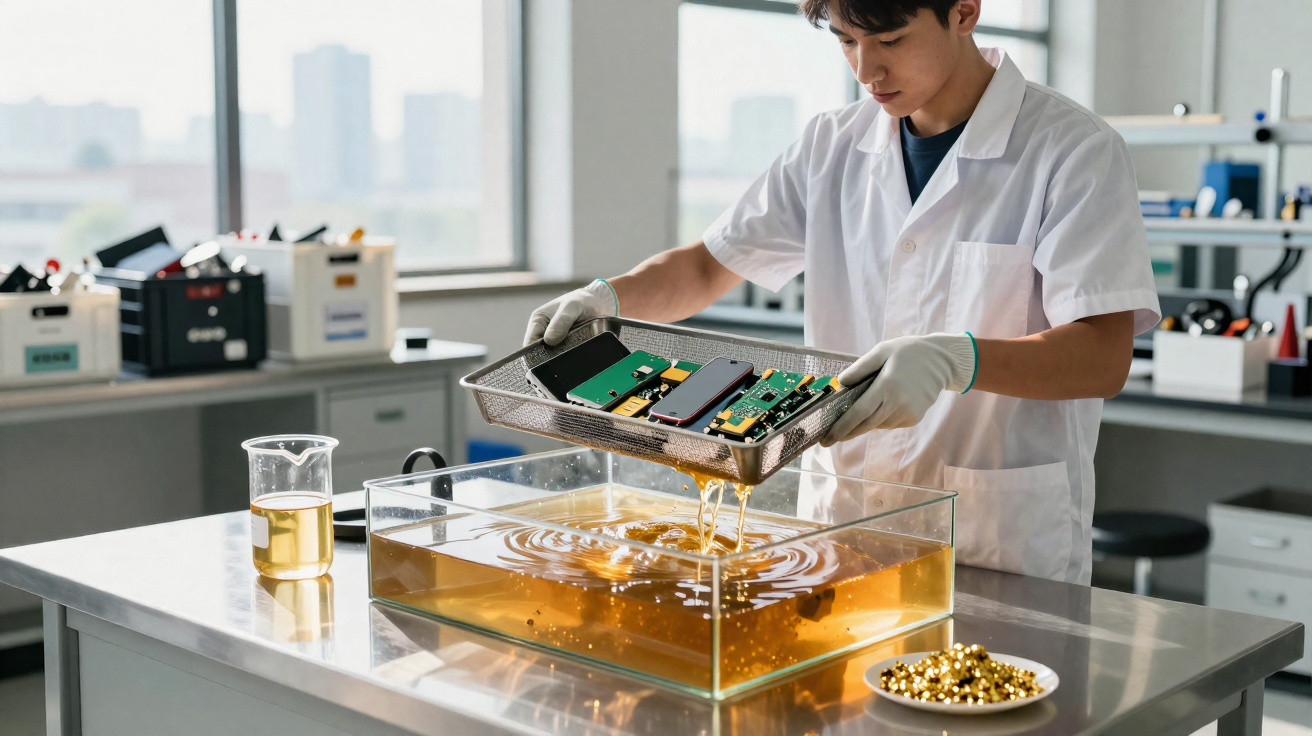
Researchers in China say they have solved a long-running challenge: extracting the huge quantities of precious metals trapped in electronic waste safely and at low cost, potentially transforming a worldwide rubbish issue into a multi-billion-euro resource.
A gold rush hiding in plain sight
That first smartphone, a tablet scratched since 2014, or the bulky laptop stored in the loft all contain minute amounts of gold. These are not nuggets, but microscopic coatings found on connectors and chips. Individually, they have little value; collectively, however, they amount to a metal reserve larger than many conventional mines.
The volume of e-waste worldwide is rising sharply. UN estimates indicate that roughly 82 million tonnes of discarded electronic equipment could be produced globally in 2030. Its circuit boards, processors and motherboards contain flecks of gold, palladium and other valuable metals.
The real “mine” isn’t buried deep underground, it is scattered across households, warehouses and scrap yards in every major city.
Industry has recognised the existence of this “urban mine” for years. The problem has been finding a way to access it without contaminating workers, communities and rivers along the way.
Why nobody really used this mine properly
Conventional methods of recovering gold from electronics depend on harsh and dangerous chemistry. Cyanide-based leaching is extremely efficient at dissolving gold, but carries substantial environmental and health hazards. Alternative approaches rely on high-temperature smelters, which consume vast amounts of energy and emit harmful fumes.
As a result, although specialist recyclers have recovered metals from obsolete circuit boards, enormous quantities of e-waste have continued to be sent to landfill or informal dumping sites. In lower-income countries, workers have often burnt cables or used rudimentary acid baths to retrieve a few grams of metal, inhaling toxic fumes for only a few pennies.
On paper, the potential value has always been extraordinary. In reality, both pollution concerns and poor economics made comprehensive recovery challenging and frequently politically contentious. Chinese researchers now hope their work can bridge that gap.
A clever chemistry trick that makes gold dissolve itself
A domino effect on the metal surface
The process was developed by a team from the Guangzhou Institute of Energy Conversion, part of the Chinese Academy of Sciences, in collaboration with South China University of Technology. Rather than using huge furnaces or aggressive acids, the researchers created a gentle water-based solution from two widely available salts: potassium peroxymonosulfate and potassium chloride.
At first, the formula appears fairly ordinary. Its ingenuity becomes apparent when the liquid meets the gold or palladium on a circuit board. The metal acts as its own catalyst, setting off a chain reaction at its surface.
The reaction creates highly reactive oxidants, including singlet oxygen and hypochlorous acid. These substances gradually remove metal atoms individually, before chloride ions bind to them and allow them to enter the liquid.
The metal effectively helps to dissolve itself, turning solid gold into a recoverable solution without the brutal side effects of cyanide.
From scrap chips to nearly all the gold
Experiments using old processors and printed circuit boards found that the technique can retrieve about 98.2% of their gold within 20 minutes at room temperature. Its recovery rate for palladium, another important metal used in electronics and catalytic converters, is about 93.4%.
On average, 10 kilograms of circuit boards contain approximately 1.4 grams of gold. The researchers put the overall processing cost for those 10 kilograms at around €65 using the new approach. This equates to approximately €1,350 per ounce of recovered gold, considerably below a gold price that has recently exceeded €3,800 per ounce.
At industrial e-waste volumes, those margins become increasingly compelling.
Cheaper, cleaner and designed for scale
Cutting energy and chemical bills
As well as delivering strong recovery rates, the process is notable for avoiding extreme heat and unusual, costly reagents. According to the team, it reduces energy consumption by around 62% compared with standard industrial techniques. Chemical reagent expenditure falls by more than 90% relative to cyanide-based methods.
Lower energy requirements reduce operating costs and carbon emissions. Using fewer aggressive chemicals also means less hazardous waste and fewer contaminated locations for future generations to address.
Once leaching is complete, conventional reduction and purification methods remove the dissolved gold from the liquid, producing high-purity metal that can be sold or reused in new electronic products.
Lower energy, fewer toxic by-products and high recovery rates bring e-waste recycling closer to a mainstream, profitable industry rather than a niche or informal activity.
A process that can leave the lab
The researchers maintain that their design could be converted into a compact industrial operation. It requires no enormous furnaces, no rare catalysts and no remote mining settlements. A moderately sized facility could be built beside an e-waste collection centre and supplied directly with discarded household and business electronics.
Such proximity could alter worldwide metal supply routes. Rather than sending unwanted phones from Europe or Africa to major Asian smelters, local plants could recover the precious metals themselves, retaining both jobs and value near the source of the waste.
How you reach €70 billion a year from old phones
Running the numbers on the “invisible” mine
Using the research team’s findings and UN data produces a straightforward, if remarkable, calculation:
- Projected global e-waste in 2030: about 82 million tonnes per year
- Share made up of circuit boards: roughly 5% on average (between 3% and 7%)
- That gives around 4.1 million tonnes of boards potentially treatable
- Each tonne of boards holds about 140 grams of gold, on average
- Total theoretical gold: roughly 574 tonnes per year
- With 98.2% recovery: about 564 tonnes of gold actually extracted
A tonne of gold is equal to around 32,150.7 troy ounces. Multiplying 564 tonnes by that figure gives approximately 18.1 million ounces of gold. At prices above €3,800 per ounce, the yearly value of the gold recovered alone comes close to €70 billion.
For decades, this “mine” sat in rubbish tips, recycling centres and cupboards, visible to anyone, yet commercially out of reach. Chemistry may have just changed that.
That headline estimate excludes palladium, silver, copper and rare metals also found in the boards. Together, these could contribute several further billions to the urban mine’s overall value.
What this could mean for mining, geopolitics and households
Pressure on traditional gold mining
If technologies of this kind become widespread, they could progressively reduce pressure on traditional gold mines, many of which are located in environmentally sensitive places or regions affected by unsafe labour conditions. Recycling will not eliminate the need to mine, but it could postpone new pits and reduce reliance on some of the most harmful operations.
Nations with little or no natural gold but high electronics consumption, including those in Europe, North America and parts of Asia and Africa, would suddenly possess another form of resource: their accumulated stock of obsolete devices.
New players in the metals game
For China, which already has a dominant role in rare earths and battery materials, effective precious-metal recycling may strengthen its standing as a global processing centre. However, the technology is not limited to a single country. Any nation that can gather and sort e-waste at scale could use comparable chemistry, either by licensing the process or creating its own versions.
This change could prompt governments to view e-waste as a strategic asset rather than merely an inconvenience. Support for take-back schemes, compulsory collection locations and device deposit systems could quickly shift from environmental policy into industrial strategy.
What this means for your old electronics
For individual households, the amount in each item remains very small: a typical smartphone contains only a few euro cents’ worth of gold. Melting old phones in the kitchen will not make you wealthy, and attempting it would almost certainly damage your lungs.
Nevertheless, individual devices are significant in the wider picture. The more successfully a country collects e-waste, the more material is available for these emerging processes. Council schemes, retailer take-back programmes and repair shops can all form part of the supply chain for this developing “gold mine”.
Some analysts already believe cities could manage electronic-waste streams as long-term assets. An efficiently run collection network can provide material to local recyclers, which can then sell refined metals to regional manufacturers, creating a closed loop in place of today’s largely linear and wasteful system.
Key concepts worth unpacking
What “autocatalytic leaching” actually means
The phrase may sound daunting, but its meaning is straightforward. “Leaching” describes dissolving metal out of a solid material, while “autocatalytic” means that the metal itself helps accelerate the process.
Under this Chinese method, gold and palladium cause reactive oxidants to form precisely where they lie on the board. The process sustains itself: while metal remains, it continues efficiently. When most of the metal has been removed, it naturally slows down. This self-regulating quality is one reason it can operate at room temperature.
Risks, limits and next steps
Even a greener approach raises important issues. Operating at scale requires managing large quantities of chemical solution, which must still be properly treated and kept within closed-loop systems to prevent leaks. The method targets high-value materials such as circuit boards, while low-value plastics and mixed scrap need separate treatment.
There is also a social dimension. Informal e-waste work provides income for many people in the Global South. If advanced recycling facilities replace such activity without creating safer employment, communities could be worse off. Policymakers will need to manage transitions that safeguard people as well as the environment.
Even so, the fundamental prospect is striking. A waste stream expanding by millions of tonnes annually could become a reliable, long-term supply of gold and other metals. The “mine” already exists; the chemistry needed to exploit it is finally beginning to catch up.





Comments
No comments yet. Be the first to comment!
Leave a Comment