
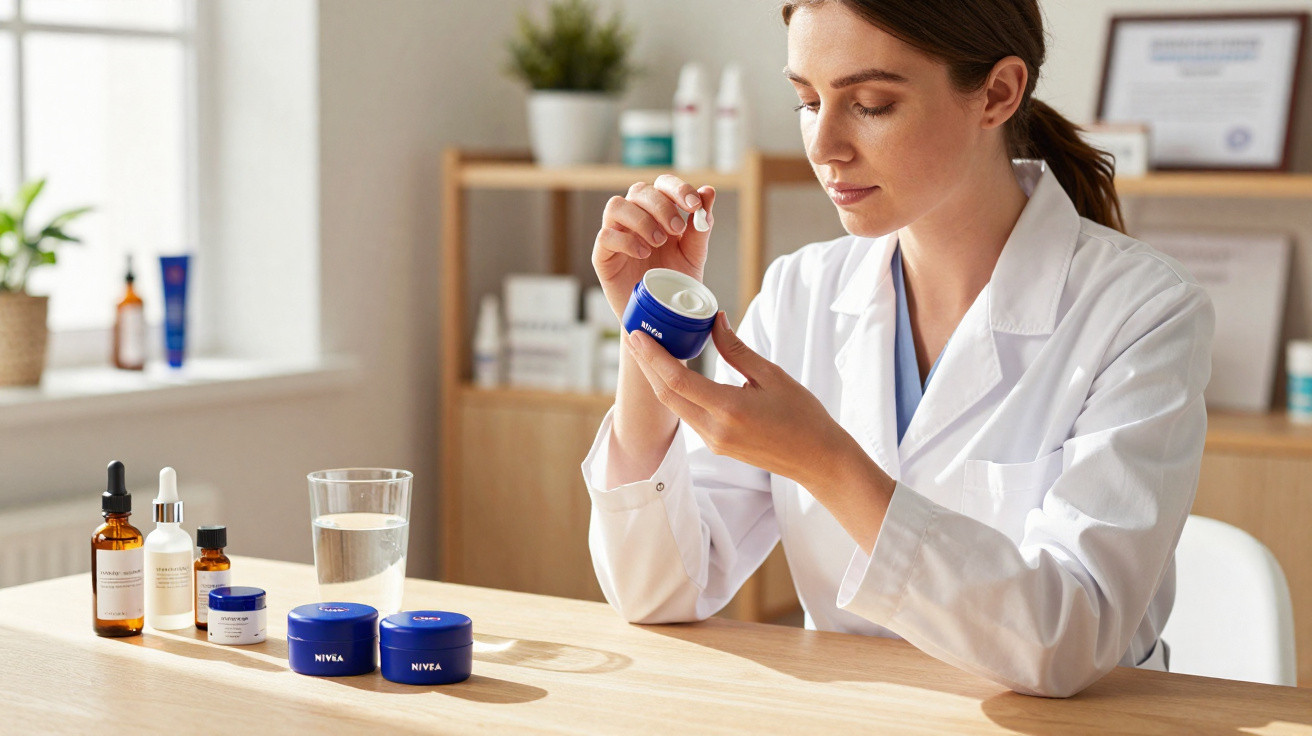
Nivea’s “blue cream” has been on sale since 1911 and remains a fixture on pharmacy shelves across Europe. Dermatologists have now examined the formula closely, assessing both its ingredients and what it genuinely does for the skin.
Why a face cream from 1911 still sells millions of pots
Nivea’s original cream is a product many people have known throughout their lives. Parents apply it to cracked hands, grandparents rely on it for winter-dry faces, and teenagers carry it in school bags to deal with dry areas.
Even after more than a century of new serums, acids and sophisticated textures, the blue tin has retained its appeal. In France alone, 3.6 million pots were sold in 2023 – equivalent to about 414 tins every hour.
Its price is a major part of the appeal. Usually costing only a few pounds or euros, it is sold in supermarkets, chemists and small local shops. There is no waiting list, luxury beauty counter or influencer discount code required.
What dermatologists see in the Nivea blue cream formula
Beyond its familiar fragrance and dense consistency, dermatologists begin by studying the ingredients list. Several specialists on the “Les Matins Cotons” blog examined the composition and gave their assessment.
The blue cream is, above all, a straightforward occlusive moisturiser: simple ingredients, effective barrier support, and a very accessible price tag.
The ingredients responsible for its performance
Although the exact formula may differ slightly between markets, its basic structure is much the same. Its main hardworking components include:
- Glycerin: a well-known humectant that draws water into the skin’s upper layers.
- Emollient fats and waxes: these soften coarse skin and create the cream’s thick, balm-like texture.
- Occlusive agents: these leave a fine layer over the skin, helping to limit water loss throughout the day or while sleeping.
- Shea butter (in some versions): a nourishing plant butter that helps support the skin barrier and improves glide.
Dermatologists note that this combination is particularly useful for dry, rough skin on the face and body. It is not designed to do everything; instead, it retains moisture and relieves skin that feels tight or uncomfortable.
For basic hydration and protection, the formula does the job, even on many sensitive skins, according to dermatologists who have reviewed it.
How effectively does the blue cream hydrate?
Clinical testing commissioned for the product has found increased hydration in the skin’s outer layers. This reflects what dermatologists observe in their practices: with regular application, dry and flaky areas generally become smoother and feel more comfortable.
The product has another advantage that few brands can purchase: an extensive history of use. Having been available for more than 110 years, it offers doctors decades of informal real-world evidence from millions of users across every age group and climate.
While many fashionable moisturisers vanish after a few seasons, the Nivea tin has remained through the acid trend, K-beauty, clean beauty and, more recently, skin cycling.
When dermatologists suggest it – and when they advise against it
Experts quoted by French parenting and skincare publications make a clear distinction: the blue cream can be helpful, but it is not a cure-all.
It is often recommended for:
- Very dry hands, elbows, knees and feet
- Winter-related dryness on the cheeks
- An inexpensive night cream for normal to dry skin
- A final “slugging” layer used to lock in lighter hydrating products
They recommend caution, or pairing it with other products, in the following situations:
- Acne-prone or very oily skin that blocks easily
- Rosacea or highly reactive skin, which may be better suited to lighter, fragrance-free formulas
- Noticeable pigmentation, wrinkles or acne that require active ingredients
- Daytime skincare without SPF – blue cream is not a substitute for sunscreen
Dermatologists stress that it can be a solid base moisturiser, but it won’t address issues like acne, sun damage or ageing by itself.
Why Nivea blue cream should not be your only skincare product
Professionals make one point clear: although the cream moisturises, it does not meet every modern skincare requirement. On its own, it can reduce flakiness and tightness, but it cannot resolve more complex concerns.
Most people require a routine that includes at least three stages:
| Step | What Nivea cream does | What you still need |
|---|---|---|
| Cleanse | Not a cleanser | Gentle face wash suited to your skin type |
| Treat | No active, targeted ingredients | Serum or treatment (vitamin C, niacinamide, retinoids, etc.) |
| Moisturise/protect | Hydrates and locks in moisture | Daytime SPF; possibly a lighter moisturiser for oily skin |
Dermatologists who have reviewed the cream emphasise using it alongside other products. It should form one part of a routine designed around your individual needs, whether these involve anti-ageing, blemish control, pigment spots or redness.
Who can use it safely – and who needs to take care?
For most people with normal to dry skin, the cream is viewed as both effective and low-risk, particularly when used on the body. Its rich texture is not unusual, and dermatologists are very familiar with formulas of this kind.
The main concerns relate to particular groups:
- Acne-prone teenagers and adults: its dense, occlusive consistency may be excessive for skin that is already congested.
- Very oily skin: a gel-cream moisturiser is often more pleasant to wear and leaves less shine.
- Fragrance-sensitive users: anyone who reacts to perfume or preservatives should carry out a patch test before use.
Paediatric dermatologists may sometimes permit its use on dry areas in children, although many favour specialist baby creams with less fragrance and dedicated safety testing.
How to use the blue cream in a modern skincare routine
Rather than considering it a universal solution, dermatologists recommend applying it selectively. Some practical examples include:
- The “winter shield”: apply a lightweight hydrating serum, then use a small amount of blue cream on the cheeks and dry areas before heading out in cold, windy conditions.
- The hand-saver: spread a generous amount over the hands before bed and wear cotton gloves to enhance softness by morning.
- The emergency balm: keep a small tin in your bag for sudden dry patches around the nose, lips (not on the mucosa) or knuckles.
Treat it less like a high-tech anti-ageing cream, and more like a reliable, multipurpose balm that supports the skin barrier.
Hydration, barrier support and actives: what is missing?
Much of the uncertainty surrounding blue cream comes from confusing three distinct concepts: hydration, barrier repair and active treatment.
Hydration is about raising the water content in the skin’s upper layers. This is where humectants such as glycerin are useful, and where Nivea cream performs strongly.
Barrier repair is intended to reinforce the skin’s protective outer layer, using ingredients such as ceramides, cholesterol and fatty acids. The blue cream helps in this respect through its fats and occlusive ingredients, but it is not a specialist barrier-repair product.
Active treatment uses ingredients that directly affect cell behaviour: retinoids for wrinkles and acne, vitamin C for pigmentation, salicylic acid for breakouts and azelaic acid for redness. The classic Nivea formula does not include these targeted actives.
Dermatologists assessing the composition say it excels in the first category – hydration – provides some support in the second, and largely does not address the third.
Practical advice from a dermatologist’s viewpoint
For anyone building or simplifying a skincare routine, blue cream can be a useful way to keep things straightforward. Dermatologist-inspired guidance includes:
- Apply it over serums in the evening to lock them in, rather than using it in place of them.
- If clogged pores are a concern, use only a thin layer on the face.
- Keep thicker applications for the body, hands, feet and particularly dry areas.
- Stop using it if your skin becomes hot, red or bumpy, and move to a fragrance-free formula.
- Combine it with daily sunscreen, as the cream provides no UV protection.
For those on a limited budget, dermatologists often suggest a minimal routine consisting of a gentle cleanser, an affordable SPF, a targeted active serum where necessary, and a straightforward moisturiser such as Nivea blue cream. This approach can be more effective than relying on one costly cream that has been poorly selected.
Put simply, the iconic tin still has a role in 2024 skincare – not as a miracle treatment, but as a familiar, barrier-supporting basic that works well alongside more intelligent, targeted products.






Comments
No comments yet. Be the first to comment!
Leave a Comment