
What initially appears to be an entirely routine moment: a plastic chair, a trolley on wheels and a quiet GP surgery at the end of a long corridor.
A nurse fastens a cuff around a man’s upper arm, presses the button and waits for the familiar hum and tightening sensation. He looks towards the display, perhaps already expecting advice about salt, stress and going to the gym more regularly.
Without noticing, he crosses his legs. His arm hangs slightly too low, with his wrist on his thigh. The monitor beeps and shows a high result. The nurse pauses, then carefully raises his arm and supports it on the desk at chest height. The second measurement is lower. It is the same person, the same monitor and the same day.
All at once, the certainty of that first result seems far less convincing.
When a few centimetres change the story on the screen
This understated drama unfolds during blood pressure checks in surgeries and kitchens every day. A cuff, a beep and two figures can steer a person towards medication, tests or reassurance. We tend to regard those figures as fixed facts: straightforward and dependable. You are either “high” or “fine”.
But researchers are drawing attention to a strikingly basic issue: where your arm sits can push those figures up or down. The difference is not merely one or two points; it can be enough to take somebody from “borderline” to “hypertensive”. Put simply, a result may be misleading - not because the monitor has failed, but because of the position of your elbow.
Most of the time, nobody present even spots it.
Across a recent set of laboratory and real-world studies, scientists compared blood pressure results with the arm held in several positions: slightly above heart level, hanging beneath it and properly supported at the right height. The same pattern appeared repeatedly. Results increased when the arm was below heart level, while raising it too high reduced them. Systolic readings could vary by 5, 10 or sometimes 15 mmHg.
That is far more than a minor fluctuation. It can separate “keep an eye on it” from “you need treatment”. For older people, or those already taking medication, such a difference may lead to altered doses or further prescriptions. With a monitor at home, it could even prompt someone to contact emergency services at 2 a.m., their heart pounding from worry rather than blood pressure.
The explanation, scientists say, rests on a simple fact: gravity affects blood. If your arm is below your heart, the blood column in the arteries is subject to greater hydrostatic pressure. The cuff detects this and reports a higher figure. Lift the arm too far and the opposite occurs. The device is honest about what it senses, but the setup cheats the context.
It is similar to stepping on scales while leaning against the sink: the scales are not dishonest, but they are measuring the wrong thing. In the crowded, pressured reality of a busy surgery, that distinction can easily be lost.
Blood pressure arm position: small posture changes that prevent “phantom” hypertension
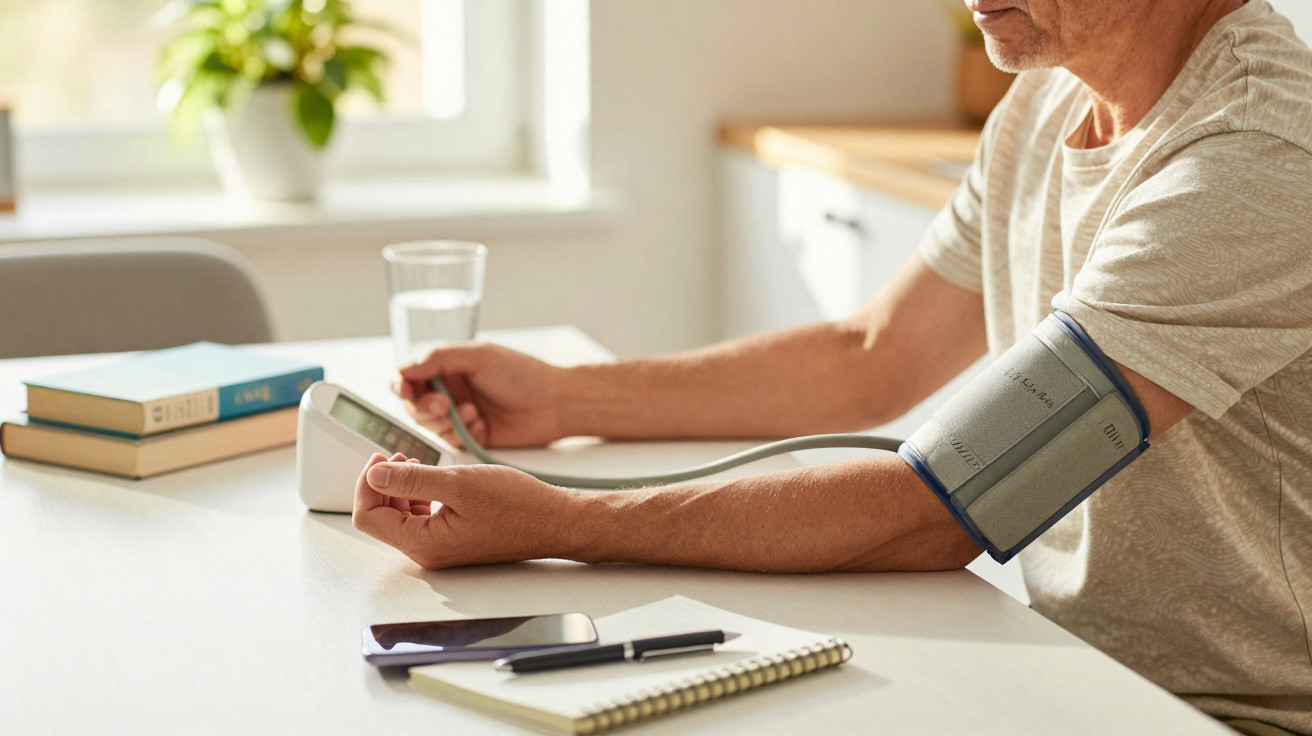
Scientists continue to stress one uncomplicated rule: keep your arm at heart level. It should not simply be somewhere nearby or hanging in your lap, but aligned with the centre of your chest. The most practical approach is remarkably simple. Sit with your back supported, then rest your forearm on a table or desk so the cuff sits at about the height of your sternum. Keep your shoulder relaxed and allow your hand to rest loosely.
If there is no table available, support your elbow with a cushion or folded towel. Some people place their forearm across their chest, although this can make the muscles tense. The ideal position is an easy, almost idle one: a loose shoulder, supported arm and palm facing upwards. Breathe as usual and remain silent. Do not chat, scroll or check emails “just for a second”.
The more motionless you remain, the less interference reaches the figures.
In practice, these guidelines often clash with everyday life. Sitting at the kitchen table with a home cuff, many of us cross our legs, hold a phone in one hand and wear the cuff on the other. At the GP surgery, patients may sit on the edge of the chair with an unsupported arm because the desk is too high or too distant. Nurses make do with whatever is at hand: a knee, a pile of folders or a chair armrest that is not quite the right height for the patient.
One research team watching consultations found arm position to be “suboptimal” for most readings, particularly when appointments were rushed. The difference was not invariably large, but for people near the diagnostic threshold, it can be sufficient to categorise someone as “ill” or “safe”. We have all experienced the situation in which one reading determines whether or not you leave with a prescription.
Let’s be honest: hardly anyone manages this perfectly every day. Few people sit in virtuous silence for five minutes before measuring at home, with their arms carefully raised to textbook heart level. Daily life is untidy. Dogs bark, children shout, phones buzz, and you want the measurement finished before your coffee goes cold.
This is precisely why repeated, consistent results are more valuable than one flawless-looking measurement.
Experts now advise treating arm position rather like brushing your teeth: a minor routine that eventually becomes automatic. Sit down with both feet flat on the floor. Make sure the cuff is level with the middle of your chest. At home, choose a place where a table or worktop already supports your arm comfortably. Use the same chair, same location and, where possible, the same time of day. Your body becomes accustomed to the routine, and the results fluctuate less dramatically.
One hypertension specialist put it bluntly:
“If your arm is in the wrong place, you’re not measuring your blood pressure, you’re measuring your posture.”
For anyone made anxious by figures, a brief checklist can reduce stress and create a greater sense of control:
- Sit quietly for at least 5 minutes before taking the first measurement.
- Keep the cuff supported at heart level, on a table or cushion.
- Take 2–3 readings, 1 minute apart, and record the average.
- Do not talk, text or move while the cuff is inflating.
- Take your home readings to your doctor instead of depending on a single surgery measurement.
This is not about becoming obsessive. It is about shifting the odds in your favour, so the figures tell a story that more closely reflects your usual life rather than an uncomfortable position on a Tuesday morning.
A figure on a screen and what it reveals about the rest of your life
Once you understand how much a small shift in arm position can alter a result, it is difficult to forget. The statement “I have high blood pressure” suddenly becomes more complicated. Some people find that an alarming first measurement at the surgery was partly caused by “white coat” anxiety and partly by poor posture, while calmer, correctly positioned readings at home offer a gentler, more detailed picture.
That does not remove risk by magic, nor does it mean that everyone with high results is well. It does, however, encourage a different conversation with both yourself and your doctor. Instead of panicking about a single figure, you begin to look for patterns: morning compared with evening, hurried appointments compared with quiet weekends, unsupported arms compared with supported ones. The account moves away from one verdict and towards a longer, more truthful record.
There is also a quietly empowering aspect to recognising that such a small physical adjustment can affect data on which so many decisions depend. In a healthcare system that can feel distant, technical and beyond your influence, arm position is one of the few factors you can manage yourself. It also reminds us that bodies do not exist in spreadsheets; they sit on chairs and sofas, in waiting rooms, half-dressed in a paper gown that never quite fastens properly.
The next time a cuff tightens around your arm and the display lights up, you may stop briefly. Where is my elbow? Is my shoulder relaxed? Does this number really reflect my arteries, or the way I am sitting at this moment? You may still leave with the same diagnosis, advice and prescription. Or a calmer routine and better posture may show that your figures describe an entirely different landscape.
Either way, that small change in how you hold your arm may be the quietest and most overlooked act of self-care you make this week.
| Key point | Detail | Why it matters to the reader |
|---|---|---|
| Arm at heart level | Keeping the cuff aligned with the middle of the chest reduces falsely high or low results. | Helps prevent being mistakenly classified as “hypertensive” or “normal”. |
| Consistent routine | Using the same chair, time and posture each day makes results more stable. | Provides a clearer view of genuine blood pressure patterns over weeks. |
| Multiple readings | Taking 2–3 measurements and calculating their average reduces outliers. | Reduces the influence of stress, movement or one poor result on major decisions. |
FAQ:
- How much can arm position really change a blood pressure reading? Studies show shifts of 5–15 mmHg systolic when the arm is too low or too high, enough to change a diagnosis or trigger medication adjustments.
- Which arm should I use for measuring blood pressure? Use the arm your doctor recommends, often the one with slightly higher readings; stick to the same arm for consistency and comparison over time.
- Can crossing my legs affect my blood pressure result too? Yes, crossing your legs can push the numbers up a bit; sitting with both feet flat on the floor is the calmer, more neutral position.
- Is a high reading at the doctor always a sign of real hypertension? Not always; anxiety, rushed conditions, arm position and recent activity can all inflate a one-off reading, so repeat and home measurements matter.
- What should I do if my home monitor shows very different numbers from the clinic? Bring your device and your logged readings to your next appointment so your doctor can compare, check technique and decide which values best reflect your everyday reality.






Comments
No comments yet. Be the first to comment!
Leave a Comment