
The front door may be one of the shortest journeys in any home.
It is only a few metres from the bedroom and a few steps from the kitchen. Yet, for plenty of us, it is exactly where the day begins to unravel. Keys go missing. Shoes are not a pair. Somebody cannot locate their headphones, or a school bag suddenly “needs” a permission slip that is nowhere to be found.
When you finally get out of the house, your pulse is up and you are already running late. The day has barely begun, yet it feels as though you have already got it wrong. You promise, “Tomorrow we’ll be ready earlier,” but tomorrow follows precisely the same pattern.
But what if the issue is not that you are “disorganised”, but that your home is subtly making things harder? And what if a very ordinary, almost dull solution could change that completely?
The hidden chaos between you and the front door
Observe any family or house share at 8.15am and the same routine plays out. One person, only partly dressed, calls from the hall, “Has anyone seen my wallet?” Another searches for clean mask or a pair of sunglasses. Someone else checks three separate coats for their train card. The minutes keep passing, while nobody has actually left.
At first glance, it seems as simple as stressful mornings. Look again, though, and the problem is made up of small points of friction. The umbrella is in the bedroom. The keys are in yesterday’s coat. The dog lead is, “for now”, hanging in the kitchen. None is particularly far away, but every item costs 30 or 40 seconds and triggers another jolt of stress.
By the time you shut the door behind you, you have already used up mental energy dealing with needless small emergencies. That is not laziness; it is design.
In a survey conducted by a UK home insurer, respondents said they lose or misplace their keys four times a week on average. That is more than irritating: it shapes the mood of the day. A woman I spoke with in Manchester described her usual school run: “We’re on time until the last five minutes. Then we lose everything. Shoes, keys, even the water bottle. It’s like the house is fighting us.”
Her experience is not dramatic, which is exactly what makes it important. Everyday friction affects how we experience our days. It is not about oversleeping or a major disaster, but gradual losses of time.
Another dad described the “morning search party” at his flat. “The kids are actually ready. I’m the problem,” he laughed. “I’m the one crawling under the sofa for my work pass.” He had attempted to get up earlier and to use alarms, but the disorder simply started earlier too.
Psychologists refer to this as a “bottleneck moment” – a point at which everything you need must pass through one restricted place at the same time. Your hallway becomes an examination of systems that you have never consciously created. Without those systems, your brain bridges the gap with panic.
So, when we tell ourselves, “I’m bad in the mornings”, we are often attributing an architectural problem to our personality. It comes down to where objects are placed, how invisible essentials become and the way jobs accumulate just before departure. Meanwhile, your brain is attempting to retain all of that in working memory alongside the day’s timetable and concerns.
The real answer is not extra willpower, but fewer decisions. Give belongings fewer opportunities to disappear. Establish one dependable routine that runs quietly in the background, without fuss, whenever you return home and leave again.
The everyday trick: build a “launch pad” for your life
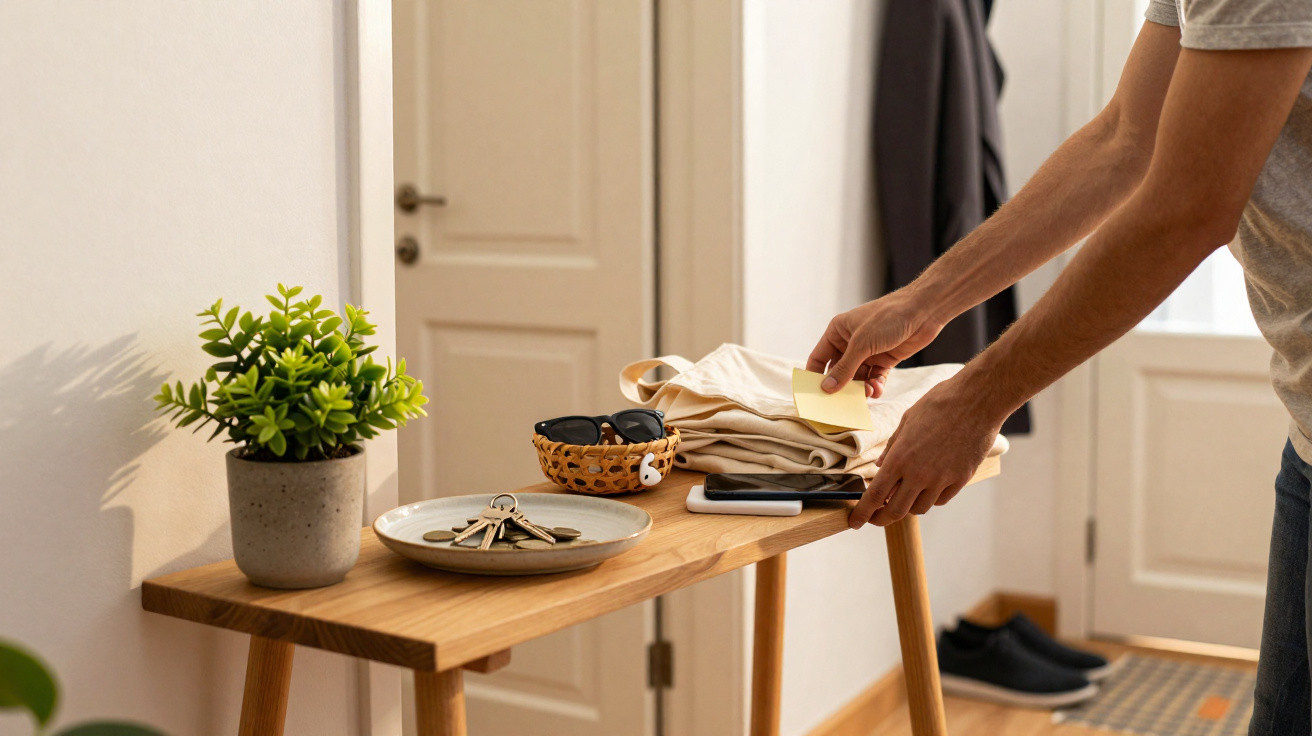
The method used by many seemingly calm people is remarkably simple: they set up a “launch pad” beside the door. This does not mean a Pinterest-perfect boot room. It is simply one fixed, dependable place where everything that goes out of the home... stays.
Picture it as your home’s version of an airport gate. Keys, wallet, phone, headphones, work pass, dog lead, sunglasses, child’s book bag and tomorrow’s sports kit all belong within one small zone. The principle is straightforward but forgiving: if it must leave the house, it goes there first.
For some, this is one bench, a tray and two or three hooks. Others choose a slim shelving unit with a bowl for keys. The furniture itself is not the important part. What matters is that your brain only needs to search in one area, at one level and in one direction. You reach the door and the door... hands your life back to you.
The understated key is that a launch pad begins to do its job when you arrive home, rather than when you are trying to go out. Put your keys in the same bowl. Hang your bag on the same hook. Place tomorrow’s letters in the same tray instead of leaving them “on the table for later”. It may take only 15 seconds.
A couple in London I met transformed an unused stretch of hallway into their launch pad using one inexpensive shoe rack and three hooks. For a joke, they marked each hook with their initials. Within a week, their 8am rows had largely stopped. Stress had not vanished from their lives, but it was no longer catching them out at the front door.
There is no magic involved. In fact, it is the opposite: unremarkable repetition that steadily reduces the opportunities for chaos. Your future self does not have to recall where your keys were thrown down, because your present self did not throw them down anywhere.
People commonly fall into a few traps when trying this approach. One is trying to do too much at once: huge wall storage, 12 baskets and colour-coding for everything. It may look brilliant for three days, before real life takes over. Let’s be honest: nobody really keeps that up every day.
Another mistake is positioning the launch pad too far from the door because it looks better elsewhere. That short distance makes a difference. When it is even slightly inconvenient, you will bypass it when tired – and you will often be tired. The system must work for exhausted-you, late-you and kids-screaming-you.
Keep the first step small: a bowl for keys and cards, one hook for the bag you use daily and a shelf for the shoes you genuinely wear. Expand it gradually if the routine lasts. Be gentle with yourself too: a launch pad that is untidy by Thursday does not mean you have failed. Messy and dependable is always better than neat and imaginary.
“Once we put a basket and a hook by the front door, my mornings dropped from a 7 out of 10 on the stress scale to maybe a 3,” says Hannah, a nurse in Leeds. “I still have rough shifts. But at least I’m not crying over missing keys at 6am anymore.”
This straightforward approach is even more effective alongside micro-habits. Take five seconds to put tomorrow’s essentials on the launch pad the evening before. Glance at the area before bed, then check it once more as you pick up your coat.
- Place it within arm’s reach of the door, rather than on the other side of the room.
- Keep only genuine essentials there, so it cannot turn into a pile of clutter.
- Assign each regularly used item a “home” in the zone: a hook, bowl or shelf.
- Use it whenever you come in, including when you are tired.
- Regard the launch pad as essential, just like locking the door.
Leaving faster, arriving calmer
People often assume a life-changing hack ought to feel dramatic. This one does not. Instead, it gradually alters the feel of your mornings. In place of a constant undercurrent of panic, there is a rhythm: coat, bag, keys, door. Out.
It also gives your brain a different message. Rather than, “I’m always late, I’m a mess,” it becomes, “I have a small system that works most days.” The change is both subtle and significant. It is easier to pursue larger ambitions when the day does not begin with a spiral of self-blame over missing trainers.
At a deeper level, a launch pad means showing consideration for your tired future self. Tonight, you know that tomorrow you will be rushed and distracted, so you remove obstacles now. It is a form of care that does not look impressive in photos, yet can feel quietly transformative.
Imagine the doorway becoming the opening of your day rather than the setting for a string of minor crises. No desperate searching, no theatrical sighs and no snapping at loved ones because the keys have gone walkabout again. Just a small, reliable ritual that says: you are ready.
On a grey Tuesday morning, when the bus is approaching and your inbox is already lit up, that matters. It can be the difference between walking outside already tense and walking outside with at least one thing going well. On a difficult day, that one small success may matter more than it seems.
| Key point | Detail | Benefit for the reader |
|---|---|---|
| Create a “launch pad” | Set up a fixed zone near the door for all everyday items | Immediately reduces stress and repeated lateness |
| Start small | A key bowl, bag hook and shelf for shoes that are actually worn | Makes the new habit practical and sustainable in real life |
| Arrival and departure ritual | Always put items down when arriving home, then collect them in the same order when leaving | Reduces mental load and creates a sense of day-to-day control |
FAQ:
- Do I need a big hallway to create a launch pad? Not at all. One hook, a narrow shelf or even a small tray placed on a shoe rack can work perfectly in a tight corridor.
- What if I live with messy people or kids? Keep the system obvious and straightforward: allocate one hook or basket to each person, at the right height for them. Aim for imperfect use rather than perfection, and offer gentle reminders instead of nagging.
- I’ve tried “being organised” before and it never lasts. Why would this be different? This is not about keeping everything tidy in general. It focuses on a single habit in one very small space, connected to a fixed daily event: walking through the door.
- How long before I feel the benefit? Many people find their mornings feel calmer within a week, once putting belongings on the launch pad as they arrive home begins to become automatic.
- What if the launch pad turns into a dumping ground? Restrict it to items that truly leave the house. Everything else should be put back in its proper place during a quick weekly reset lasting a few minutes.

Comments
No comments yet. Be the first to comment!
Leave a Comment