
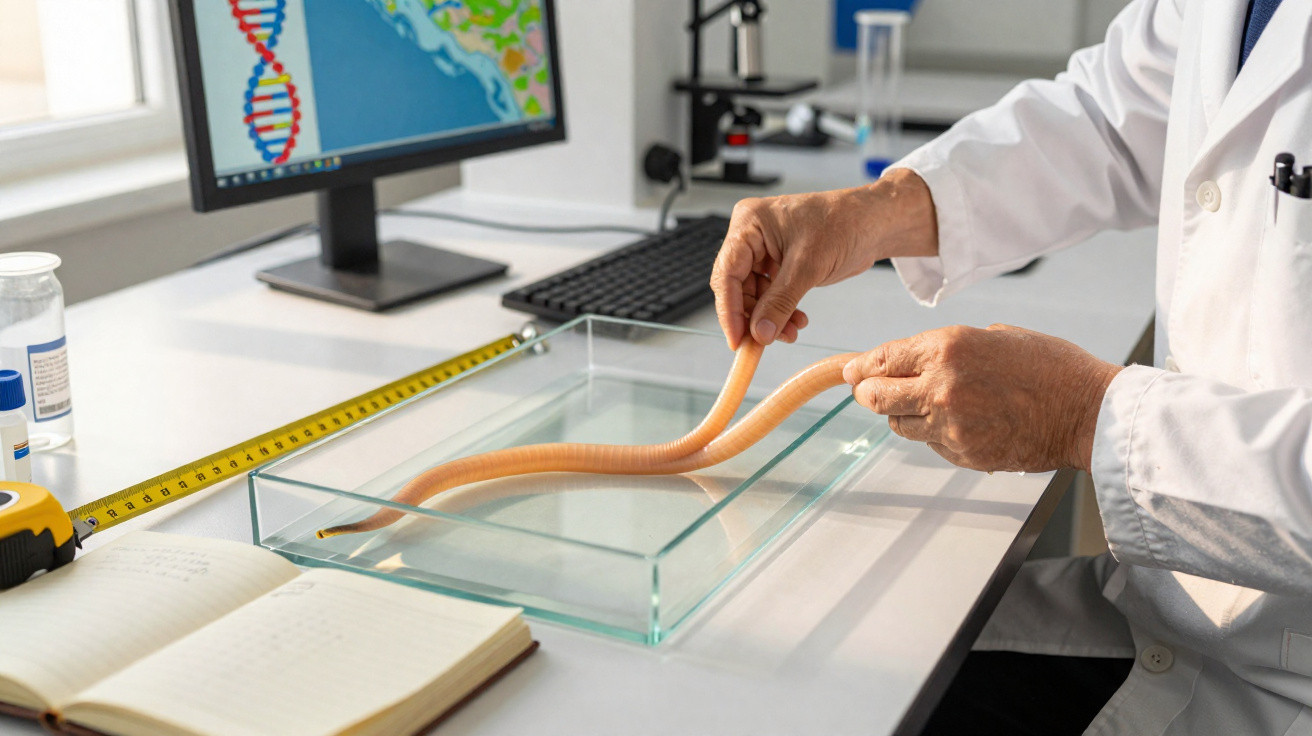
Biologist Jon Allen is the proud keeper of the oldest ribbon worm ever documented.
The adopted invertebrate, affectionately known as Baseodiscus the Eldest, is at least 26 years old and is likely to be about 30, a new analysis suggests.
Baseodiscus the Eldest: the oldest ribbon worm
When extended to its full length, Baseodiscus - or simply ‘B’ - measures about 1 metre. Establishing its age, however, has proved more difficult.
Marine invertebrates include some of the planet’s longest-lived animals. Deep-sea tube worms, for example, can survive for 300 years and perhaps even longer.
Ribbon worms are especially widespread marine invertebrates, although very little is known about how long they live.
B is by far the oldest recorded member of the phylum Nemertea. The only other possible comparison Allen and his colleagues identified in the scientific literature was a ribbon worm that was just three years old.
"Ribbon worms are an incredibly diverse and widespread phylum, yet almost nothing is known about their natural longevity," says Allen.
"This finding fills a genuine knowledge gap, increasing their known lifespan by an order of magnitude. This shifts our understanding of an entire major group of marine predators."
B’s journey between aquariums
Allen has kept B in a tank filled with plenty of mud to wander through since 2005. He originally received the soft-bodied animal from the University of North Carolina’s biology department after building work disturbed its previous home.
Although the marine invertebrate’s precise date of birth is not known, Allen says researchers collected B as an adult in the San Juan Islands sometime in the late 1990s.
Over the past two decades, B has lived in Washington state, North Carolina, Maine and Virginia. He has certainly travelled widely for a worm.
In 2024, one of Allen’s former students persuaded him to arrange genetic testing for B.
The results showed that the pet worm is Baseodiscus punnetti, making it only the second member of the species to receive a genetic barcode.
What ribbon worms could reveal about longevity
Ribbon worms such as B are not merely advanced in age; they can also grow to astonishing lengths.
A ribbon worm collected from a Scottish beach in 1864 is believed to be the longest animal ever discovered alive. Some accounts indicate that, when fully extended, the beached worm was roughly twice as long as a blue whale.
How old might that worm have been?
"Marine worms may offer important insights into longevity research, and developing lifespan estimates for nemerteans will help researchers to better assess the ecological impact of these long‐lived benthic predators on marine ecosystems," Allen and his colleagues conclude.
The study appeared in the Journal of Experimental Zoology.






Comments
No comments yet. Be the first to comment!
Leave a Comment